Facts
The petitioners sought to quash the order dated 30 June 2022 by which the S.D.J.M., Dehri-On-Sone, took cognizance in Dehri (D.L.M.) P.S. Case No. 232 of 2017 for offences under Sections 419, 420, 468, 471 and 120(B) IPC
Source reference: p. 1The case alleged that the petitioners and others operated a fictitious organisation and obtained money from the informant and others
Source reference: p. 2The petitioners disputed their alleged roles and the sufficiency of the material against them
Source reference: p. 2They later offered to pay the informant Rs. 2,42,000; the informant accepted the demand draft and agreed to settle the dispute, stating that he had no objection to quashing the proceedings against the petitioners
Source reference: p. 3Issues
Whether the High Court should exercise its inherent jurisdiction under Section 482 Cr.P.C. to quash the criminal proceedings against the petitioners in light of the parties’ settlement
Source reference: pp. 3–4Whether the cognizance order and resulting prosecution, insofar as they concerned the petitioners, should be set aside
Source reference: pp. 1, 4Law Applied
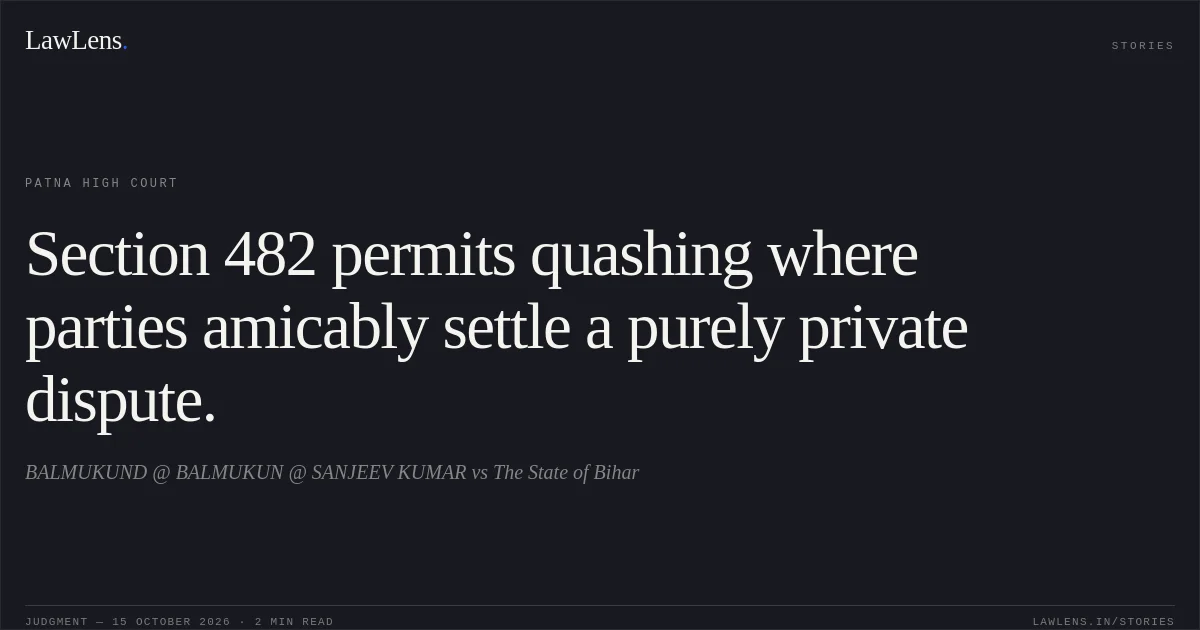
Section 482 Cr.P.C. preserves the High Court’s inherent power to prevent abuse of the process of court and secure the ends of justice.
Source reference: no citationIn Parbatbhai Aahir and Ors. v. State of Gujarat and Anr., (2017) 9 SCC 641, the Supreme Court held that an amicable settlement may be considered in exercising that power where the dispute is private, the compromise is voluntary and free from coercion, and continuation of the prosecution would serve no legitimate purpose
Source reference: p. 3The underlying prosecution invoked Sections 419, 420, 468, 471 and 120(B) IPC
Source reference: p. 1Reasoning
The Court accepted the parties’ settlement after noting that the agreed sum of Rs. 2,42,000 had been paid by demand draft and that the informant’s counsel expressly consented to quashing
Source reference: p. 3It found no external influence on the compromise and treated the dispute as private, without an impact on society at large
Source reference: pp. 3–4Applying Parbatbhai Aahir, the Court concluded that continuing the prosecution against the petitioners would serve no legitimate or useful purpose
Source reference: p. 4Holding
The Court allowed the application and quashed the cognizance order dated 30 June 2022, together with all consequential prosecution, insofar as it related to the petitioners
Acts & Sections Cited
5 provisions across 2 statutes referred to in this judgment. Each provision opens on LawLens.
Indian Penal Code, 18604
Code of Criminal Procedure, 19731
Original Court PDF
BALMUKUND @ BALMUKUN @ SANJEEV KUMARvsThe State of Bihar
Click to open original judgment
Original judgment, available to read, download and summarize on LawLens.in


