Facts
Petitioner No. 1, proprietor of M/s Gupta Polymers, and Petitioner No. 2, his son, were accused of inducing the complainant to supply EVA raw material on credit and thereafter failing to make payment.
Source reference: paras. 2–4The petitioners characterised the dispute as a commercial transaction concerning unpaid goods and denied any dishonest intention at inception; they also contended that Petitioner No. 2 had no role in the transaction.
Source reference: paras. 9–13The complainant alleged that goods worth approximately ₹77.92 lakhs were supplied on assurances of payment within one month and that the petitioners subsequently avoided payment and closed their business premises.
Source reference: paras. 5, 17–18, 26–27On the complainant’s application under Section 156(3) Cr.P.C., the Metropolitan Magistrate directed registration of an FIR, observing that the allegations prima facie disclosed cognizable offences.
Source reference: paras. 5–6Consequently, FIR No. 272/2023 was registered at Police Station Model Town under Sections 420, 406 and 120-B IPC.
Source reference: para. 1During investigation, invoices, GST records, transport documents, video recordings and witness statements were collected in support of the complainant’s allegations.
Source reference: paras. 17–21The petitioners invoked Section 482 Cr.P.C. seeking quashing of the FIR and all consequential proceedings.
Source reference: para. 1Issues
Whether the allegations in FIR No. 272/2023, concerning non-payment for goods supplied pursuant to a commercial transaction, prima facie disclose cognizable offences under Sections 420, 406 and 120-B IPC, or constitute only a civil dispute.
Source reference: para. 23Whether the High Court should exercise its inherent jurisdiction under Section 482 Cr.P.C. to quash the FIR and consequential proceedings at the investigation stage.
Source reference: paras. 23–25Law Applied
The court applied Section 482 Cr.P.C., which permits the High Court to exercise inherent powers sparingly to prevent abuse of process and secure the ends of justice.
Source reference: para. 24At the FIR-quashing stage, the court must examine only whether the allegations, taken at face value, disclose a cognizable offence; it must not conduct a mini-trial, assess the reliability of evidence, or determine disputed questions of fact.
Source reference: paras. 24–25Relying on Neeharika Infrastructure (P) Ltd. v. State of Maharashtra, (2021) 19 SCC 401, the court reiterated that an FIR is not an encyclopaedia and that investigation should ordinarily be permitted to proceed where the allegations disclose a cognizable offence.
Source reference: para. 25The court also distinguished Radheyshyam v. State of Rajasthan, Criminal Appeal No. 3020 of 2024, where mere non-performance of a contractual obligation, without allegations of dishonest inducement at inception, was held insufficient to constitute cheating.
Source reference: paras. 29–30The FIR invoked Sections 420 IPC relating to cheating, 406 IPC relating to criminal breach of trust, and 120-B IPC relating to criminal conspiracy.
Source reference: para. 1Reasoning
The court held that the complaint could not be reduced to a mere claim for recovery of money.
Source reference: paras. 26–27It specifically alleged that the petitioners represented themselves as established traders, promised payment within one month and offered a price above the prevailing market rate, thereby dishonestly inducing the complainant to part with goods worth approximately ₹77.92 lakhs.
Source reference: paras. 26–27The allegations of a pre-planned design, non-payment after receipt of the goods and avoidance of the complainant, if accepted at face value, prima facie disclosed cognizable offences.
Source reference: paras. 26–27The supporting material collected during investigation—including invoices reflected in GST returns, transport records, witness statements and alleged admissions—further justified allowing the investigation to continue, although the court expressly refrained from adjudicating its evidentiary value.
Source reference: paras. 17–21, 27–28The existence of a commercial suit did not by itself bar criminal proceedings where the allegations also disclosed dishonest inducement at the inception of the transaction.
Source reference: paras. 27, 30Determining whether such dishonest intention actually existed would require investigation and possibly trial, not adjudication under Section 482 Cr.P.C.
Source reference: paras. 27, 30Holding
The court answered the issues against the petitioners.
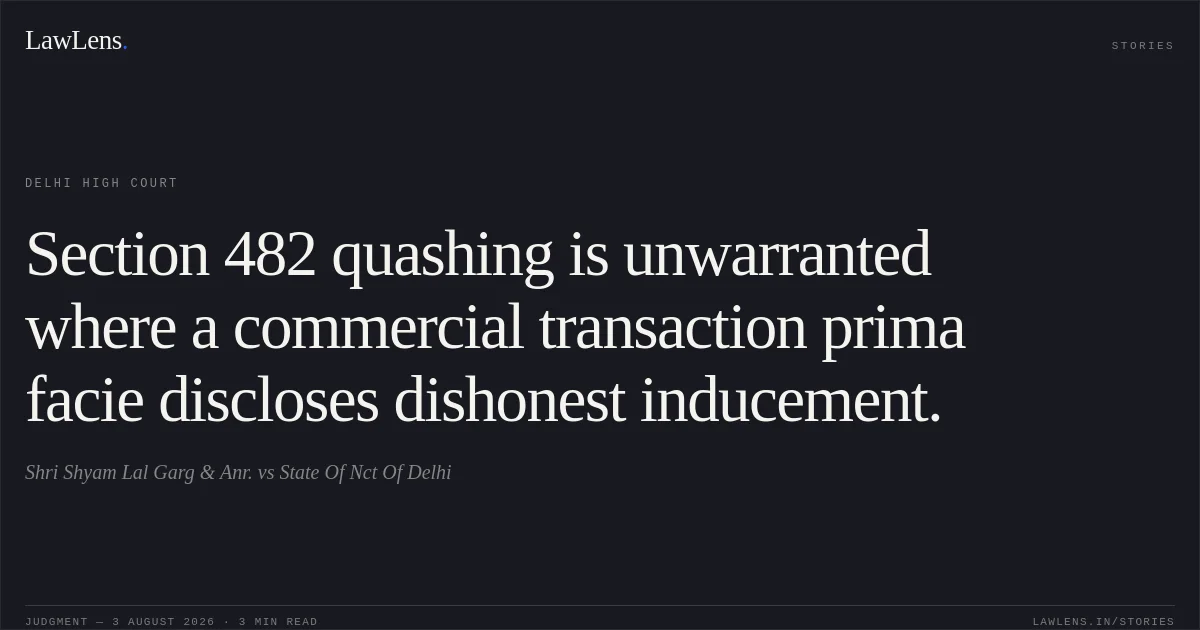
It held that the allegations prima facie disclosed cognizable offences and that the case was not, at the threshold, demonstrably a purely civil dispute warranting quashing.
Source reference: paras. 27–30The petition seeking quashing of FIR No. 272/2023 under Sections 420, 406 and 120-B IPC and all consequential proceedings was dismissed.
Source reference: paras. 31–32The court clarified that its observations were confined to the Section 482 proceedings, would not affect the merits of the case, and that the investigating agency and Trial Court were to proceed independently in accordance with law.
Source reference: paras. 33–35Original Court PDF
Shri Shyam Lal Garg & Anr.vsState Of Nct Of Delhi
Click to open original judgment
Original judgment, available to read, download and summarize on LawLens.in