Facts
The complainant alleged that her brother, Petitioner No. 1, misused their father’s deteriorating health and control over his finances to arrange property transactions and procure a Will that excluded her from the family estate.
Source reference: paras. 2–9The allegations concerned a sale deed dated 17 October 2018, an agreement to sell dated 26 March 2019, a general power of attorney dated 12 April 2019, and a Will dated 5 November 2019.
Source reference: paras. 2–9The complainant alleged that her father lacked the capacity to understand the documents and that the petitioners had concealed relevant transactions.
Source reference: paras. 2–9An FIR was registered under Sections 420, 406, 467, 471 and 120-B of the IPC after the complainant applied under Section 156(3) CrPC.
Source reference: paras. 9–10The petitioners sought quashing under Section 482 CrPC, contending that the dispute was civil and that the documents were validly executed.
Source reference: paras. 9–10During the petition, a charge-sheet was filed, charges were framed and prosecution evidence began before the Trial Court.
Source reference: paras. 14, 21Issues
1. Whether the allegations, taken at face value, disclosed a prima facie basis to proceed against the petitioners for the alleged offences
Source reference: paras. 20, 22–232. Whether the petitioners had established grounds under Section 482 CrPC to quash the FIR and consequential proceedings, including on the basis of the materials they relied upon
Source reference: paras. 20, 24–30Law Applied
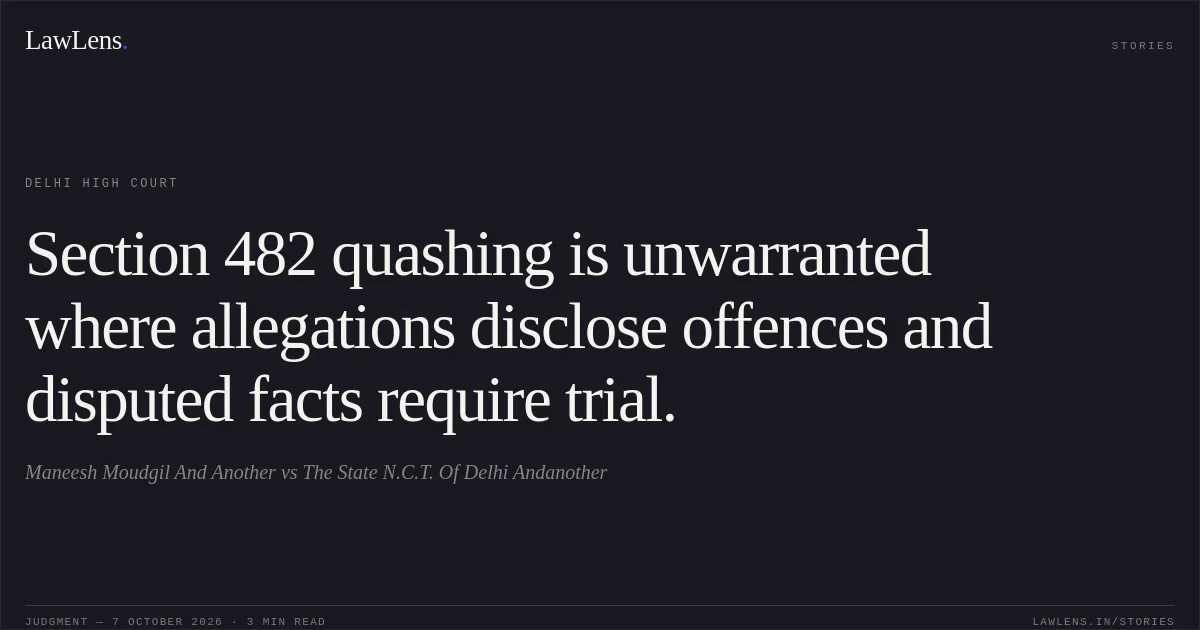
Section 482 CrPC confers inherent power to prevent abuse of process and secure the ends of justice; it must be exercised sparingly, and a quashing court must not conduct a mini-trial or decide disputed facts.
Source reference: paras. 15–16Under State of Haryana v. Bhajan Lal, proceedings may be quashed in specified categories, including where the allegations, accepted at face value, disclose no offence, or where the proceedings are manifestly mala fide; the power is to be exercised with circumspection.
Source reference: para. 17Under Rajiv Thapar v. Madan Lal Kapoor, accused-produced material may justify quashing only where it is sterling and impeccable, rules out the prosecution’s assertions, is not refuted or cannot justifiably be refuted, and continuation would amount to abuse of process.
Source reference: para. 18CBI v. Aryan Singh confirms that, at the quashing stage, the court asks whether sufficient material exists to proceed, not whether the charges have been proved.
Source reference: para. 19Further, under Amit Kapoor v. Ramesh Chander, the existence of a civil claim does not, by itself, bar criminal proceedings where the allegations also disclose an offence.
Source reference: para. 29Reasoning
The Court found that the allegations of cheating, forgery, misrepresentation and criminal breach of trust, if accepted at face value, were neither absurd nor inherently improbable and provided a prima facie basis to proceed.
Source reference: paras. 22–23The petitioners’ reliance on medical records, communications and property documents raised disputed factual questions; those materials had been filed before the High Court during the petition and had not yet been tested at trial.
Source reference: paras. 24–27They did not meet the Rajiv Thapar standard for material capable of conclusively displacing the allegations.
Source reference: paras. 24–27Given that charges had been framed and prosecution evidence was underway, assessing credibility or evidentiary weight would improperly require a mini-trial.
Source reference: paras. 21, 25–28The family and property context did not negate criminal liability where the allegations could also constitute cognizable offences.
Source reference: para. 29Holding
The Court held that the petitioners had not established grounds for quashing the FIR or consequential proceedings under Section 482 CrPC.
It dismissed the petition and pending applications without costs; its observations were limited to the quashing petition and were not to affect the Trial Court proceedings.
Source reference: paras. 30–33Acts & Sections Cited
7 provisions across 2 statutes referred to in this judgment. Each provision opens on LawLens.
Code of Criminal Procedure, 19733
Indian Penal Code, 18604
Original Court PDF
Maneesh Moudgil And AnothervsThe State N.C.T. Of Delhi Andanother
Click to open original judgment
Original judgment, available to read, download and summarize on LawLens.in