01Facts
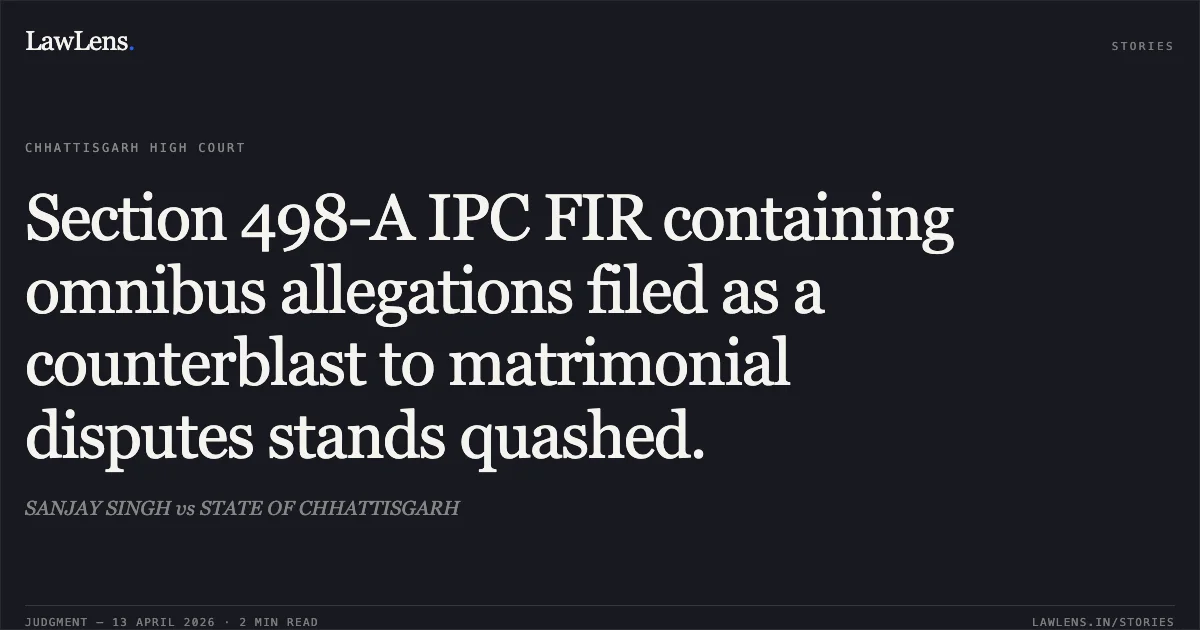
The petitioners (the husband and his brother and sister-in-law) sought the quashing of an FIR dated 03.08.2021 registered under Section 498-A/34 of the IPC.
¶ 2The marriage between Petitioner No. 1 and Respondent No. 2 took place on 28.04.2016, but they resided together for less than two months, having lived separately since May 2017.
¶ 3In 2018, the husband initiated divorce proceedings under Section 13 of the Hindu Marriage Act.
¶ 3During the pendency of these proceedings, the wife lodged the impugned FIR in 2021, alleging she lived with the husband until 2020 and was subjected to dowry harassment.
¶ 3-4On 17.01.2022, the Family Court, Durg, granted a divorce in favor of the husband on the grounds of cruelty committed by the wife.
¶ 3, 13No appeal was filed against this decree.
¶ 502Issues
i.Whether the FIR and subsequent criminal proceedings under Section 498-A/34 IPC constitute an abuse of the process of law when lodged as a counterblast to matrimonial litigation.
¶ 3, 11ii.Whether omnibus and generalized allegations against the husband’s relatives, without specific instances of involvement, are sufficient to sustain a criminal prosecution.
¶ 8, 1203Law Applied
The court primarily applied Section 482 of the CrPC regarding the inherent power to quash proceedings to prevent abuse of the judicial process.
¶ 2It relied on the "Category 7" parameter from State of Haryana v. Bhajan Lal, which allows quashing when a proceeding is maliciously instituted with an ulterior motive for wreaking vengeance.
¶ 9, 11The court further applied principles from Geeta Mehrotra v. State of U.P. and K. Subba Rao v. State of Telangana, which caution against roping in relatives through general allegations.
¶ 7, 8It also referenced Dara Lakshmi Narayan v. State of Telangana, noting the growing tendency to misuse Section 498A IPC as a tool for personal vendetta in matrimonial disputes.
¶ 11Provisions in the judgment · 9 · Linked ones open on LawLens
Indian Penal Code, 1860 Section 34Section 323Section 504Section 506
Code of Criminal Procedure, 1973 Section 156Section 482
Hindu Marriage Act, 1955 Section 13
04Reasoning
The Court observed that the allegations in the FIR were "omnibus and general," lacking specific dates, places, or particulars regarding the active involvement of the husband or his relatives.
¶ 12-13Applying the Bhajan Lal parameters, the Court found the FIR to be a "counterblast" to the husband’s 2018 divorce petition.
¶ 4, 11A critical factor in the Court's reasoning was the Family Court’s judgment dated 17.01.2022, which had already established that the wife had treated the husband with cruelty, leading to the dissolution of the marriage.
¶ 13Since the wife did not appeal the divorce decree and the FIR contained claims (such as residing together until 2020) that contradicted the established record of separation since 2017, the Court determined that the prosecution was malicious and lacked a prima facie case.
¶ 4, 1305Holding
The Court held that continuing the prosecution would amount to an abuse of process because the allegations were bald and omnibus, and the criminal case was initiated with ulterior motives to settle personal scores following a matrimonial dispute where the wife’s own cruelty had already been judicially established.
¶ 13The High Court allowed the petition and quashed FIR No. 64/2021 and all consequential proceedings.
¶ 14-15Original Court PDF
SANJAY SINGHvsSTATE OF CHHATTISGARH
Click to open original judgment
Original judgment, available to read, download and summarize on LawLens.in