Facts
On 13 March 2010, a police party intercepted the appellant near Larji Dam and recovered 1.5 kg of charas from a backpack he was carrying.
Source reference: para. 3(b)–3(e), 18, 47The substance was seized, sealed, later re-sealed and sent for forensic examination; the FSL report identified it as charas
Source reference: para. 3(b)–3(e), 18, 47The Special Judge convicted the appellant under Section 20(b)(ii)(C) of the Narcotic Drugs and Psychotropic Substances Act, 1985 (“NDPS Act”) and sentenced him to 15 years’ rigorous imprisonment and a fine of ₹1,50,000
Source reference: para. 1, 8In appeal, the appellant challenged, among other matters, compliance with Sections 42, 50 and 52A of the NDPS Act, the absence of independent witnesses, and alleged inconsistencies in the evidence and handling of the case property
Source reference: para. 10, 12Issues
1. Whether Section 50 of the NDPS Act applied to the search of the appellant’s backpack, and whether Section 42 applied to the recovery made at the place of interception
Source reference: para. 17–272. Whether the absence of independent witnesses and the alleged contradictions in the official witnesses’ evidence undermined proof of the recovery
Source reference: para. 28–433. Whether the alleged deficiencies in sealing, link evidence and compliance with Section 52A of the NDPS Act rendered the prosecution case unreliable
Source reference: para. 46–49Law Applied
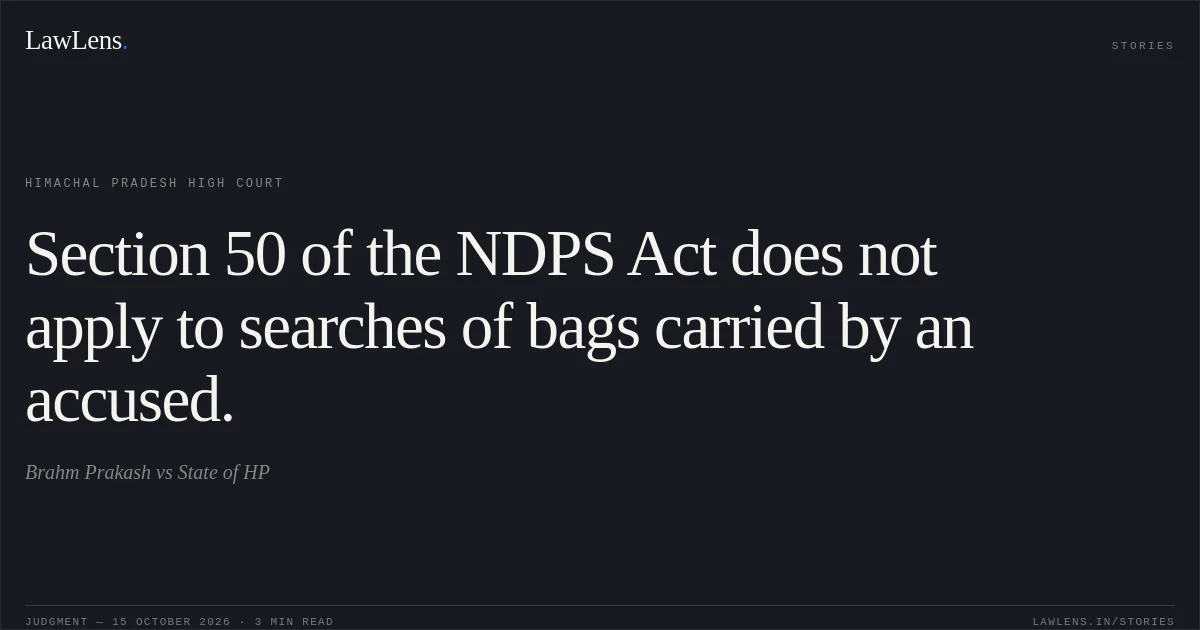
Section 50 of the NDPS Act applies to a search of a person, not to a search of a bag or other article carried by that person; the Court relied on *Madan Lal v. State of Himachal Pradesh*, *State of H.P. v. Pawan Kumar* and related Supreme Court authorities
Source reference: para. 20–23Section 42 concerns searches in buildings, conveyances or enclosed places and was held inapplicable to a recovery from a person in a public place; the Court relied on *Karnail Singh v. State of Haryana* and *S.K. Raju v. State of West Bengal*
Source reference: para. 24–27Non-association of independent witnesses does not, by itself, require rejection of a prosecution case, though police evidence must be carefully scrutinised
Source reference: para. 31–36Minor discrepancies do not discredit testimony unless they affect its core or materially undermine credibility
Source reference: para. 40–43The Court also considered compliance with Sections 55 and 57 of the NDPS Act and held that the alleged non-compliance with Section 52A was not fatal in light of *Sandeep Kumar v. State of H.P.* and *Mehboob Shah v. State of Madhya Pradesh*
Source reference: para. 46–49Reasoning
The Court found that the contraband was recovered from the appellant’s backpack, not his person; the personal-search memo was prepared after his arrest, so Section 50 was not attracted
Source reference: para. 18The recovery occurred at a public place, making Section 42 inapplicable
Source reference: para. 27It accepted the explanation that the location was secluded and found that the absence of independent witnesses did not, on its own, undermine the case
Source reference: para. 29–36The testimony of the recovery witnesses was consistent on the material facts, and the identified discrepancies were not material
Source reference: para. 37–43The Court further found that the re-sealing and transmission of the case property were supported by the documentary and oral evidence, and that the FSL report established the substance was charas
Source reference: para. 46–47It rejected the Section 52A challenge as non-fatal
Source reference: para. 48–49Holding
The High Court held that the trial court’s findings were not perverse and that the prosecution had established the appellant’s possession of 1.5 kg of charas.
It dismissed the appeal and affirmed the conviction and sentence
Source reference: para. 50–52Acts & Sections Cited
9 provisions across 2 statutes referred to in this judgment. Each provision opens on LawLens.
Narcotic Drugs and Psychotropic Substances Act, 19855
Code of Criminal Procedure, 19734
Original Court PDF
Brahm PrakashvsState of HP
Click to open original judgment
Original judgment, available to read, download and summarize on LawLens.in