Facts
Opposite Party No. 2, the proprietor of “Puja Beauty Parlour,” occupied a shop at Arya Samaj Road, Khagaul, Patna, as a tenant of Petitioner No. 1 for more than twelve years.
Source reference: pp. 2–3She alleged that on 10 December 2016, Petitioner No. 1, Petitioner No. 2, and several other persons came to the shop, demanded that she vacate it, abused her, damaged the shop’s glass counter, removed furniture, and that Petitioner No. 2 attempted to molest her.
Source reference: pp. 2–3After alleging that the police had failed to take action on her written complaint, Opposite Party No. 2 instituted Complaint Case No. 1273(C) of 2016.
Source reference: p. 1The Judicial Magistrate 1st Class, Danapur, took cognizance against the petitioners for an offence under Section 504 of the Indian Penal Code by order dated 5 July 2018.
Source reference: p. 1Issues
Whether the order dated 5 July 2018 taking cognizance under Section 504 of the IPC disclosed sufficient prima facie material and reflected due application of judicial mind.
Source reference: pp. 1, 3–4Whether continuation of the criminal prosecution, arising in the context of the landlord–tenant dispute, would amount to an abuse of the process of the court warranting exercise of the High Court’s inherent jurisdiction.
Source reference: pp. 3–5Law Applied
The Court considered Section 504 of the Indian Penal Code, which requires intentional insult of such a nature that it is intended, or known to be likely, to provoke a breach of the peace.
Source reference: p. 3It relied on State of Haryana v. Bhajan Lal, 1992 Supp (1) SCC 335, concerning the recognised categories in which criminal proceedings may be quashed to prevent abuse of process.
Source reference: p. 3It also applied the principle in Pepsi Foods Ltd. v. Special Judicial Magistrate, (1998) 5 SCC 749, that a Magistrate must apply judicial mind to the complaint and supporting material and must be prima facie satisfied that sufficient grounds exist for proceeding; a mechanical summoning or cognizance order is impermissible.
Source reference: p. 4The Court further referred to Japani Sahoo v. Chandra Sekhar Mohanty, (2007) 7 SCC 394, which cautioned that, particularly in relation to petty offences, a person should not remain under indefinite apprehension of prosecution.
Source reference: p. 4Reasoning
The petitioners characterised the complaint as a consequence of a tenancy and rent dispute and denied that the alleged acts constituted the offence under Section 504 IPC.
Source reference: p. 3They also alleged mala fides and an attempt to blackmail them.
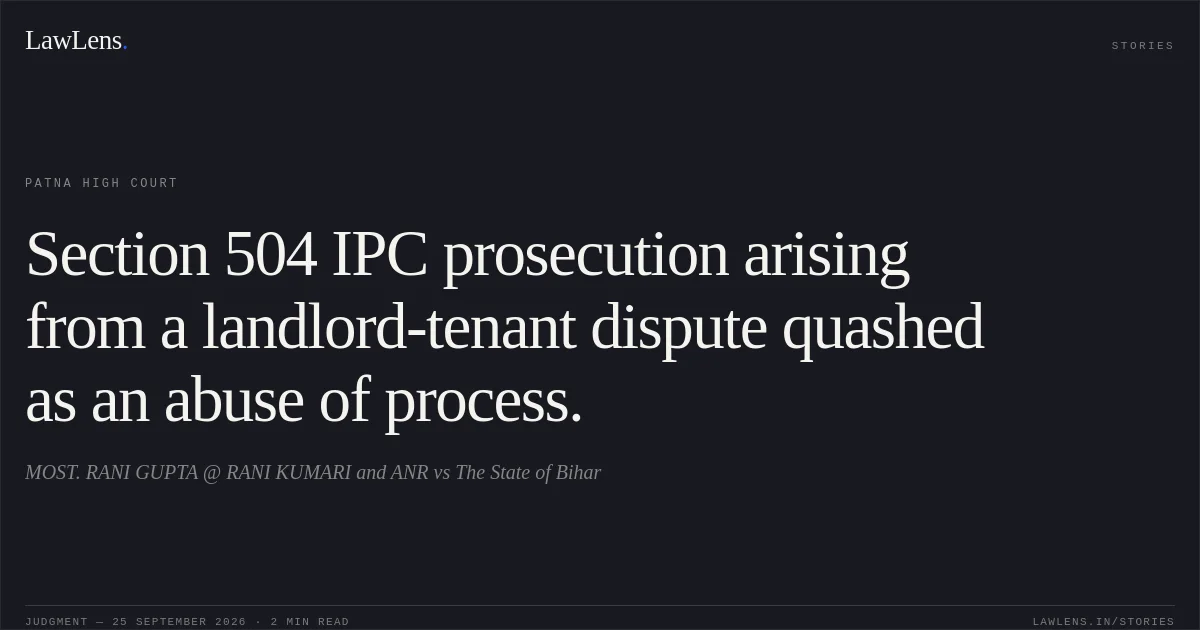
Source reference: pp. 3–5Applying the principles governing quashing under Bhajan Lal and the requirement of judicial application of mind under Pepsi Foods, the Court concluded that continuation of the prosecution would constitute an abuse of the process of the court.
Source reference: p. 5Although Opposite Party No. 2 contended that prima facie material existed, the Court accepted the petitioners’ challenge and found the prosecution unsustainable in the circumstances.
Source reference: p. 5Holding
The High Court answered the issues in favour of the petitioners.
It held that the prosecution was an abuse of the process of the court and quashed the order dated 5 July 2018 passed by the Judicial Magistrate 1st Class, Danapur, taking cognizance in Complaint Case No. 1273(C) of 2016 under Section 504 IPC.
Source reference: para. 10; p. 5The criminal miscellaneous application was accordingly allowed.
Source reference: para. 11; p. 5Acts & Sections Cited
1 provisions across 1 statute referred to in this judgment. Each provision opens on LawLens.
Indian Penal Code, 18601
Original Court PDF
MOST. RANI GUPTA @ RANI KUMARI and ANRvsThe State of Bihar
Click to open original judgment
Original judgment, available to read, download and summarize on LawLens.in