Facts
The defendants owned the suit property and entered into a registered Joint Development Agreement (JDA) and executed a General Power of Attorney in favour of the plaintiff-builder.
Source reference: paras. 3–5, 8–11The plaintiff alleged that possession was delivered, that it obtained a BBMP sanctioned plan and began construction, and that the defendants interfered.
Source reference: paras. 3–5, 8–11The defendants denied delivering possession, relied on the JDA’s clause excluding delivery of possession for the purposes of Section 53A of the Transfer of Property Act, 1882 (TPA), and stated that they had terminated the arrangement.
Source reference: paras. 3–5, 8–11The trial court dismissed the plaintiff’s suit for permanent injunction, finding that possession and construction expenditure had not been proved and that the JDA had been terminated. The plaintiff appealed under Section 96 read with Order XLI Rule 1 CPC. The judgment’s opening paragraph identifies the decree date as 18 June 2021, while the appeal caption and introductory material refer to 18 June 2022.
Source reference: paras. 1, 3–5, 8–11Issues
1. Whether the plaintiff proved possession of the suit property and construction under the JDA dated 31 December 2015.
Source reference: para. 16(1)2. Whether the plaintiff proved interference by the defendants contrary to the JDA.
Source reference: para. 16(2)3. Whether the plaintiff could claim the benefit of Section 53A TPA.
Source reference: para. 16(3)4. Whether the plaintiff was entitled to permanent injunction against the defendants, and whether the trial court’s decree required appellate interference.
Source reference: paras. 16(4)–(5)Law Applied
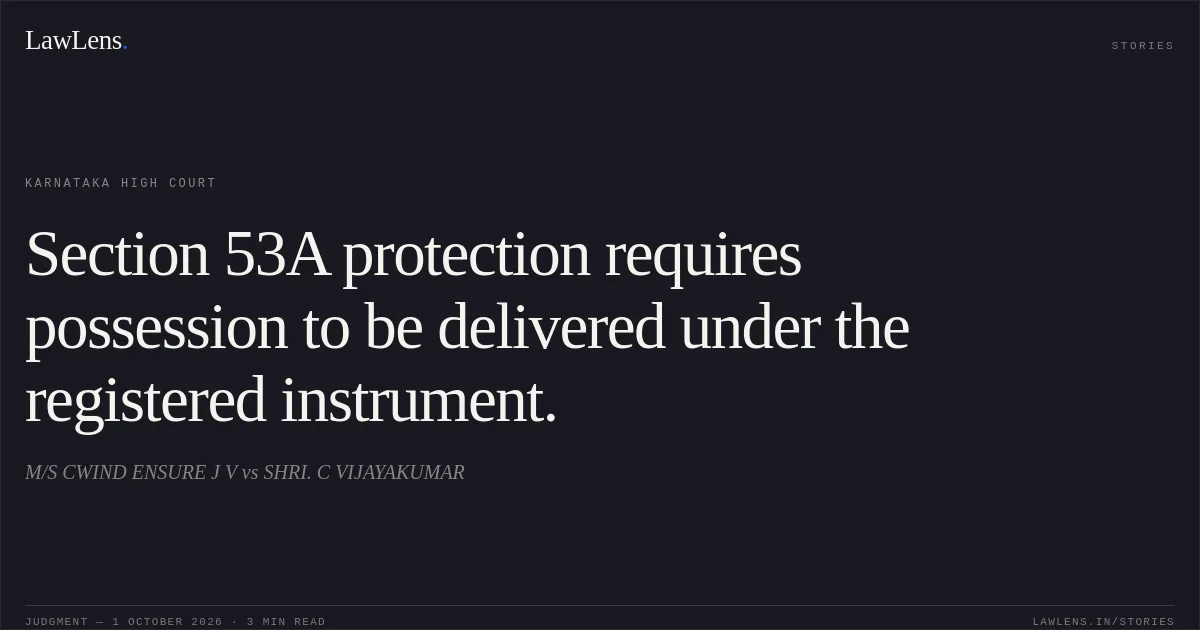
Section 53A TPA protects a transferee in part performance only where the statutory requirements are met; the court stated that, in this case, the instrument had to be registered and possession had to be taken by virtue of that instrument.
Source reference: para. 24A plaintiff seeking an injunction on the basis of a development or sale arrangement must establish the possession on which the injunction claim depends. Relying on Balram Singh v. Kelo Devi, Civil Appeal No. 6733 of 2022, decided on 23 September 2022, the court stated that a plaintiff cannot use a suit for injunction to obtain indirectly relief that would require seeking the substantive relief of specific performance.
Source reference: para. 20It also relied on Venkatesh v. Barikara Eranna, MSA No. 100006 of 2023, for the proposition that a mere agreement of sale does not, in the circumstances addressed there, support a suit for injunction alone.
Source reference: para. 21Reasoning
The JDA permitted the plaintiff to undertake construction activities but expressly stated that it did not amount to delivery of possession for Section 53A purposes. The court therefore found that permission to enter and carry out work did not establish possession, particularly where the plaintiff had not produced the alleged BBMP sanctioned plan or satisfactory evidence of construction expenditure.
Source reference: paras. 18, 23–24It also relied on the termination notice and reply, and on the dishonoured cheques, in concluding that the plaintiff had not established that the JDA had been acted upon or that it remained an adequate basis for the claimed injunction.
Source reference: paras. 19, 22Since possession was not proved, the plaintiff could not obtain the protection sought under Section 53A or a permanent injunction; the court further considered that the plaintiff had not sought specific performance of the underlying arrangement.
Source reference: paras. 20, 24–25Holding
The High Court answered the issues against the plaintiff, held that possession and entitlement to injunction had not been established, and found no perversity or illegality in the trial court’s decision.
It dismissed the Regular First Appeal.
Source reference: OrderActs & Sections Cited
2 provisions across 1 statute referred to in this judgment. Each provision opens on LawLens.
Code of Civil Procedure, 19082
Original Court PDF
M/S CWIND ENSURE J VvsSHRI. C VIJAYAKUMAR
Click to open original judgment
Original judgment, available to read, download and summarize on LawLens.in