Facts
The Petitioner, a Delhi-registered company providing script services to Zee Entertainment Enterprises Ltd., was subjected to search proceedings on 3 March 2021, after which the investigation was handled by the DGGI, Mumbai Zonal Unit.
Source reference: p.3; paras. 5–7The DGGI issued a common show-cause notice dated 31 March 2023 to 45 noticees, including the Petitioner, alleging fraudulent availment of input tax credit and invoking proceedings under Section 74 of the CGST Act, the MGST Act and the IGST Act.
Source reference: p.3; para. 8While those proceedings were pending, the Delhi GST authority issued a separate show-cause notice dated 29 May 2024 under Section 73 of the CGST Act for April 2019 to March 2020, alleging incorrect declaration of tax liability and wrongful availment of ITC under Section 16(2)(c).
Source reference: pp. 3–4; paras. 9–11The authority thereafter passed an order dated 29 August 2024 creating a demand of Rs. 10,57,75,250 against the Petitioner.
Source reference: p.4; para. 11The Petitioner did not file a statutory appeal and instead filed a rectification application on 7 April 2025.
Source reference: p.4; para. 12Subsequently, the DGGI proceedings were treated as concluded against the co-noticees, including the Petitioner, after Zee Entertainment paid the tax, interest and prescribed penalty under Explanation 1 to Section 74.
Source reference: p.4; para. 13The Petitioner then invoked the writ jurisdiction of the High Court, contending that the Delhi proceedings were barred by Section 6(2)(b) of the CGST Act and that the earlier proceedings extinguished the subsequent demand.
Source reference: pp. 4–6; paras. 14–21Issues
1. Whether the Delhi GST authority’s proceedings under Section 73 of the CGST Act were barred by Section 6(2)(b) because the DGGI had earlier initiated proceedings under Section 74 concerning the Petitioner.
Source reference: pp. 8–11; paras. 28–382. Whether the subsequent conclusion of the DGGI proceedings against the co-noticees extinguished or invalidated the separate demand raised against the Petitioner.
Source reference: pp. 11–12; paras. 39–423. Whether Section 75(13) of the CGST Act barred the subsequent proceedings on the ground that the Petitioner had already been subjected to penalty for the same act or omission.
Source reference: pp. 11–12; paras. 43–454. Whether the writ petition should be entertained despite the availability of a statutory appeal and the Petitioner’s delay in challenging the order dated 29 August 2024.
Source reference: pp. 7–8, 12–13; paras. 23–27, 46–48Law Applied
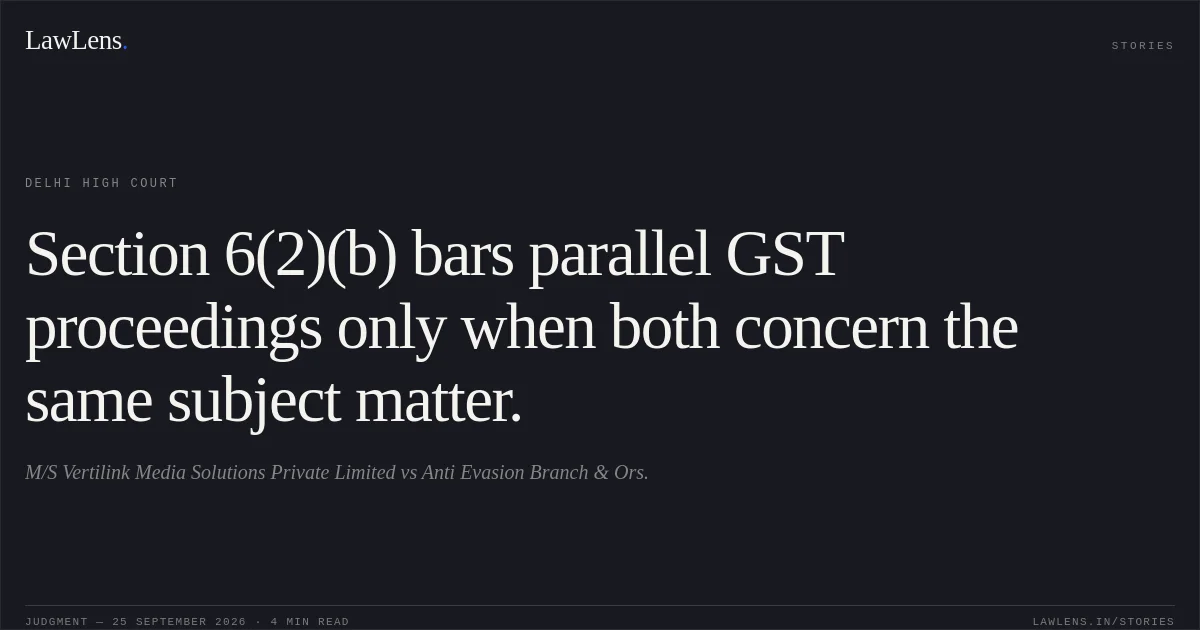
The Court applied Section 6(2)(b) of the CGST Act, which prevents parallel proceedings by Central and State tax authorities only where the proceedings concern the same subject matter, not merely the same assessee, period or broad transactions.
Source reference: pp. 8–11; paras. 28–38Sections 73 and 74 operate in materially different circumstances: Section 73 concerns tax not paid or short-paid for reasons other than fraud, suppression or wilful misstatement, whereas Section 74 concerns tax liability arising from fraud, suppression or wilful misstatement.
Source reference: p. 10; paras. 33–38Section 16(2)(c) governs entitlement to ITC where the corresponding tax has not been paid by the supplier.
Source reference: p. 9; para. 32Section 75(13) prohibits imposition of penalties for the same act or omission under more than one provision, but requires a prior penalty imposed for the same act or omission.
Source reference: pp. 11–12; paras. 43–45The Court also applied the principle that the existence of an efficacious statutory appellate remedy ordinarily warrants refusal to exercise discretionary writ jurisdiction, particularly where the petition suffers from delay and laches.
Source reference: pp. 7–8; paras. 23–27It considered Amit Gupta v. Union of India, 2023 SCC OnLine Del 6664, as authority for preventing multiple proceedings on the same subject matter, while holding that the foundational requirement of identity of subject matter must first be established.
Source reference: p. 13; para. 49Reasoning
The Court held that the two proceedings were not shown to concern the same subject matter.
Source reference: pp. 9–10; paras. 32–36The Delhi proceedings concerned determination of the Petitioner’s correct tax liability for April 2019 to March 2020, including inadmissible ITC under Section 16(2)(c), whereas the DGGI proceedings under Section 74 concerned allegations of fraudulent ITC availment without actual supply and involved 45 noticees.
Source reference: pp. 9–10; paras. 32–36Overlapping financial periods, common transactions or use of the expression “ITC” did not establish identity of subject matter, and the transfer of the earlier investigation to the DGGI did not create a blanket ouster of the jurisdiction of another competent GST officer.
Source reference: pp. 10, 13–14; paras. 37–38, 50–51The conclusion of the DGGI proceedings merely meant that no tax, interest or penalty was recovered from the Petitioner in those proceedings; it did not retrospectively invalidate an independently initiated proceeding based on a different statutory foundation.
Source reference: pp. 11–12; paras. 39–42Section 75(13) was also inapplicable because no prior penalty had been imposed upon the Petitioner for the same act or omission.
Source reference: p. 12; paras. 43–45Independently, the Court declined to exercise writ jurisdiction because the Petitioner had failed to pursue the statutory appeal and had approached the Court nearly two years after the adjudication order, with the pending rectification application not constituting a sufficient explanation for the delay.
Source reference: pp. 7–8, 12–13; paras. 23–27, 46–48Holding
The Court dismissed the writ petition, holding that the Delhi proceedings were not barred by Section 6(2)(b), that the conclusion of the DGGI proceedings did not extinguish the separate demand, and that Section 75(13) was not attracted.
The dismissal was also based on the availability of an efficacious statutory appeal and the Petitioner’s unexplained delay and laches.
Source reference: p. 14; para. 52The Court clarified that it had not expressed any final opinion on issues that might arise before the competent statutory authority.
Source reference: p. 15; paras. 53–56The Petitioner was left at liberty to pursue any legally maintainable remedy against the order on its pending rectification application, and all pending applications were closed.
Source reference: p. 15; paras. 53–56Acts & Sections Cited
7 provisions across 3 statutes referred to in this judgment. Each provision opens on LawLens.
Central Goods and Services Tax Act, 20175
Maharashtra Goods and Services Tax Act, 20171
Integrated Goods and Services Tax Act, 20171
Original Court PDF
M/S Vertilink Media Solutions Private LimitedvsAnti Evasion Branch & Ors.
Click to open original judgment
Original judgment, available to read, download and summarize on LawLens.in