Facts
The appellant, an individual proprietor of M/s Kailash Engineers, challenged an addition of ₹7,00,000 under Section 68 of the Income Tax Act, 1961, representing unsecured loans.
Source reference: pp. 2–3The Assessing Officer had added ₹9,00,400 as unexplained credits; the CIT(A) deleted ₹2,00,400 and sustained ₹7,00,000, and the ITAT affirmed that decision
Source reference: pp. 2–3The sustained amount comprised loans attributed to Pawan Kumar (₹50,000), Santosh Rani (₹4,50,000), Vimla Arora (₹1,00,000), and S. L. Magoo (₹1,00,000).
Source reference: pp. 4–7, 11The authorities found that the creditors either denied advancing loans or could not satisfactorily explain the source of the funds, including cash deposits in their bank accounts.
Source reference: pp. 4–7, 11Issues
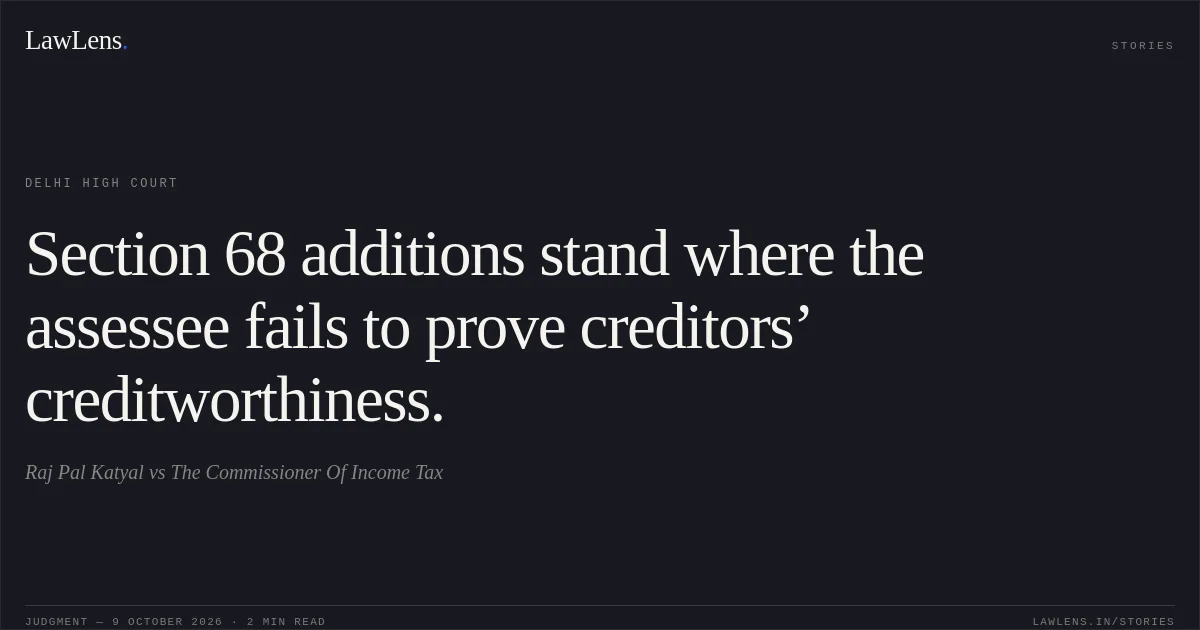
Whether the ITAT’s finding that the appellant had failed to prove the creditworthiness of the creditors was perverse?
Source reference: p. 1; p. 12Law Applied
Section 68 of the Income Tax Act, 1961 permits a sum credited in an assessee’s books to be treated as income where the assessee offers no explanation, or the Assessing Officer considers the explanation unsatisfactory.
Source reference: p. 7Under CIT v. NRA Iron & Steel (P) Ltd., (2019) 15 SCC 529, the assessee bears the initial onus of establishing the identity and creditworthiness of the creditor and the genuineness of the transaction through cogent evidence; proving identity alone is insufficient.
Source reference: pp. 8–11Where that initial onus is discharged, the Assessing Officer must make further inquiry, but an unsatisfactory explanation of the nature and source of the credit may justify treating it as the assessee’s income.
Source reference: pp. 8–11Reasoning
The Court considered the creditors’ statements and the concurrent findings of the Assessing Officer, CIT(A), and ITAT.
Source reference: pp. 4–7, 11Pawan Kumar and S. L. Magoo denied advancing loans, while Santosh Rani and Vimla Arora did not satisfactorily explain the funds advanced, including relevant cash entries in their accounts.
Source reference: pp. 4–7, 11Applying the Section 68 principles in NRA Iron & Steel, the Court held that the appellant had not established the creditors’ creditworthiness.
Source reference: pp. 11–12It found no basis to characterize the authorities’ assessment of the evidence as perverse.
Source reference: pp. 11–12The Court distinguished Principal Commissioner of Income-Tax v. KRBL Infrastructure Ltd., (2026) 486 ITR 88, because that case involved accepted creditworthiness and concurrent findings in the assessee’s favour, unlike the present case.
Source reference: p. 12Holding
The Court answered the substantial question of law in favour of the Revenue and against the assessee, holding that the ITAT’s finding was not perverse and that the appellant had failed to prove the creditworthiness of the creditors.
The appeal and pending application(s), if any, were dismissed.
Source reference: p. 12Acts & Sections Cited
4 provisions across 1 statute referred to in this judgment. Linked provisions open on LawLens.
Income Tax Act, 19614
Original Court PDF
Raj Pal KatyalvsThe Commissioner Of Income Tax
Click to open original judgment
Original judgment, available to read, download and summarize on LawLens.in