Facts
M/s Bhoomi Creators and Developers Partnership Firm instituted Original Suit No. 803 of 2025 seeking mandatory and prohibitory injunctions against the revisionists.
Source reference: para. 3The suit was founded on a developer agreement under which the revisionists were required to partition and mutate certain land in their favour and thereafter deliver possession to the firm, while the firm claimed to have performed its obligations by obtaining permissions from government authorities.
Source reference: para. 3The revisionists moved an application under Order VII Rule 11 CPC, asserting that the plaintiff-firm was unregistered and that the suit was barred by Section 69(2) of the Indian Partnership Act, 1932.
Source reference: para. 4The trial court rejected the application on the ground that the issue of registration involved a mixed question of law and fact requiring evidence. The revisionists challenged that order before the High Court.
Source reference: paras. 4–9Issues
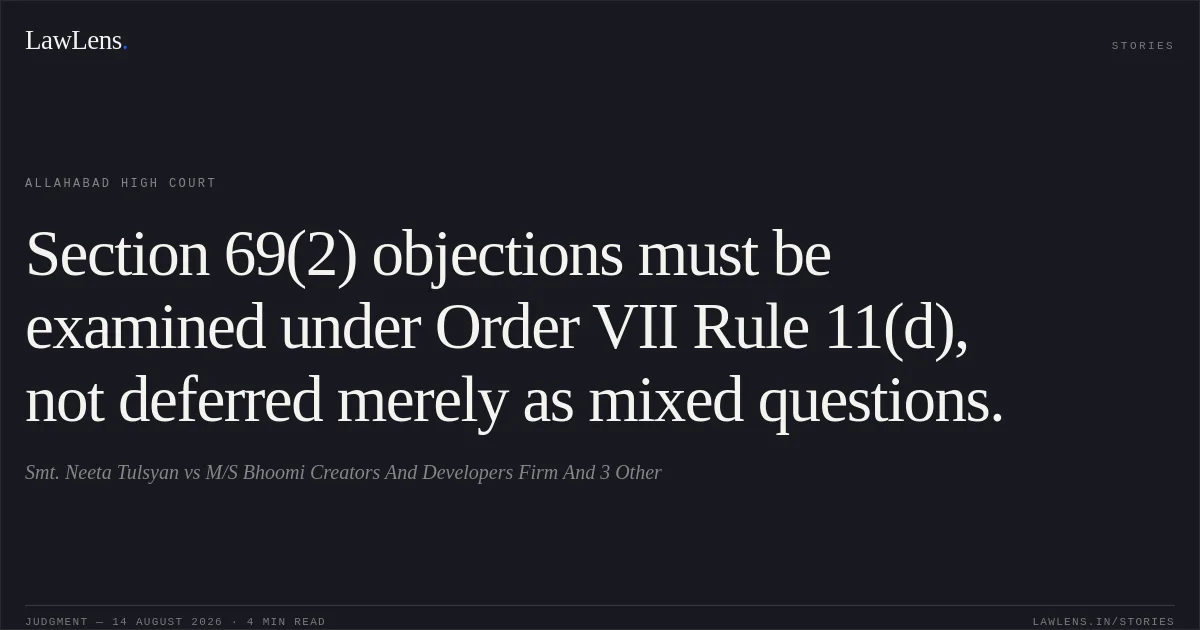
Whether the trial court was justified in rejecting the application under Order VII Rule 11 CPC merely on the ground that the objection under Section 69(2) of the Partnership Act involved a mixed question of law and fact requiring evidence?
Source reference: para. 9Whether, on a consideration of the plaint and legally permissible material, the suit appeared to be one for enforcement of contractual rights attracting the bar under Section 69(2) of the Partnership Act?
Source reference: paras. 13–18, 21Whether the absence of any pleading or material showing registration of the plaintiff-firm justified rejection of the plaint at the threshold?
Source reference: paras. 11–12, 19–23Law Applied
The Court applied Section 69(2) of the Indian Partnership Act, 1932, which bars an unregistered partnership firm from instituting a suit against a third party for enforcement of a right arising from a contract entered into in the course of the firm’s business, subject to the statutory requirements concerning registration and the partners’ names in the Register of Firms.
Source reference: paras. 13, 17, 21Under Order VII Rule 11(d) CPC, a plaint may be rejected where the suit appears from the plaint to be barred by law; the court must examine the plaint as a whole and cannot defer the issue merely by labelling it a mixed question of law and fact.
Source reference: paras. 16, 19, 22Relying on Haldiram Bhujiawala v. Anand Kumar Deepak Kumar, (2000) 3 SCC 250, Raptakos Brett & Co. Ltd. v. Ganesh Property, (1998) 7 SCC 184, Purushottam v. Shivraj Fine Arts Litho Works, (2007) 15 SCC 58, and Shiv Developers through Partner Sunilbhai Somabhai Ajmeri v. Aksharay Developers, 2022 INSC 119, the Court held that the nature of the right sought to be enforced—not merely the reference to a contract—determines the applicability of Section 69(2).
Source reference: paras. 13–17It also considered Ashoka Group v. Shri Hariram Buddhraja, First Appeal No. 302 of 2013, which recognised that Section 69(2) may be examined at the Order VII Rule 11 stage.
Source reference: para. 15Reasoning
The plaint identified the plaintiff as a partnership firm and pleaded that its rights to mandatory and prohibitory injunctions arose directly from the developer agreement with the defendants. The agreement was therefore the foundation of the alleged rights, rather than a mere background reference, prima facie satisfying the contractual-right requirement under Section 69(2).
Source reference: paras. 3, 10, 18The plaint contained no averment regarding the firm’s registration, registration number, or the particulars of its partners. Even after the specific statutory objection was raised, the plaintiff did not assert that it was registered or produce material evidencing registration.
Source reference: paras. 11–12Accordingly, the trial court erred in treating the issue as incapable of consideration under Order VII Rule 11(d) CPC merely because registration could involve a factual inquiry.
Source reference: para. 19However, the plaintiff’s silence was not conclusive proof of non-registration, particularly since it had not appeared before the High Court to explain its position. The Court therefore declined to conclusively determine the firm’s registration status and directed reconsideration by the trial court after affording the plaintiff an effective opportunity of hearing.
Source reference: paras. 20, 22–23Holding
The High Court held that an objection under Section 69(2) of the Partnership Act cannot be rejected at the threshold solely on the ground that it involves a mixed question of law and fact.
The trial court’s order dated 18 May 2026 was set aside, and the matter was remanded for fresh consideration of the Order VII Rule 11 application.
Source reference: para. 28The trial court was directed to determine whether the plaintiff-firm was registered on the date of institution and, if not, whether the suit sought enforcement of contractual rights arising from the firm’s business so as to attract Section 69(2).
Source reference: para. 26The High Court expressed no final opinion on the firm’s registration status or the ultimate maintainability of the suit.
Source reference: para. 27Acts & Sections Cited
1 provisions across 1 statute referred to in this judgment. Each provision opens on LawLens.
Indian Partnership Act, 19321
Original Court PDF
Smt. Neeta TulsyanvsM/S Bhoomi Creators And Developers Firm And 3 Other
Click to open original judgment
Original judgment, available to read, download and summarize on LawLens.in