Facts
The Respondent-co-operative society claimed possession of the second floor of property bearing No. F-144, Gali No. 2, Ganga Vihar, Delhi, asserting that it was in possession and control of the property under a registered General Power of Attorney. The Appellant, the Society’s former President from 2012 to 2018, allegedly occupied the second floor as a caretaker and resided there with his family. He paid ₹2,000 per month on only two occasions, without any written tenancy agreement.
Source reference: paras. 4–5; pp. 2–3After notices demanding possession were not complied with, the Society first instituted eviction proceedings under Section 14(1)(e) read with Section 25-B of the Delhi Rent Control Act, 1958; those proceedings were withdrawn with liberty to file afresh after it was reported that the Act did not apply to the property.
Source reference: para. 6; p. 3A subsequent legal notice dated 6 December 2024 terminating the Appellant’s caretaker status was also not complied with, leading to the civil suit for possession, permanent injunction and damages/mesne profits.
Source reference: para. 7; p. 3The Appellant’s Written Statement, filed belatedly, was initially taken on record subject to payment of ₹25,000 in costs. As the costs were not paid, the Trial Court directed that the Written Statement would not form part of the record; the Appellant’s challenge to that order was withdrawn.
Source reference: paras. 8–10, 50; pp. 3–4, 12The Trial Court decreed possession and permanent injunction in favour of the Society, while dismissing the claim for damages/mesne profits for want of evidence.
Source reference: paras. 16–18; p. 5Issues
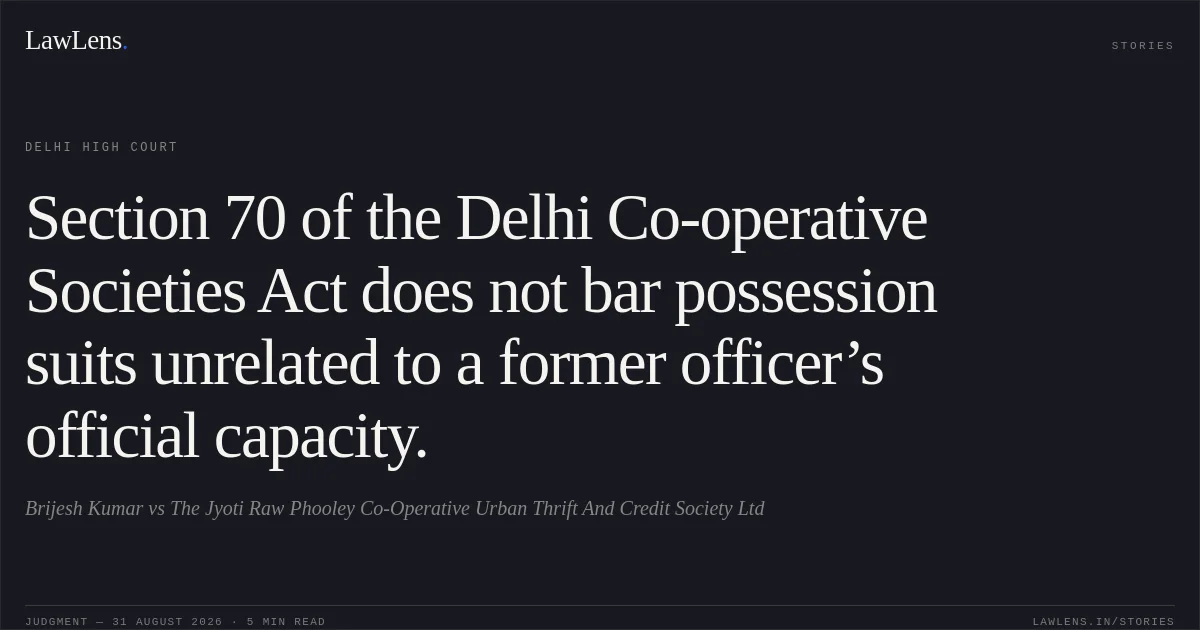
Whether the civil suit for possession was barred by Sections 70 and 132 of the Delhi Co-operative Societies Act, 2003, on the ground that the dispute involved a former officer of the Society and allegedly touched its management or business?
Source reference: paras. 24–33; pp. 6–8Whether the Respondent established prior settled possession or a better possessory right sufficient to obtain a decree for possession, despite the absence of conventional title documents in its favour?
Source reference: paras. 34–43; pp. 8–10Whether the alleged tenancy attracted the bar under Section 50 of the Delhi Rent Control Act, 1958, and whether the earlier eviction proceedings barred the present suit under Order II Rule 2 CPC?
Source reference: paras. 44–49; pp. 10–12Whether the Trial Court’s refusal to restore the Written Statement upon payment or waiver of costs warranted interference in appeal under Section 105 CPC?
Source reference: paras. 20, 50; pp. 5–6, 12Law Applied
The Court applied Section 70 of the Delhi Co-operative Societies Act, 2003, under which disputes touching the constitution, management or business of a co-operative society, including disputes between a society and its past officer, may be referred to the Registrar; Section 132 excludes civil-court jurisdiction only in disputes required to be so referred.
Source reference: paras. 25–33; pp. 6–8Relying on Deccan Merchants Co-operative Bank Ltd. v. Dalichand Jugraj Jain, AIR 1969 SC 1320, the Court held that “business” refers to the society’s actual trading, commercial or similar authorised activities and not everything undertaken in furtherance of its objects.
Source reference: para. 28; p. 7Under Rame Gowda v. M. Varadappa Naidu, (2004) 1 SCC 769, read with Nair Service Society Ltd. v. K.C. Alexander, (1968) 3 SCR 1 and Nagar Palika, Jind v. Jagat Singh, (1995) 3 SCC 426, prior peaceful and settled possession may support a decree for possession where the defendant cannot establish a better title or right; possession is presumed to follow title unless rebutted.
Source reference: para. 38; p. 9The Court further applied the principle that occupation as an agent, servant or caretaker on behalf of the owner does not constitute possession in one’s own right.
Source reference: para. 41; p. 10It also considered Sections 1(2), 3 and 50 of the Delhi Rent Control Act, 1958, and Order II Rule 2 CPC, holding that the DRC Act did not apply absent the requisite notification extending it to the relevant area, and that withdrawal of the earlier eviction petition with liberty to file afresh did not bar the civil suit.
Source reference: paras. 44–49; pp. 10–12Reasoning
The Court held that Section 70 was not attracted merely because the Appellant had formerly been the Society’s President. The dispute concerned recovery of immovable property allegedly occupied without authority, rather than the Society’s constitution, management or authorised thrift-and-credit business.
Source reference: paras. 27–33; pp. 7–8The evidence showed that the Appellant’s occupation was not pursuant to any resolution, appointment, authorisation or institutional arrangement and was therefore not referable to the office he held.
Source reference: paras. 27–33; pp. 7–8The Society’s registered GPA and evidence established its possession and control of the property, while the Appellant produced no competing title or lawful right. His occupation, even if initially as a caretaker, was derived through the Society and could not mature into an independent possessory right; the unrebutted testimony of the Society’s witnesses supported this conclusion.
Source reference: paras. 35–43; pp. 8–10Even assuming that the two payments of ₹2,000 indicated a tenancy, the property in Village Gokulpur was not shown to fall within the notified territorial operation of the DRC Act, and the Appellant produced no notification establishing otherwise. Consequently, Section 50 did not bar the suit.
Source reference: paras. 44–49; pp. 10–12The earlier eviction proceedings had been withdrawn with liberty to institute fresh proceedings, so Order II Rule 2 CPC was also inapplicable.
Source reference: paras. 44–49; pp. 10–12Finally, the order excluding the Written Statement had attained finality after withdrawal of the Appellant’s earlier challenge, and the Appellant could not reopen that issue in the appeal.
Source reference: para. 50; p. 12Holding
The High Court dismissed the appeal, holding that the suit was not barred by Sections 70 or 132 of the Delhi Co-operative Societies Act, 2003; that the Respondent had established a superior possessory right and was entitled to recover possession; and that neither Section 50 of the Delhi Rent Control Act nor Order II Rule 2 CPC prevented the suit.
The decree for possession and permanent injunction, along with costs, was affirmed. The Trial Court’s dismissal of the claim for damages/mesne profits remained undisturbed, and all pending applications were disposed of.
Source reference: paras. 16–17, 52; pp. 5, 12Acts & Sections Cited
9 provisions across 3 statutes referred to in this judgment. Each provision opens on LawLens.
Code of Civil Procedure, 19084
delhi rent control act, 19584
Delhi Municipal Corporation Act, 19571
Original Court PDF
Brijesh KumarvsThe Jyoti Raw Phooley Co-Operative Urban Thrift And Credit Society Ltd
Click to open original judgment
Original judgment, available to read, download and summarize on LawLens.in