Facts
On 27 February 2018, railway police allegedly apprehended the petitioner at Patna Junction while he was carrying a red bag.
Source reference: p.2A search conducted in the presence of two independent witnesses allegedly resulted in the recovery of six one-litre bottles of foreign liquor, comprising 100 Pipers, V.A.T. 69 and Johnnie Walker Red Label whisky.
Source reference: p.2A seizure list was prepared and signed by the petitioner and the witnesses, and the petitioner was arrested after allegedly disclosing that he had brought the liquor from Shalimar Railway Station for delivery at Patna Junction.
Source reference: pp.2–3Patna GRP Police Station Case No. 61 of 2018 was registered, and cognizance was taken on 27 March 2018 for offences under Section 273 of the Indian Penal Code and Section 30(a) of the Bihar Excise Amendment Act.
Source reference: p.1The petitioner challenged the cognizance order, contending that the search and seizure were unlawful, the statutory procedure had not been followed, and the charge-sheet had been filed beyond the prescribed period.
Source reference: pp.3–4Issues
1. Whether the alleged search and seizure were invalid because they were conducted by an Assistant Sub-Inspector in breach of Section 73(e) of the Bihar Prohibition and Excise Act, 2016, as amended in 2020.
Source reference: pp.3–4, 52. Whether non-compliance with Section 100 of the Code of Criminal Procedure and alleged inconsistencies in the seizure witnesses’ statements justified quashing of the cognizance order.
Source reference: p.43. Whether filing the charge-sheet seven days beyond the statutory period rendered the cognizance invalid or barred by law.
Source reference: pp.4–54. Whether the materials on record disclosed a prima facie case warranting continuation of the prosecution.
Source reference: p.5Law Applied
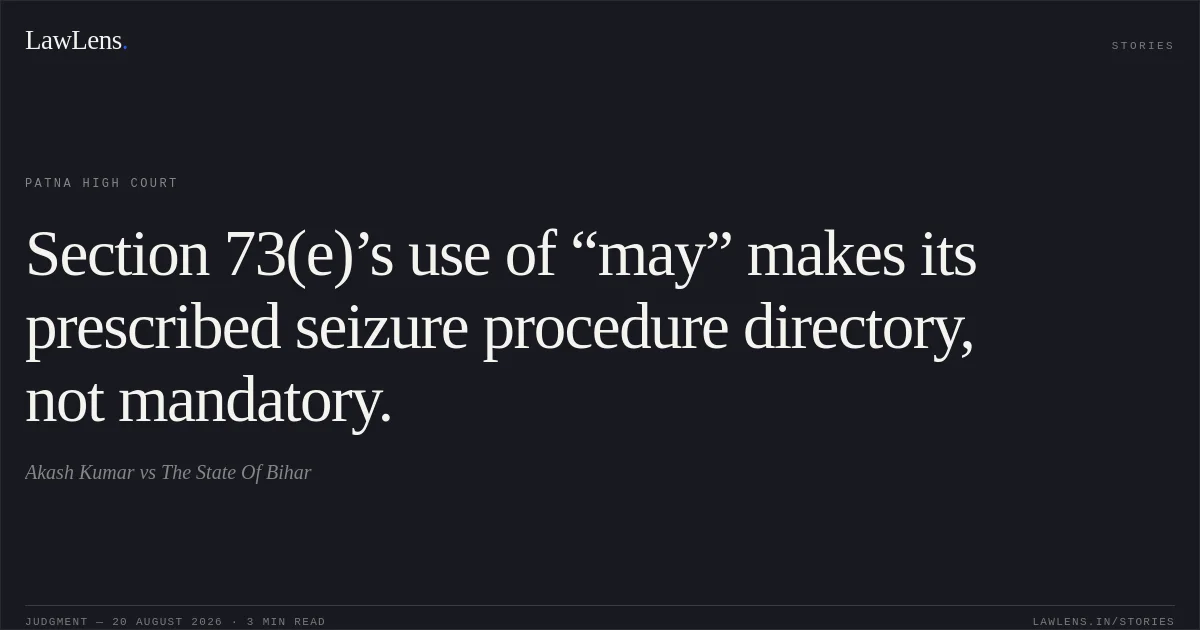
The Court applied Section 73(e) of the Bihar Prohibition and Excise Act, 2016, including its amendment under the Bihar Prohibition and Excise (Amendment and Validation) Act, 2020, and held that the use of the word “may,” rather than “shall,” indicated that the prescribed requirement was not mandatory.
Source reference: p.5The Court considered Section 100 of the Code of Criminal Procedure in relation to search procedure, but treated alleged procedural inconsistencies as matters requiring evidentiary consideration at trial.
Source reference: p.4It further held that delay in filing the charge-sheet, by itself, did not invalidate the trial or render cognizance legally barred.
Source reference: pp.4–5The Court also referred to State of Haryana v. Bhajan Lal, 1992 Supp (1) SCC 335, concerning interference with criminal proceedings on grounds such as mala fides, while observing that such contentions could be examined at the defence stage.
Source reference: p.5The offences alleged were Section 273 IPC and Section 30(a) of the Bihar Excise Amendment Act.
Source reference: p.1Reasoning
The Court found that the challenge based on the rank of the seizing officer could not succeed because Section 73(e), both before and after the 2020 amendment, used the expression “may” and did not impose an expressly mandatory requirement through the use of “shall”.
Source reference: p.5The alleged inconsistencies in the statements of the seizure witnesses and the challenge under Section 100 CrPC involved disputed factual matters, which could not ordinarily be adjudicated while examining the validity of cognizance and were appropriate for consideration during trial.
Source reference: pp.4–5The delayed filing of the charge-sheet did not extinguish the prosecution or create a legal bar to cognizance.
Source reference: p.5In view of the alleged recovery of liquor from the petitioner’s conscious possession and the seizure materials on record, the Court held that there were sufficient prima facie materials to constitute the alleged offences.
Source reference: p.5The authorities cited by the petitioner concerned release of vehicles and did not determine the merits of the prosecution in the present case.
Source reference: p.5Holding
The Court answered the issues against the petitioner.
It held that the alleged defect concerning the Assistant Sub-Inspector, the disputed search-and-seizure facts, and the seven-day delay in filing the charge-sheet did not invalidate the cognizance order.
Source reference: paras. 7–9; p.5Finding prima facie material to support the offences under Section 273 IPC and Section 30(a) of the Bihar Excise Amendment Act, the Court declined to interfere with the order dated 27 March 2018 and dismissed the criminal miscellaneous application as devoid of merit.
Source reference: paras. 7–9; p.5Acts & Sections Cited
3 provisions across 3 statutes referred to in this judgment. Each provision opens on LawLens.
Indian Penal Code, 18601
BIHAR PROHIBITION AND EXCISE ACT, 20161
Code of Criminal Procedure, 19731
Original Court PDF
Akash KumarvsThe State Of Bihar
Click to open original judgment
Original judgment, available to read, download and summarize on LawLens.in