Facts
The petitioner filed an RTI application on 25.02.2020 seeking details of a third-party public servant (Dr. Ram Narayan Sharma), specifically his dates of joining (1998) and superannuation, along with relevant note-sheets
Source reference: para 2.1, 2.2The Public Information Officer and subsequent appellate authorities rejected the request on two grounds: first, that the information pertained to an event occurring more than twenty years ago and was thus barred under Section 8(3); and second, that it constituted third-party personal information exempted under Section 11
Source reference: para 2.3–2.5The petitioner challenged the Second Appellate Authority’s order dated 18.12.2021 before the High Court
Source reference: para 1Issues
1. Whether the passage of twenty years acts as a statutory bar under Section 8(3) of the RTI Act to deny information
Source reference: para 7, 102. Whether the appellate authority failed to follow the mandatory procedure for third-party information as prescribed under Section 11 of the RTI Act
Source reference: para 14Law Applied
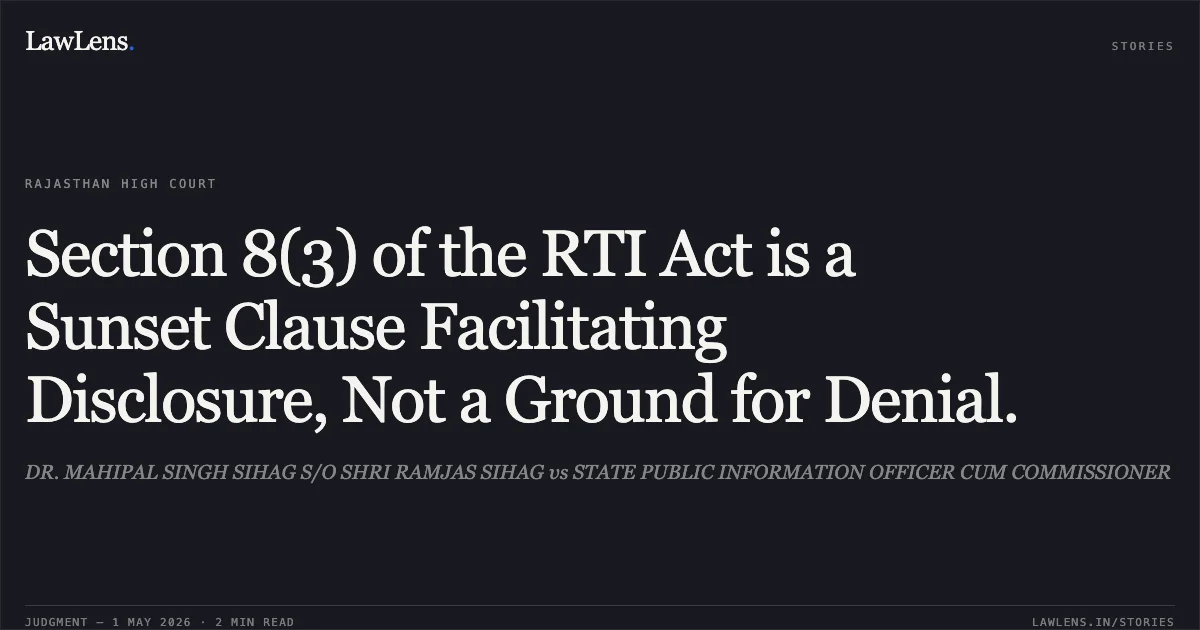
The court primarily interpreted Section 8(3) and Section 11 of the Right to Information Act, 2005. It held that Section 8(3) is a "sunset clause" intended to lift exemptions for most records after twenty years, rather than a provision to impose a bar on disclosure
Source reference: para 10, 11The court relied on CBSE v. Aditya Bandopadhyaya (2011) to establish that protections under Section 8(1)(j) cease after twenty years. Furthermore, it applied the procedural mandates of Section 11 regarding third-party notice as elucidated in the Constitution Bench judgment of CPIO, Supreme Court of India v. Subhash Chandra Agarwal (2020)
Source reference: para 12, 15Reasoning
The court found that the Second Appellate Authority committed a "patent illeagality" by weaponizing Section 8(3) as a ground for denial.
Source reference: para 18The court reasoned that since the information sought was over twenty years old, the personal information exemption under Section 8(1)(j) had expired by operation of the sunset clause.
Source reference: para 11, 12Additionally, the court observed that the authority failed to follow the mandatory "balancing exercise" under Section 11; it cannot act as a "proxy defender of privacy" without issuing notice to the third party to seek their objections/submissions. The court noted that the passage of six years since the application made further procedural delays vexatious.
Source reference: para 14, 15, 21Holding
The court allowed the writ petition and quashed the impugned order dated 18.12.2021. It held that Section 8(3) facilitates disclosure rather than prohibiting it.
The court directed the respondents to supply the requested information to the petitioner within sixty days. The Registrar (Judicial) was directed to serve the order upon the Rajasthan State Information Commission for future compliance.
Source reference: para 21, 23Original Court PDF
DR. MAHIPAL SINGH SIHAG S/O SHRI RAMJAS SIHAGvsSTATE PUBLIC INFORMATION OFFICER CUM COMMISSIONER
Click to open original judgment
Original judgment, available to read, download and summarize on LawLens.in


