Facts
The Petitioner Society entered into a Development Agreement (DA) in 2013 with Respondent No. 1 (Developer) for redevelopment
Source reference: para. 3The Developer defaulted on statutory dues, transit rent, and construction milestones, leading the Society to file a Section 9 petition under the Arbitration and Conciliation Act, 1996, in 2017
Source reference: paras. 4-5On December 14, 2017, the Court passed a wide-reaching injunction attaching the Developer’s personal assets and restraining them from creating third-party rights in any of their projects
Source reference: paras. 5, 30-32Over time, 31 Interim Applications (IAs) were filed, mostly by third-party decree-holders and allottees from unrelated projects seeking a share of the funds (~Rs. 11 crores) deposited in Court
Source reference: paras. 6, 12-14In September 2024, an Arbitral Tribunal was finally constituted, and Section 17 proceedings commenced
Source reference: paras. 5, 7Issues
1. Whether a Section 9 Court should continue exercising jurisdiction after an Arbitral Tribunal has been constituted and an application under Section 17 has been filed.
Source reference: para. 222. Whether third parties (decree-holders and allottees of unrelated projects) who are not signatories to the arbitration agreement can intervene or claim relief in a Section 9 petition.
Source reference: paras. 20, 27-28Law Applied
The court primarily applied Section 9 and Section 17 of the Arbitration and Conciliation Act, 1996. Section 2(1)(h) defines a "party" strictly as a party to an arbitration agreement
Source reference: para. 20Under Section 9(3), once a tribunal is constituted, the Court shall not entertain interim measures unless Section 17 is found to be inefficacious
Source reference: para. 19The court further applied the "veritable party" doctrine established in Cox and Kings Ltd. v. SAP India (P) Ltd. and ASF Buildtech Pvt. Ltd. v. Shapoorji Pallonji, which requires a non-signatory to demonstrate proximity, consent, or a de facto connection to the specific dispute to be impleaded
Source reference: paras. 27-28Reasoning
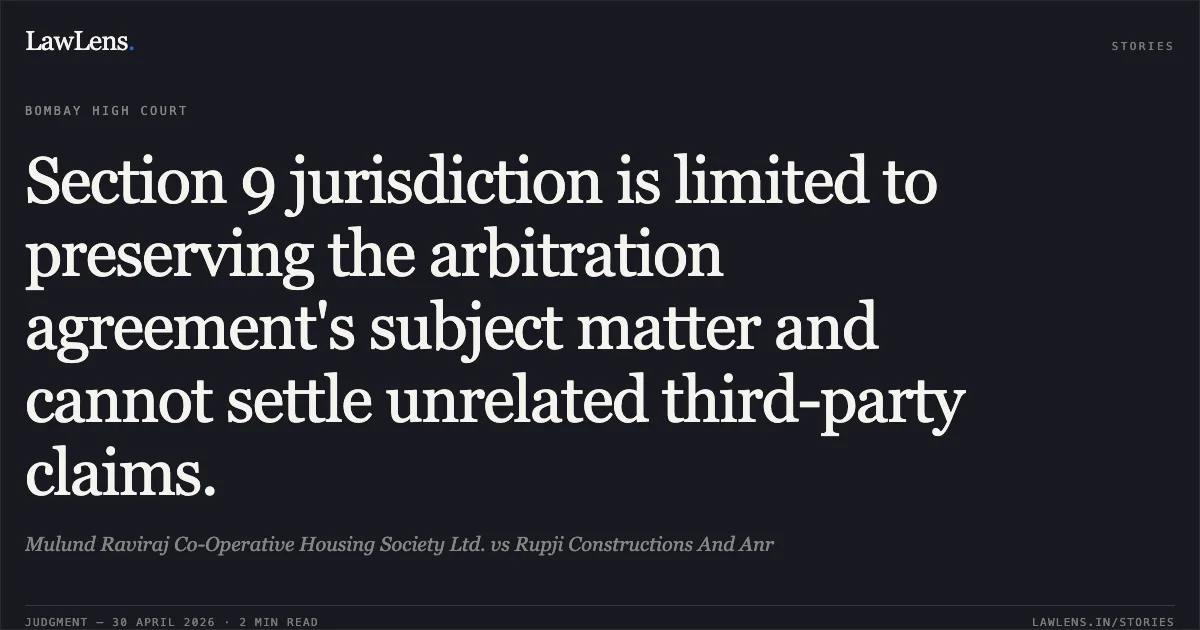
The Court reasoned that Section 9 is a protective jurisdiction in aid of arbitration, not a standalone equity jurisdiction for the world at large
Source reference: paras. 19-21Since the Arbitral Tribunal was now functional and had already passed a Section 17 order, the "rule of law" required the Section 9 Court to cease its involvement, as there was no evidence that Section 17 was inefficacious
Source reference: paras. 24-25Regarding the third-party intervenors, the Court held they lacked privity to the DA and were not "veritable parties"; their claims originated from entirely distinct projects and contracts
Source reference: paras. 28, 49The Court noted that allowing them to "chase assets" in Section 9 proceedings regarding a bilateral contract would be coram non judice (without jurisdiction)
Source reference: paras. 46, 54Holding
The Court disposed of the Section 9 Petition and all 31 IAs
all third-party interventions are rejected as they lack privity to the arbitration agreement
Source reference: para. 70(A)the Arbitral Tribunal shall determine within three months what portion of the deposited funds is necessary to secure the Society's claim; any surplus shall be released to the Developer
Source reference: para. 70(C-D)the Tribunal is empowered to vary or vacate the December 2017 injunction
Source reference: para. 70(E)the Court Commissioner is disbanded and replaced by an official Registry officer for a joint handover
Source reference: paras. 68, 70(G)Third-party decree-holders were granted liberty to approach appropriate execution forums, with the time spent here excluded for limitation purposes
Source reference: paras. 44, 50, 70(B)Acts & Sections Cited
7 provisions across 1 statute referred to in this judgment. Each provision opens on LawLens.
Arbitration and Conciliation Act, 19967
Original Court PDF
Mulund Raviraj Co-Operative Housing Society Ltd.vsRupji Constructions And Anr
Click to open original judgment
Original judgment, available to read, download and summarize on LawLens.in