Facts
Tata Capital Limited sanctioned and disbursed construction-equipment finance to the respondents under Loan-Cum-Hypothecation Agreements dated 8 November 2024.
Source reference: paras. 2, 20The respondents hypothecated the financed construction equipment in favour of Tata Capital as security for repayment of the principal, interest and other contractual dues.
Source reference: paras. 2, 20Following alleged defaults and part-payments, Tata Capital issued reminders and demand notices, recalled the loan facilities, demanded the foreclosure amount and invoked the arbitration clauses in the agreements.
Source reference: paras. 3–4Tata Capital apprehended that the respondents might conceal, transfer or otherwise deal with the hypothecated equipment, thereby frustrating recovery and the pending or contemplated arbitral proceedings.
Source reference: paras. 4–6The respondents did not appear despite service.
Source reference: no citationTata Capital therefore sought interim measures under Section 9 of the Arbitration and Conciliation Act, 1996, including disclosure of assets and the equipment’s location, attachment or freezing of bank accounts, furnishing of a bank guarantee or other security, appointment of a Receiver, restraint against creation of third-party rights, directions to transport authorities, and permission to take possession with police assistance.
Source reference: paras. 19–23, 28, 33, 36, 39, 46, 58, 65, 69, 71Issues
Whether Tata Capital had established a prima facie contractual right, a subsisting arbitral dispute and a sufficient basis for interim protection under Section 9 of the Arbitration and Conciliation Act, 1996?
Source reference: paras. 19–25Whether the respondents should be directed to disclose the present location and deployment contracts of the hypothecated construction equipment?
Source reference: paras. 46–57Whether the respondents’ bank accounts should be attached or frozen, or whether they should be directed to furnish a bank guarantee or additional security for Tata Capital’s monetary claim?
Source reference: paras. 28–45Whether a Court Receiver should be appointed to trace and take possession of the hypothecated construction equipment, with police assistance where necessary?
Source reference: paras. 58–64, 71–73Whether the respondents should be restrained from selling, transferring, encumbering or creating third-party rights in the hypothecated equipment?
Source reference: paras. 65–68Whether directions should be issued to transport authorities throughout the country to blacklist the equipment and disclose its location?
Source reference: paras. 69–70Law Applied
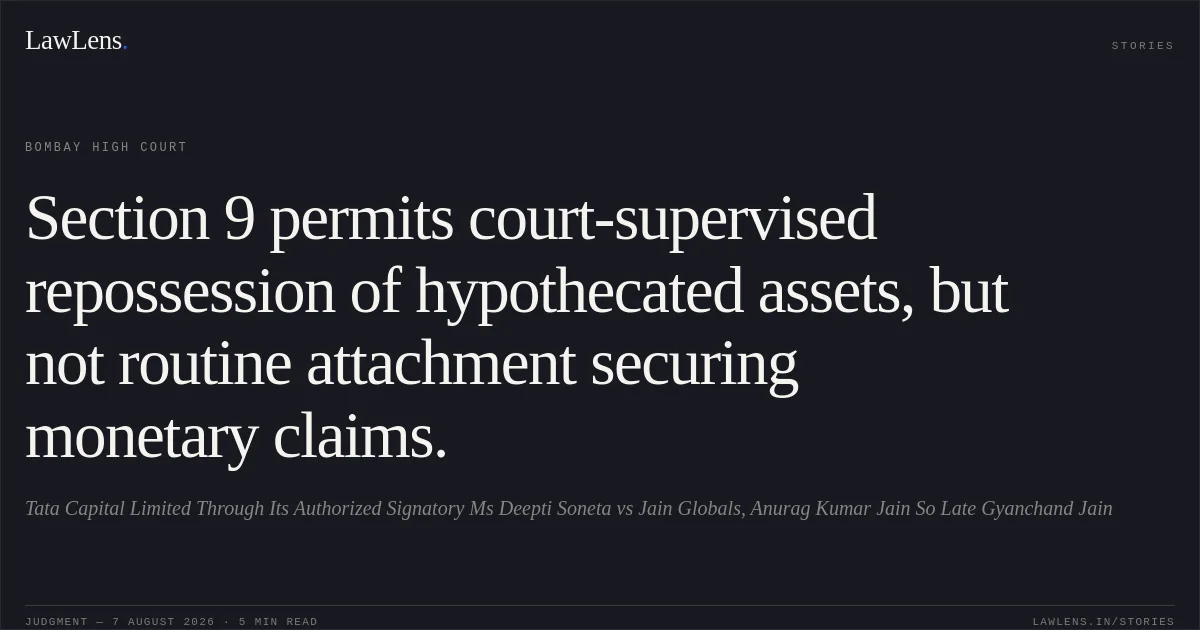
The Court applied Section 9 of the Arbitration and Conciliation Act, 1996, which empowers the Court to grant just and convenient interim measures for securing the amount in dispute, preserving the subject matter of arbitration and preventing frustration of arbitral proceedings.
Source reference: paras. 22, 24–25Relying on Essar House (P) Ltd. v. Arcellor Mittal Nippon Steel (India) Ltd., (2022) 20 SCC 178, the Court held that Section 9 proceedings are guided by equitable principles and the basic standards of prima facie case, balance of convenience and prevention of frustration, although the Court is not bound by every technical requirement of the CPC, including Order XXXVIII Rule 5.
Source reference: para. 24Relying on Sadbhav Engineering Ltd. v. Efftech Infra Engineers, 2024 SCC OnLine Guj 63, the Court held that attachment or security for a monetary claim cannot be granted routinely; there must be material showing that the arbitral proceedings may otherwise become ineffective or that preservation of the subject matter requires intervention.
Source reference: paras. 25–26, 31–32, 44The Court also relied on ICICI Bank Ltd. v. Nidhi Sharma, 2019 SCC OnLine Del 12265, for the principle that hypothecated movable assets may depreciate or become untraceable and that repossession and preservation should be supervised through appropriate safeguards.
Source reference: paras. 27, 51, 60, 72Contractually, Clauses 18.1, 18.2 and 18.5 permitted Tata Capital, upon default, to declare the dues payable, repossess and sell the hypothecated assets, require delivery of possession and seek repossession through a Court or arbitral tribunal.
Source reference: paras. 8–16, 21Reasoning
The Court found that the loan agreements, hypothecation documents, statements of account, demand notices and recall of the loan facilities established, at least prima facie, a contractual relationship, enforceable security and a subsisting arbitral dispute.
Source reference: paras. 19–23However, Section 9 relief remained discretionary and could not be used merely to secure a pre-arbitration money decree.
Source reference: paras. 22, 25The respondents’ unexplained absence and failure to disclose the location of the secured equipment justified limited disclosure orders because those orders preserved and facilitated identification of the subject matter without transferring ownership or possession.
Source reference: paras. 29–30, 46–52Disclosure of contracts under which the equipment was deployed was similarly connected with tracing and preserving the secured assets, but disclosure of all receivables, cash flows, investments and tax returns was excessive because the contractual security extended to the equipment, not demonstrably to its income streams.
Source reference: paras. 53–57The Court refused attachment or freezing of bank accounts because Tata Capital produced no material showing dissipation or diversion of funds intended to defeat the arbitral proceedings; the hypothecation clauses did not create a charge over the respondents’ bank accounts.
Source reference: paras. 31–35It also refused a bank guarantee or additional security because the hypothecated equipment remained the agreed security and there was no evidence that it had disappeared, become unavailable or become incapable of protecting Tata Capital’s interests.
Source reference: paras. 36–45Conversely, because the equipment was movable, potentially depreciating and undisclosed in location, appointment of a Receiver was necessary to preserve the contractual security.
Source reference: paras. 58–64The Receiver’s powers were confined to locating, identifying and taking possession, with inventory and preservation safeguards; sale required further judicial or arbitral permission and notice to the respondents.
Source reference: paras. 58–64A restraint against transfer or creation of third-party rights was granted as a proportionate protective measure.
Source reference: paras. 65–68Omnibus directions to all transport authorities were refused for want of material showing attempted registration changes or involvement of those authorities.
Source reference: paras. 69–70Holding
The petitions were partly allowed.
The respondents were directed, within two weeks of service, to file affidavits disclosing the present location and identifying particulars of the hypothecated construction equipment, together with details of contracts under which the equipment was deployed.
Source reference: para. 74(ii)–(iii)They were restrained, pending arbitration and until further orders, from selling, transferring, encumbering, creating third-party rights in or parting with possession of the equipment without permission of the arbitral tribunal or, before its constitution, the Court.
Source reference: para. 74(iv)The Court Receiver, High Court, Bombay, was appointed with power to locate, identify and take symbolic or physical possession of the equipment and to obtain police assistance.
Source reference: para. 74(v)–(ix)The Receiver was required to prepare inventories, record the equipment’s condition, take photographs and preserve the assets; no sale or disposal could occur without further orders after notice to the respondents.
Source reference: para. 74(v)–(ix)Relief seeking attachment or freezing of bank accounts, a bank guarantee, additional security, disclosure of receivables and cash flows, and omnibus directions to transport authorities was rejected.
Source reference: para. 74(x)–(xiv)The findings were expressly declared prima facie, and Tata Capital was directed to commence or continue arbitration in accordance with Section 9(2).
Source reference: para. 74(xv)–(xvii)There was no order as to costs.
Source reference: para. 74(xviii)Acts & Sections Cited
1 provisions across 1 statute referred to in this judgment. Linked provisions open on LawLens.
Arbitration And Conciliation Act, 19961
Original Court PDF
Tata Capital Limited Through Its Authorized Signatory Ms Deepti SonetavsJain Globals, Anurag Kumar Jain So Late Gyanchand Jain
Click to open original judgment
Original judgment, available to read, download and summarize on LawLens.in