Facts
The Petitioner and Respondent entered into an agreement for sale of a flat on 31 March 2021.
Source reference: para. 2–5After the Respondent failed to deliver possession by the agreed date, the parties executed and registered a Deed of Cancellation on 28 March 2026, under which the Respondent was to refund ₹58,97,600.
Source reference: para. 2–5The Respondent issued a post-dated cheque for that amount; it was dishonoured for “Funds Insufficient” on 1 July 2026.
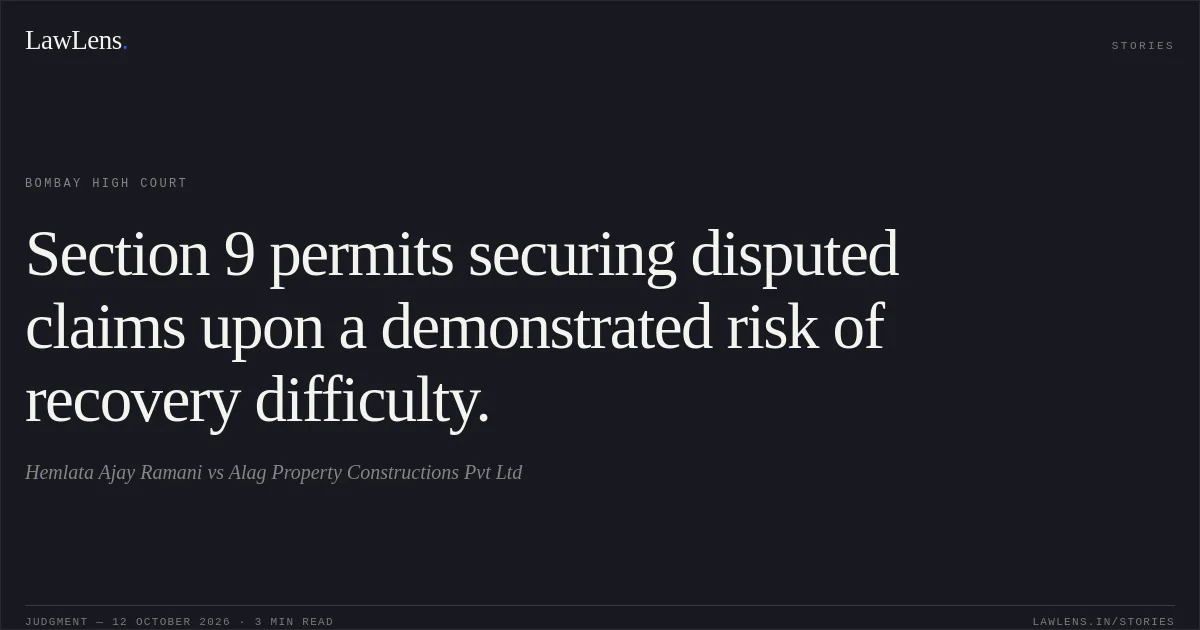
Source reference: para. 2–5The Petitioner sought, under Section 9 of the Arbitration and Conciliation Act, 1996, an interim direction requiring the Respondent to deposit the amount. She relied on the registered cancellation deed, the dishonoured cheque, and the Respondent’s other disputes and proceedings as grounds for apprehending difficulty in recovery.
Source reference: para. 6–11The Respondent disputed liability and the underlying transaction.
Source reference: para. 12–14Issues
1. Whether the Petitioner established a prima facie basis for the claimed refund under the registered Deed of Cancellation and supporting cheque.
Source reference: para. 15–202. Whether the circumstances justified an interim measure under Section 9 directing the Respondent to secure the disputed amount by deposit.
Source reference: para. 15, 21–30Law Applied
Section 9 of the Arbitration and Conciliation Act, 1996 empowers the Court to grant interim measures, including measures to secure the amount in dispute in arbitration.
Source reference: para. 21The power must be exercised judicially: a disputed monetary claim alone does not warrant security; the applicant must show circumstances establishing a genuine need to protect the efficacy or enforceability of a potential arbitral award.
Source reference: para. 21In Essar House Private Limited v. Arcellor Mittal Nippon Steel India Limited, (2022) 20 SCC 178, the Supreme Court recognised the Court’s power under Section 9 to secure the amount in dispute and held that procedural principles inform its exercise, without requiring mechanical application of every technical requirement of the CPC.
Source reference: para. 21The Court also considered the prima facie case, balance of convenience, and risk of difficulty in recovery.
Source reference: para. 22, 29–30Reasoning
The registered Deed of Cancellation recorded the refund arrangement, and the cheque for the same amount was issued in connection with it and dishonoured for insufficient funds. Although the Respondent disputed liability, it did not explain the execution of the deed or issuance of the cheque; the claim therefore had documentary support and was not merely an unsupported assertion.
Source reference: para. 16–20The Court treated the dishonour, other pending disputes and execution proceedings, and assignments of redevelopment rights as relevant circumstances when considered cumulatively, while recognising that none alone proved an intention to defeat the Petitioner’s claim or established the Respondent’s financial position.
Source reference: para. 23–26Given the resulting concern about recoverability, and because deposit would secure rather than release the money while leaving liability to the arbitral tribunal, the balance of convenience favoured requiring security.
Source reference: para. 28–30Holding
The Court partly allowed the petition under Section 9 and directed the Respondent to deposit ₹58,97,600 within four weeks.
The amount is to be kept in a fixed deposit with a nationalised bank, renewed until further orders, and is not to be released to the Petitioner at this stage.
Source reference: para. 31(i)–(ix)The parties’ rights and contentions, including the Petitioner’s claim for interest or other amounts, remain open for determination in arbitration; the Court’s observations are prima facie only.
Source reference: para. 31(i)–(ix)Acts & Sections Cited
3 provisions across 2 statutes referred to in this judgment. Each provision opens on LawLens.
Arbitration and Conciliation Act, 19961
Original Court PDF
Hemlata Ajay RamanivsAlag Property Constructions Pvt Ltd
Click to open original judgment
Original judgment, available to read, download and summarize on LawLens.in