Facts
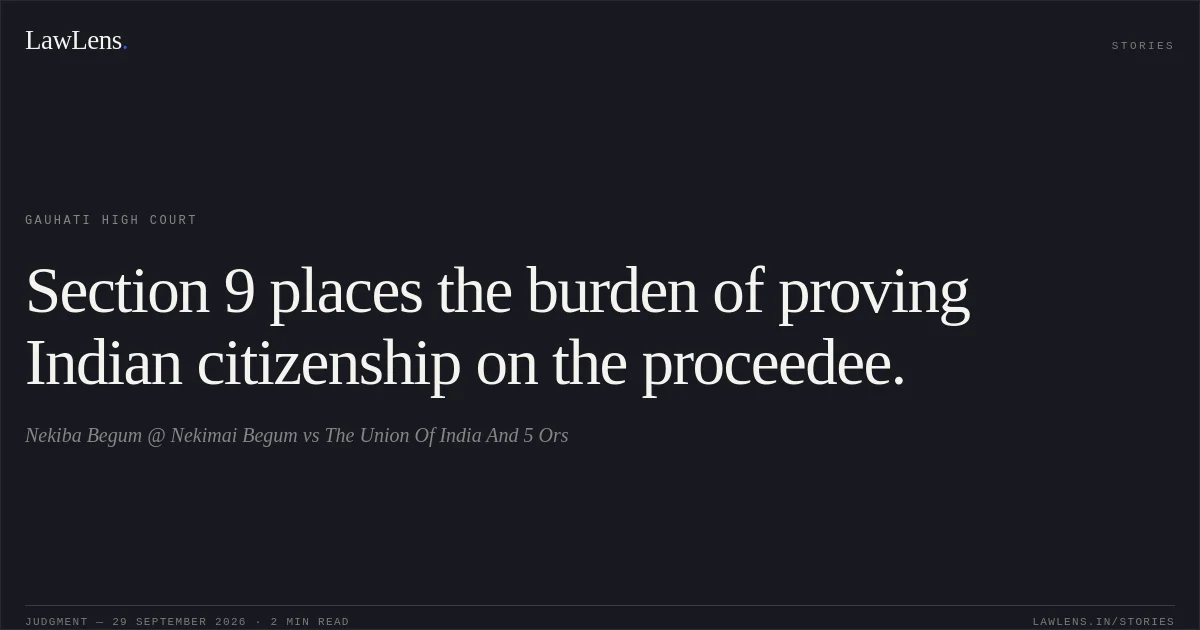
The petitioner challenged the Foreigners Tribunal, Jorhat’s opinion dated 26 May 2023 declaring her a foreigner who entered India after 25 March 1971.
Source reference: p. 3, para. 1Before the Tribunal, she relied on oral testimony, school and voter-list documents, among other materials, to establish her citizenship and her relationship to her projected parents.
Source reference: pp. 3–5, paras. 2, 4–7The High Court examined the Tribunal’s record and considered whether the opinion disclosed grounds for interference under Article 226.
Source reference: p. 3, para. 3; p. 10, para. 20Issues
Whether the petitioner discharged the burden under Section 9 of the Foreigners Act, 1946, to establish that she was not a foreigner.
Source reference: pp. 9–10, paras. 18–20Whether the Tribunal’s opinion contained an error warranting interference under the High Court’s certiorari jurisdiction under Article 226.
Source reference: pp. 10–12, paras. 20–22Law Applied
Section 9 of the Foreigners Act, 1946 places on the person concerned the burden of proving that they are not a foreigner, notwithstanding the Indian Evidence Act, 1872.
Source reference: p. 9, para. 18Sarbananda Sonowal v. Union of India, (2005) 5 SCC 665, explains that facts ordinarily relevant to establishing citizenship—including date and place of birth and the identity and citizenship of parents—are especially within the person’s knowledge.
Source reference: pp. 6, 12, paras. 10, 22Under Central Council for Research in Ayurvedic Sciences v. Bikartan Das, Civil Appeal No. 3339 of 2023, certiorari is supervisory, not appellate: the High Court does not reweigh evidence or substitute its view, but may intervene for a facial legal error or other reviewable defect.
Source reference: pp. 10–12, paras. 20–21Documentary evidence must be proved, including its contents and truthfulness, with support from relevant records where required, as stated in Narbada Devi Gupta v. Birendra Kumar Jaiswal, (2003) 8 SCC 745, and Romila Khatun v. Union of India, 2018 (4) GLT 373.
Source reference: pp. 7–8, paras. 12–13Reasoning
The Court found the written statement vague and lacking essential particulars, including the petitioner’s date of birth.
Source reference: p. 12, para. 22The school certificate was not proved by school authorities or supported by contemporaneous records; it also recorded names differing from those of the petitioner and her projected father.
Source reference: p. 13, para. 23The earlier voter lists did not establish a link between the petitioner and her projected parents, while later lists recorded her with her husband.
Source reference: p. 13, para. 23The Gaonburah certificate post-dated the Tribunal’s opinion, and the Jamabandi was not before the Tribunal.
Source reference: p. 13, para. 23The petitioner’s testimony and the additional documents did not cure these deficiencies or establish the required linkage; the additional affidavit and identity documents did not provide proof of citizenship.
Source reference: p. 14, paras. 24–26The Court therefore found no reviewable basis to disturb the Tribunal’s factual conclusion.
Source reference: pp. 10–11, 14–15, paras. 20–21, 27Holding
The High Court held that the petitioner had failed to discharge her burden of proving that she was not a foreigner and that the Tribunal’s opinion did not warrant interference.
The writ petition was dismissed, the interim order vacated, and consequential action was left to proceed in accordance with law.
Source reference: p. 15, para. 28Acts & Sections Cited
5 provisions across 3 statutes referred to in this judgment. Linked provisions open on LawLens.
Foreigners Act, 19463
Foreigners (Tribunals) Order, 19641
Citizenship Act, 19551
Original Court PDF
Nekiba Begum @ Nekimai BegumvsThe Union Of India And 5 Ors
Click to open original judgment
Original judgment, available to read, download and summarize on LawLens.in