Facts
On 9 May 2026, the parties executed a Binding Term Sheet for the Petitioner’s proposed acquisition of 100% of Respondent No. 4’s share capital, alongside an Addendum setting out specified funding obligations and pre-conditions.
Source reference: paras. 2–6; pp. 1–5The Petitioner acquired 9.5% of the shares and asserted that it advanced approximately ₹23.45 crore toward the transaction; the Respondents maintained that the advances were loans under a separate Inter-Corporate Loan Agreement.
Source reference: paras. 29, 34–38; pp. 25–32The Petitioner did not pay the additional ₹52.50 lakh instalment due by the thirtieth day under the Term Sheet.
Source reference: paras. 34–38; pp. 27–32After Respondent No. 4 issued a termination notice and sought release of escrowed shares, the Petitioner disputed the termination and applied under Section 9 of the Arbitration and Conciliation Act, 1996, for interim protection of the shares and the proposed acquisition.
Source reference: paras. 34–38, 47; pp. 27–32, 37–38Respondent No. 4 subsequently asked the Escrow Agent to maintain status quo over the escrowed shares.
Source reference: para. 47; pp. 37–38Issues
1. Whether the Term Sheet and Addendum constituted binding obligations, and what funding obligations they imposed on the parties.
Source reference: paras. 27–31, 58; pp. 24–27, 442. Whether the ₹23.45 crore advanced by the Petitioner could be treated as performance of its obligations under the Term Sheet, and whether the unpaid ₹52.50 lakh instalment affected its claim to interim relief.
Source reference: paras. 32–38; pp. 27–323. Whether the Petitioner established a sufficient basis under Section 9 for interim or ad-interim protection of the escrowed shares, the wider acquisition, and Respondent No. 4’s business and assets.
Source reference: paras. 41–60; pp. 33–46Law Applied
Section 9 of the Arbitration and Conciliation Act, 1996 empowers the Court to grant interim measures of protection in aid of arbitration; the applicant must establish that the relief sought is necessary to protect the claimed right and the subject matter of the dispute.
Source reference: paras. 42–43, 51Sections 51–54 of the Indian Contract Act, 1872, concerning reciprocal promises, were considered in assessing whether one party’s performance depended on the other’s performance; the Court treated that question as dependent on the wording and sequence of the particular contractual obligations.
Source reference: paras. 42–43, 51No judicial precedent was cited.
Source reference: no citationReasoning
The Court held that the Term Sheet was binding, but did not itself effect a completed, unconditional transfer of all shares: completion remained subject to due diligence, regulatory approvals, escrow and other pre-conditions, followed by the contemplated Definitive Agreements.
Source reference: paras. 27–29, 40, 58The Addendum did not support either the Petitioner’s claim that its total contribution was limited to ₹20 crore or the Respondents’ claim that all funding was unconditionally due; the specified contributions remained subject to their respective terms and conditions.
Source reference: paras. 29–31, 51The contemporaneous Loan Agreement and related communications supported the Respondents’ position that the ₹23.45 crore was advanced as loans, not as the ₹5 crore share purchase price.
Source reference: paras. 32–38, 50–51Separately, the ₹52.50 lakh instalment was payable by the earlier of completion of due diligence or the thirtieth day, and the Petitioner had not shown that it paid that amount by the due date; its later offer to deposit it did not establish timely performance.
Source reference: paras. 32–38, 50–51Although the parties’ performance and the validity of termination remained disputed, the Respondents’ later request to maintain status quo reduced the immediate risk to the escrowed shares.
Source reference: paras. 41–48, 56The broader requested orders would also have constrained Respondent No. 4’s corporate and operational affairs without a sufficiently established right to immediate completion or control.
Source reference: paras. 59–60Holding
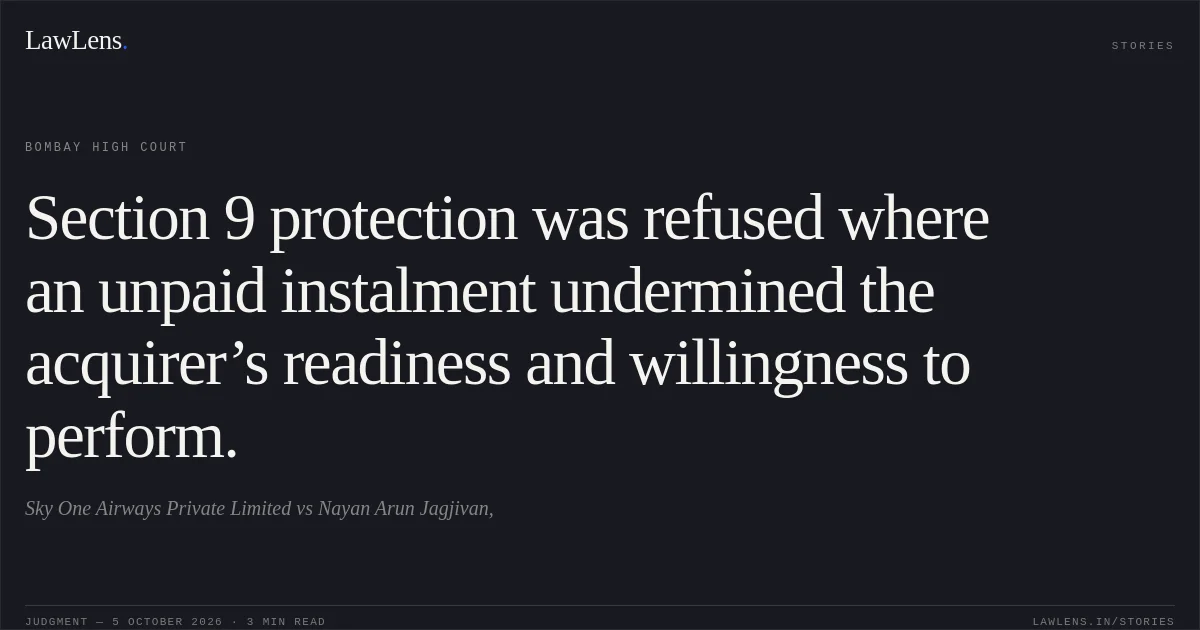
The Court dismissed the Section 9 petition.
It declined the requested restraints over the shares, company and business assets, and the mandatory directions concerning additional shares, finding that the Petitioner had not established a sufficient basis for the interim protection sought.
Source reference: paras. 59–62; pp. 45–47The Court clarified that its observations were confined to the Section 9 application, left all contentions open, and permitted the parties to seek appropriate interim or protective relief before the arbitral tribunal; there was no order as to costs.
Source reference: para. 62; p. 47Acts & Sections Cited
5 provisions across 2 statutes referred to in this judgment. Each provision opens on LawLens.
Arbitration and Conciliation Act, 19961
Indian Contract Act, 18724
Original Court PDF
Sky One Airways Private LimitedvsNayan Arun Jagjivan,
Click to open original judgment
Original judgment, available to read, download and summarize on LawLens.in