Facts
The applicant is the accused in Criminal Case No. 1573 of 2021 filed under Section 138 of the Negotiable Instruments Act
Source reference: para. 3During the cross-examination of the complainant (PW-1), the applicant moved an application under Section 91 Cr.P.C. (now Section 94 B.N.S.S.) seeking the production of specific documents mentioned by the complainant, arguing they were essential for adjudication
Source reference: para. 4The Judicial Magistrate, Kotdwar, rejected the application on 23.12.2025, a decision subsequently upheld by the Additional Sessions Judge, Pauri Garhwal, in Criminal Revision No. 04 of 2026 on 25.03.2026
Source reference: para. 3-4The applicant approached the High Court seeking the quashing of these orders
Source reference: para. 3Issues
1. Whether the trial and revisional courts erred in rejecting the application for summoning documents under Section 91 Cr.P.C./94 B.N.S.S. on the grounds that a party cannot be compelled to produce documents to aid the adversary's defense
Source reference: para. 5, 72. Whether the production of the requested documents was "necessary or desirable" for a just decision of the case under the statutory framework
Source reference: para. 8, 9Law Applied
Section 91 of the Code of Criminal Procedure, 1973 (corresponding to Section 94 of the Bharatiya Nagarik Suraksha Sanhita/B.N.S.S.), which empowers a court to issue a summons for the production of documents deemed necessary or desirable for the purposes of any investigation, inquiry, or trial
Source reference: para. 3, 8The court relied on the legal principle that while Section 91 is a discretionary power used for a "just decision," it cannot be invoked by an accused to compel a complainant to produce documents for the purpose of a "fishing enquiry" or to collect evidence to fill lacunae in the defense
Source reference: para. 6, 8Reasoning
The Court examined the concurrent findings of the lower courts, which held that the documents sought were not requisite for substantiating the applicant's defense
Source reference: para. 7The High Court reasoned that the power under Section 91 Cr.P.C./94 B.N.S.S. is not an absolute right of the accused but is contingent upon the Court’s satisfaction regarding the necessity of the documents for a just adjudication
Source reference: para. 8The Court noted that the applicant was effectively attempting to compel the complainant to produce evidence to build his own defense case, which contradicts the principle that each party must independently establish its case
Source reference: para. 5-6The Court found that the lower courts had assigned "cogent and valid reasons" and that the applicant failed to demonstrate any jurisdictional error, perversity, or illegality in the impugned orders
Source reference: para. 9Holding
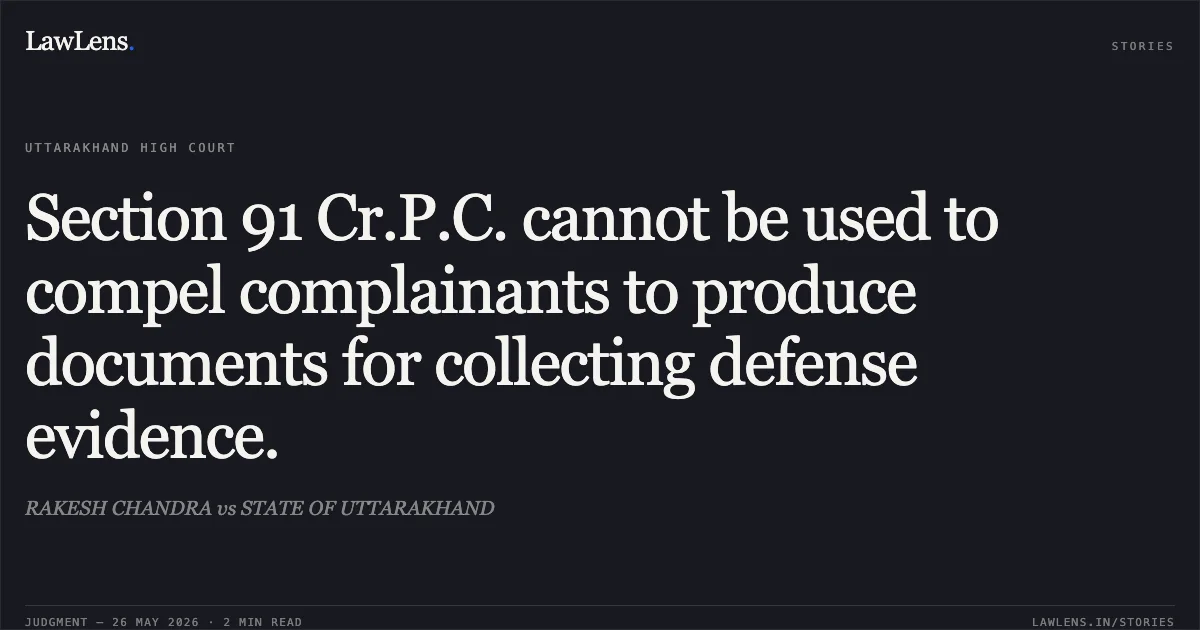
The Court held that the application under Section 91 Cr.P.C./94 B.N.S.S. cannot be used to conduct a fishing enquiry or to force a complainant to fill the gaps in an accused's defense
Finding no grounds for interference under its inherent jurisdiction, the High Court dismissed the C-528 application and affirmed the orders of the trial and revisional courts
Source reference: para. 10No order as to costs was made
Source reference: para. 11Acts & Sections Cited
3 provisions across 3 statutes referred to in this judgment. Each provision opens on LawLens.
Negotiable Instruments Act, 18811
Code of Criminal Procedure, 19731
Bharatiya Nagarik Suraksha Sanhita, 20231
Original Court PDF
RAKESH CHANDRAvsSTATE OF UTTARAKHAND
Click to open original judgment
Original judgment, available to read, download and summarize on LawLens.in


![Authorities must decide pensionary and retiral-benefit claims through a reasoned order within eight weeks.. Habibullah khan vs HOME DEPARTMENT. CAT - ['Srinagar']. LawLens](/stories/thumbnails/authorities-must-decide-pensionary-and-retiral-benefit-claims-through-a-reasoned-order-wit-d0cbe8a8119c48fbabe7df9f2d353488.webp)