Facts
The complainant alleged that officials of the Revenue Department, after accepting illegal gratification, entered the name of Bihar Vidyapeeth in the revenue records concerning land claimed by the complainant.
Source reference: para. 3–4; p. 2It was further alleged that the Halka Karmchari and Circle Officer submitted a false report and that the petitioner, a retired Bihar Administrative Service officer acting as Secretary of a society registered under the Societies Registration Act, was connected with the mutation proceedings.
Source reference: para. 3–4; p. 2The Judicial Magistrate First Class, Patna, took cognizance against the petitioner under Sections 166 and 167 of the Indian Penal Code by order dated 26 August 2016 in Complaint Case No. 487 of 2016.
Source reference: para. 2; p. 1The petitioner invoked the High Court’s jurisdiction under Section 482 of the Code of Criminal Procedure, seeking quashing of the cognizance order.
Source reference: para. 2; p. 1Issues
1. Whether cognizance could validly be taken against the petitioner under Sections 166 and 167 of the Indian Penal Code when he was not a public servant within the meaning of Section 21 of the Code
Source reference: para. 4, 8; pp. 2, 32. Whether continuation of the criminal proceedings against the petitioner amounted to vexatious or malicious prosecution and an abuse of the process of court warranting exercise of the High Court’s inherent jurisdiction
Source reference: para. 5, 8; pp. 2–3Law Applied
Sections 166 and 167 of the Indian Penal Code apply to misconduct by a person who is legally bound, or authorised, in his capacity as a public servant to perform or prepare a particular official act; consequently, the accused must fall within the definition of “public servant” under Section 21 of the Indian Penal Code.
Source reference: para. 8; p. 3The High Court also applied the principles governing quashing of criminal proceedings under Section 482 of the Code of Criminal Procedure, including the categories identified in State of Haryana v. Bhajan Lal, 1992 Supp (1) SCC 335, and the principle in Pepsi Foods Ltd. v. Special Judicial Magistrate, (1998) 5 SCC 749, that criminal proceedings may be quashed where continuation would amount to abuse of the process of court.
Source reference: para. 5; p. 2Reasoning
The Court examined the complaint’s own averment that the petitioner was a retired Bihar Administrative Service officer who had filed the mutation case as Secretary of a society registered under the Societies Registration Act.
Source reference: para. 4; p. 2Since the petitioner was not a serving public servant and did not act in a public office while undertaking the alleged acts, the essential legal requirement for offences under Sections 166 and 167 IPC was absent.
Source reference: para. 8; p. 3The Court therefore found that the Magistrate had taken cognizance without the foundational ingredients of the alleged offences being satisfied.
Source reference: para. 8; p. 3It further held that the prosecution appeared vexatious and malicious, and that permitting the proceedings to continue would constitute an abuse of the process of court.
Source reference: para. 5, 8; pp. 2–3Holding
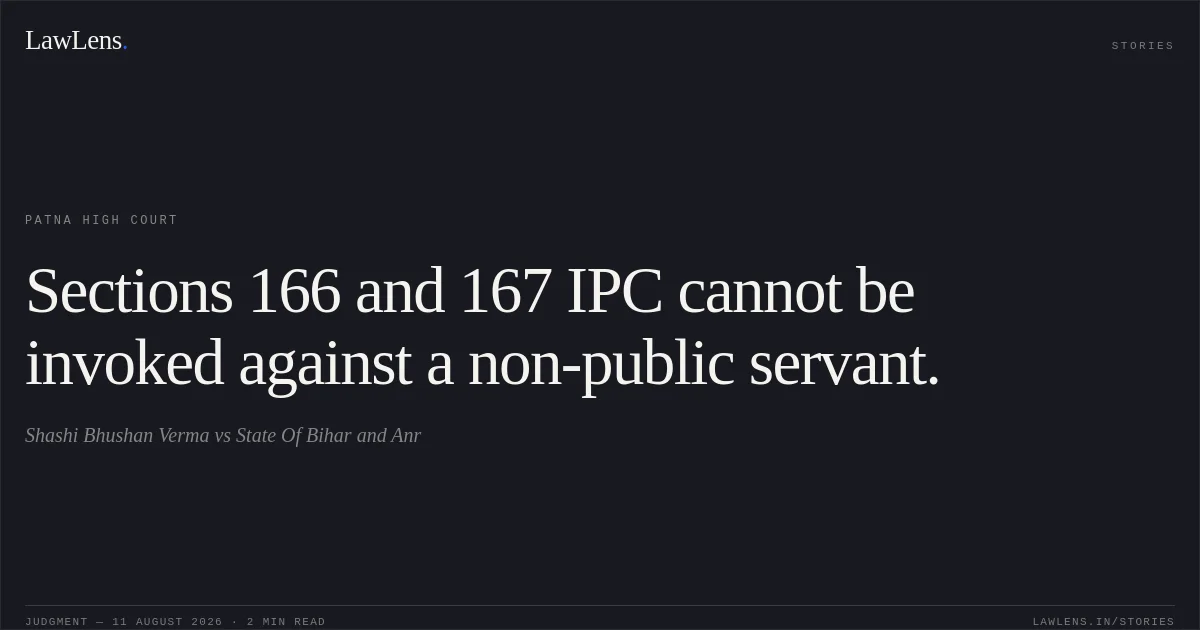
The High Court answered the principal issue in the negative: the petitioner, not being a public servant within Section 21 IPC, could not be prosecuted under Sections 166 and 167 IPC on the allegations made.
The cognizance order dated 26 August 2016 was accordingly quashed insofar as it related to the petitioner, and the criminal miscellaneous application was allowed.
Source reference: para. 8–9; p. 3Acts & Sections Cited
3 provisions across 1 statute referred to in this judgment. Each provision opens on LawLens.
Indian Penal Code, 18603
Original Court PDF
Shashi Bhushan VermavsState Of Bihar and Anr
Click to open original judgment
Original judgment, available to read, download and summarize on LawLens.in