Facts
The appellant, Managing Partner of Ashok Finance, challenged the order of the learned Single Judge in W.P.(MD) No.26553 of 2023.
Source reference: p.2; para.2Respondents 1 to 4 had sought certiorarified mandamus to quash the District Registrar’s order dated 27.09.2023 and to direct the registration and release of a document presented as pending Document No.60/2023 dated 11.05.2023.
Source reference: p.2; para.2The Sub-Registrar had issued a refusal check slip on the ground that a suit, O.S.No.907 of 2022, concerning the property was pending before the Principal Sub Court, Karur.
Source reference: p.2; para.2The appellant contended that the property document had been pledged as security for money advanced by him and that the dispute involved questions of fact requiring adjudication by the civil court.
Source reference: p.3; para.3The District Registrar declined to interfere with the Sub-Registrar’s decision.
Source reference: p.3; para.4The learned Single Judge held that the Registration Department could not refuse registration of a lawfully executed document merely because a creditor objected, and directed registration.
Source reference: p.3; para.4The learned Single Judge also directed the civil court to dispose of the appellant’s application under Order XXXVIII Rule 5 of the Code of Civil Procedure for attachment before judgment.
Source reference: pp.3–4; paras.4–5The civil court subsequently accepted another property as security, thereby protecting the appellant’s interests.
Source reference: p.4; para.5In the writ appeal, the appellant additionally alleged that the respondents had falsely represented that the document was missing, despite it being in the appellant’s possession, and had obtained a police non-traceable certificate.
Source reference: p.4; para.6Issues
Whether the Registration Department could refuse registration of the document merely because a civil suit concerning the property was pending and the appellant, as creditor, objected to the transaction?
Source reference: pp.2–4; paras.2–5Whether the alleged false representation regarding the missing document warranted action under Sections 82 and 83 of the Registration Act in proceedings under Article 226 of the Constitution?
Source reference: pp.4–6; paras.6–10Whether the order of the learned Single Judge directing registration of the document required interference in the writ appeal?
Source reference: p.6; paras.10–11Law Applied
The Court applied the principle that the Registering Authority is not entitled to adjudicate disputed questions of title, pledge, liability, or other complex questions of fact arising from a civil dispute; such matters must be decided by the competent civil court.
Source reference: p.3; para.3It accepted the learned Single Judge’s view that an objection by a creditor does not, by itself, authorise the Registration Department to refuse registration of a lawfully executed document.
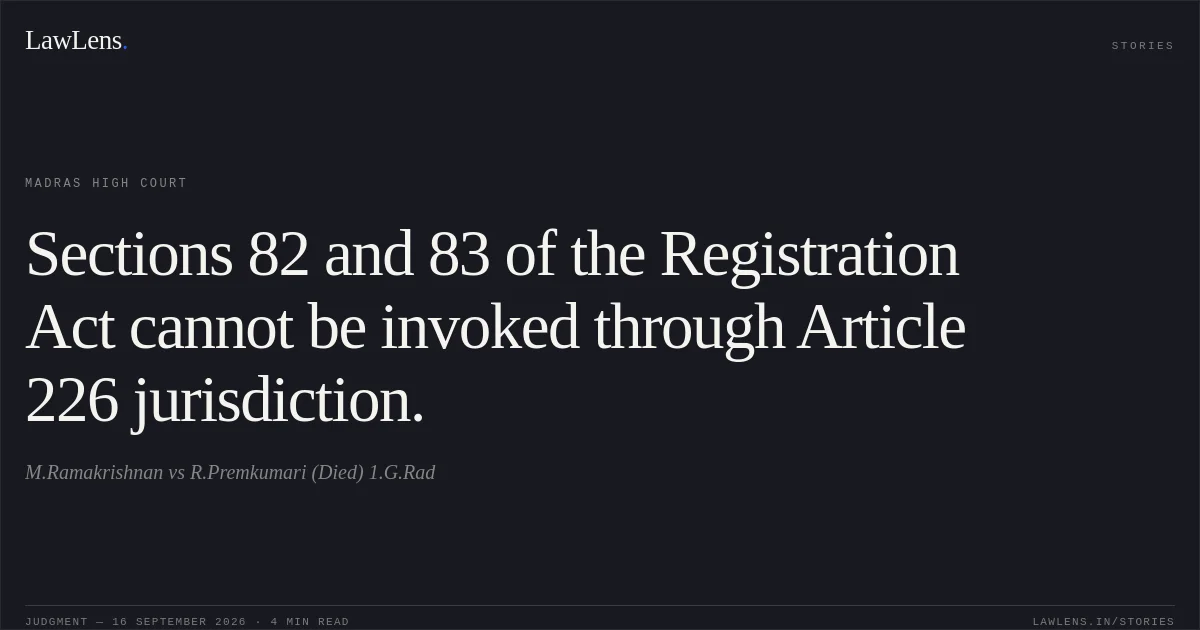
Source reference: p.3; para.4The Court also considered Sections 82 and 83 of the Registration Act, which contemplate penal and investigative proceedings in relation to offences connected with registration, but held that those provisions could not be invoked by the High Court itself, exercising writ jurisdiction under Article 226, in the absence of a complaint or registered FIR.
Source reference: pp.5–6; paras.7–10The decision in Navin Kumar Rai v. Surendra Singh, 2024 SCC OnLine SC 145, was distinguished because it arose from proceedings concerning the quashing of an FIR under Section 482 of the Code of Criminal Procedure, where an investigation into the alleged fraud was already underway.
Source reference: p.5; para.8The Court further relied on the fact that the appellant’s financial interests had been protected through security furnished in the civil proceedings.
Source reference: pp.4, 6; paras.5, 10Reasoning
The Court held that the appellant’s contention that the property document had been pledged as security raised a disputed factual issue concerning the underlying loan transaction and could not be conclusively determined by the Registration Authorities or in writ proceedings.
Source reference: p.3; para.3The pendency of the recovery suit and the creditor’s objection therefore did not constitute a valid basis to refuse registration of the document.
Source reference: p.3; para.3The appellant’s interests had also been adequately safeguarded because the civil court had considered his application under Order XXXVIII Rule 5 CPC and accepted another property as security.
Source reference: p.4; para.5Although the appellant alleged that the respondents had made a false statement regarding the missing document, the Court noted that no complaint had been lodged and no FIR had been registered.
Source reference: p.5; para.9Consequently, the statutory procedure under Sections 82 and 83 of the Registration Act could not be initiated or directed by the High Court merely while exercising jurisdiction under Article 226.
Source reference: p.6; para.10Since the factual and financial concerns raised by the appellant were either matters for the civil court or were otherwise protected, no ground existed to interfere with the Single Judge’s order.
Source reference: p.6; para.10Holding
The Division Bench answered the issues against the appellant.
It held that the Registration Authorities could not refuse registration solely on the basis of the pending civil suit or the creditor’s objection, and that Sections 82 and 83 of the Registration Act could not be invoked in the writ proceedings in the absence of a complaint or FIR.
Source reference: p.6; paras.9–10Finding that the appellant’s interests were sufficiently protected by the security furnished before the civil court, the Court dismissed the writ appeal and closed the connected miscellaneous petition, with no order as to costs.
Source reference: p.6; para.11Acts & Sections Cited
4 provisions across 3 statutes referred to in this judgment. Each provision opens on LawLens.
Transfer of Property Act, 18821
Registration Act, 19082
Code of Criminal Procedure, 19731
Original Court PDF
M.RamakrishnanvsR.Premkumari (Died) 1.G.Rad
Click to open original judgment
Original judgment, available to read, download and summarize on LawLens.in