Facts
The Petitioners, lab contractors and businessmen, were implicated in a corruption case involving the Food Corporation of India (FCI)
Source reference: p. 2During search operations between 05.03.2025 and 07.03.2025, the CBI seized 19 documents, six mobile phones, a laptop, and locker keys from them
Source reference: p. 2The Trial Court (Special Judge, CBI) ordered the release of these articles on 09.01.2026 and accepted indemnity bonds on 11.02.2026
Source reference: p. 3Despite these orders, the CBI failed to return the items, orally advising the Petitioners to travel from Bargarh to New Delhi to collect them
Source reference: p. 4The Petitioners approached the High Court seeking enforcement of the release orders, citing financial hardship and the risk of damage to the electronic devices
Source reference: p. 5The CBI opposed the release, arguing that the investigation was at a nascent stage and that the devices contained vital evidence linked to illegal money parking
Source reference: p. 7-8Issues
1. Whether the Investigating Agency can justify the continued retention of seized electronic devices after a competent Trial Court has directed their release and the necessary data has presumably been preserved
Source reference: p. 10/122. Whether the insistence by the CBI for the Petitioners to travel to New Delhi for the release of property seized within the jurisdiction of the local Trial Court is arbitrary and oppressive
Source reference: p. 4/6Law Applied
The court primarily applied Section 482 of the Code of Criminal Procedure (mirrored by Section 528 of the Bharatiya Nagarik Suraksha Sanhita) regarding the inherent powers of the High Court to prevent abuse of the process of law
Source reference: p. 1, 10The principle established in CBI v. Saroj Kumar Das (2026), which dictates that seized property should not be retained longer than absolutely necessary and should be released upon securing evidentiary value (e.g., hash values/data extraction) to avoid undue hardship
Source reference: p. 11-12The Court further referenced the CBI Manual and the Information Technology Act, emphasizing the use of "hash values" to maintain the integrity of digital evidence while allowing the return of physical hardware
Source reference: p. 11Reasoning
The Court balanced the State's investigative powers against the individual’s right to property and livelihood
Source reference: p. 10It observed that the CBI had already had ample time to extract and preserve digital data, thereby securing the evidentiary value of the devices through hash values
Source reference: p. 5, 11The Court reasoned that since the substantial part of the investigation regarding the data was completed, the hardware served no further immediate purpose for the prosecution
Source reference: p. 5, 13It criticized the CBI's failure to comply with the Trial Court's orders as arbitrary and noted that forcing senior citizens to travel to New Delhi for property release was an unreasonable burden
Source reference: p. 6, 12The Court concluded that continued retention would cause "irreparable prejudice" and "permanent damage" to the electronics without advancing the cause of justice
Source reference: p. 5, 12Holding
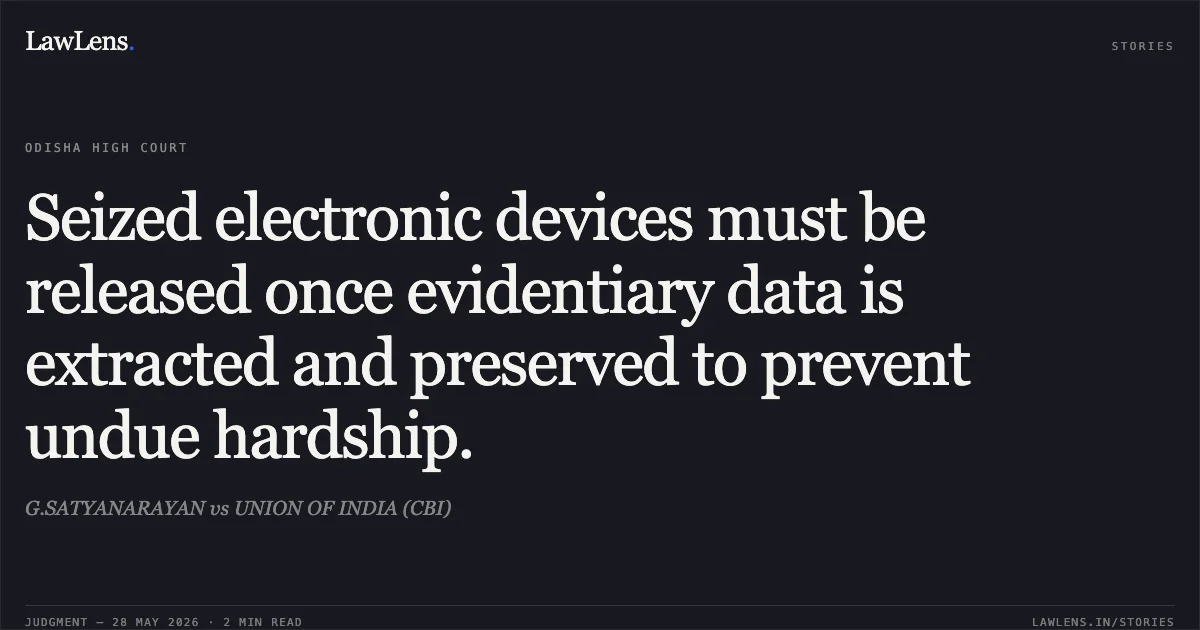
The Court allowed the petition
The Court held that the prolonged retention of the articles was arbitrary and lacked compelling justification
Source reference: p. 12The Court directed the immediate release of the seized mobile phones, laptops, and locker keys to the Petitioners
Source reference: p. 13This release is subject to stringent conditions to ensure the items are produced if required during the trial, and all prior interim orders were vacated
Source reference: p. 13Acts & Sections Cited
9 provisions across 3 statutes referred to in this judgment. Each provision opens on LawLens.
Code of Criminal Procedure, 19731
Bharatiya Nagarik Suraksha Sanhita, 20233
Prevention of Corruption Act, 19885
Original Court PDF
G.SATYANARAYANvsUNION OF INDIA (CBI)
Click to open original judgment
Original judgment, available to read, download and summarize on LawLens.in


![Subsequent exoneration does not retrospectively invalidate a finalized promotion select list.. UNNIKRISHNAN M vs M/o Environment And Forests. CAT - ['Ernakulam']. LawLens](/stories/thumbnails/subsequent-exoneration-does-not-retrospectively-invalidate-a-finalized-promotion-select-li-ce80a0e84f2f4887857271e8b4341c42.webp)