Facts
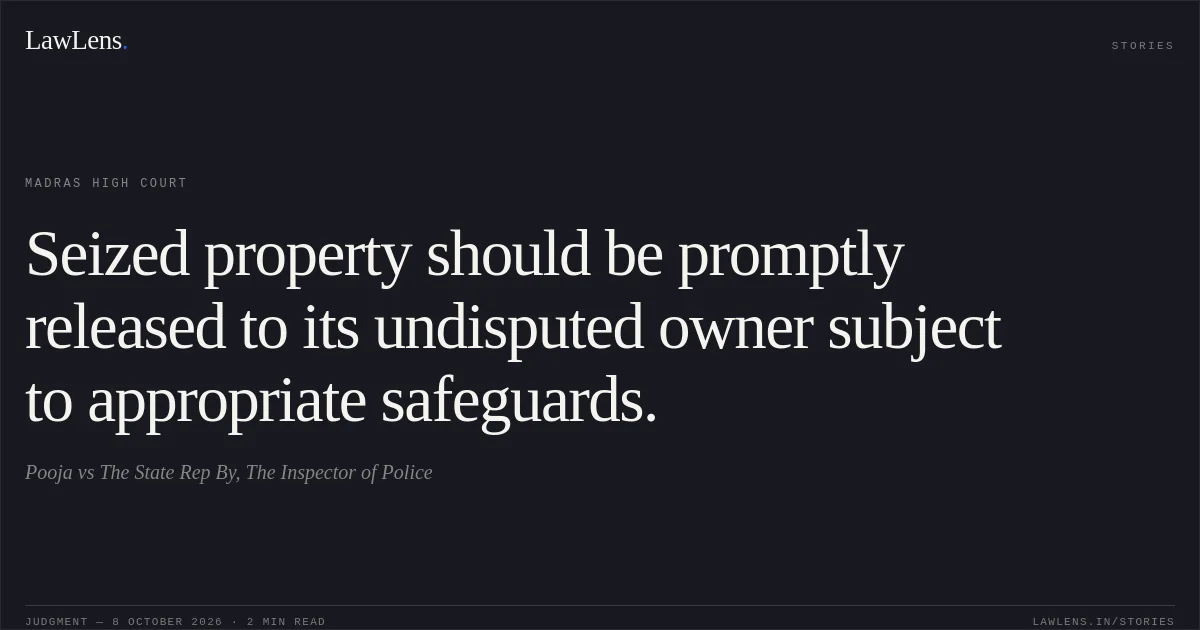
The petitioner claimed ownership of a Samsung Z Fold 7 mobile phone seized by the respondent police in Crime No. 164 of 2026, registered for offences under Sections 189(2) and 292 of the Bharatiya Nyaya Sanhita, 2023, read with Section 41(b) of the Tamil Nadu City Police Act.
Source reference: p. 2, para. 2After the Judicial Magistrate No. I, Alandur, dismissed her application for return of the phone on 29 July 2026, she filed this criminal revision seeking to set aside that order and obtain its release.
Source reference: p. 1; p. 2, para. 2The petitioner relied on her undisputed ownership and the risk of deterioration while the phone remained in custody; the State opposed release on the ground that the phone was connected with the alleged offences.
Source reference: pp. 2–5, paras. 4–8Issues
Whether the Magistrate’s refusal to release the seized mobile phone was sustainable where the petitioner’s ownership was undisputed.
Source reference: pp. 2, 5–7, paras. 4, 7, 13–16Whether the phone should be released to the petitioner subject to conditions to secure its production during proceedings.
Source reference: pp. 3–4, para. 7; p. 8, para. 18Law Applied
Section 497 of the Bharatiya Nagarik Suraksha Sanhita, 2023 empowers a criminal court to make appropriate orders for custody of property pending inquiry or trial and provides for its documentation and disposal; Section 503 permits a Magistrate to order disposal or delivery of seized property to the person entitled to possession when it has not been produced before a criminal court.
Source reference: pp. 3–4, para. 6Relying on Sunderbhai Ambalal Desai v. State of Gujarat, AIR 2003 SC 638, the Court reiterated that seized property should not be kept in custody unnecessarily and may be released on appropriate bonds, guarantees, or security to ensure its return when required.
Source reference: p. 5, para. 10The Court also referred to Nand v. State of U.P., Jai Prakash v. State of U.P., and Kamaljeet Singh v. State of U.P. for the proposition that pending proceedings concerning seized property do not, by themselves, bar release on suitable conditions.
Source reference: pp. 6–7, paras. 11–12Reasoning
The Court considered the petitioner’s ownership undisputed and noted that neither the State nor another person claimed ownership of the phone.
Source reference: pp. 6–7, paras. 13–15It concluded that continued retention would serve no useful purpose and could cause the property to deteriorate, while release could be safeguarded by requiring a guarantee and an undertaking to produce the phone when required and not to alter it.
Source reference: pp. 5–7, paras. 10, 13–15On that basis, it held that the Magistrate’s refusal to release the phone was unsustainable.
Source reference: p. 8, paras. 16–17Holding
The revision was allowed, and the Magistrate’s order dated 29 July 2026 was set aside.
The Magistrate was directed to release the phone to the petitioner upon her furnishing a bank guarantee of ₹2,000 and a bond undertaking to produce it whenever required and not to make any changes or variations to it.
Source reference: p. 8, para. 18No order as to costs was made.
Source reference: p. 8, para. 18Acts & Sections Cited
5 provisions across 3 statutes referred to in this judgment. Each provision opens on LawLens.
Bharatiya Nyaya Sanhita, 20232
Bharatiya Nagarik Suraksha Sanhita, 20232
Code of Criminal Procedure, 19731
Original Court PDF
PoojavsThe State Rep By, The Inspector of Police
Click to open original judgment
Original judgment, available to read, download and summarize on LawLens.in