Facts
The eleven applicants applied for the posts of Majdoor, Fireman, and Messenger at the Central Ordnance Depot (COD), Kanpur, following a vacancy release in 1996.
Source reference: p. 2-3After their selection in 1997, complaints regarding recruitment irregularities led the Army Headquarters to stay the appointments in May 1998.
Source reference: p. 2-3Previous litigation (O.A. 917/1998) was dismissed by the Tribunal in 2000, a decision later upheld by the Allahabad High Court (2011) and the Supreme Court (2015), on the grounds that a Staff Court of Inquiry had found the selection process tainted by gross procedural lapses.
Source reference: p. 3-4, 7-8In 2016, the respondents issued a fresh notification to fill current vacancies.
Source reference: p. 5The applicants challenged this notification, seeking appointment based on their 1997 selection, citing a 2005 internal recommendation letter (discovered via RTI) that suggested appointments be given on humanitarian grounds since the candidates were not at fault.
Source reference: p. 5, 11Issues
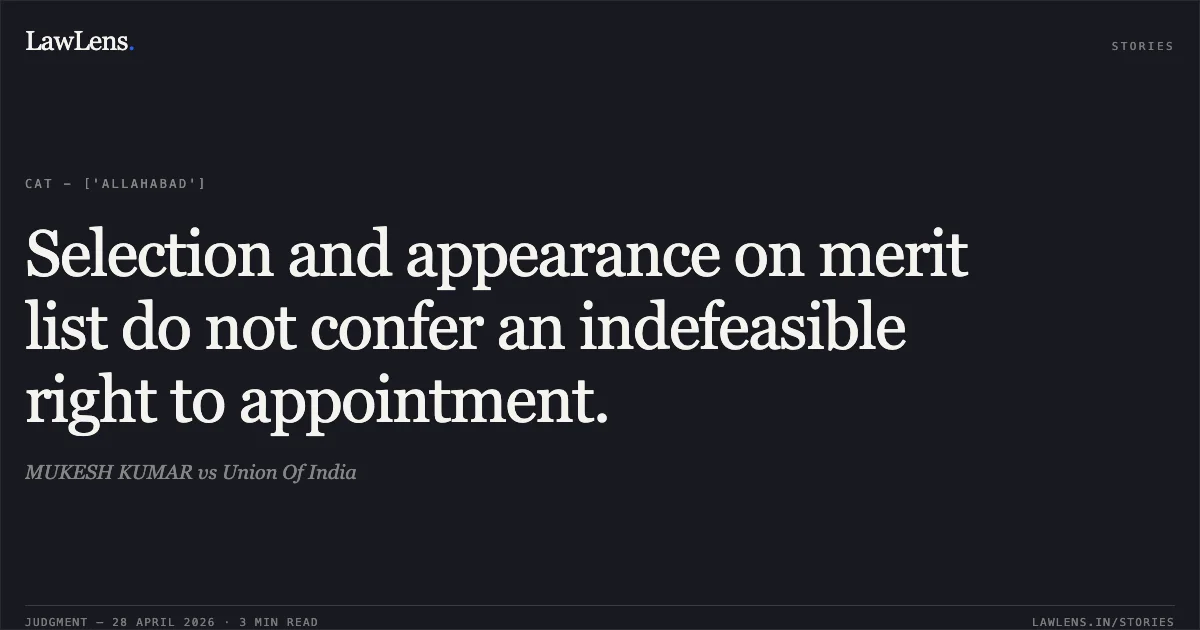
1. Whether the applicants acquired an indefeasible right to appointment by virtue of their name appearing on the 1997 merit list
Source reference: p. 112. Whether the fresh recruitment notification dated 22-04-2016 is liable to be quashed in light of the previous selection process
Source reference: p. 183. Whether the recommendation for appointment in the internal letter dated 18-05-2005 constitutes a binding directory order
Source reference: p. 11Law Applied
The Tribunal applied the settled legal principle that mere selection does not confer a vested or indefeasible right to appointment, as established in Union Territory of Chandigarh v. Dilbagh Singh
Source reference: p. 7Shankarsan Dash v. Union of India. The court emphasized that while the State cannot act arbitrarily, it has the bona fide right to refuse appointments if the selection process is found to be tainted or due to administrative exigencies like downsizing.
Source reference: p. 12, 16Doctrine of Legitimate Expectation does not apply where the recruitment process is compromised by procedural irregularities and lacks transparency.
Source reference: p. 15, 16Reasoning
The Tribunal reasoned that the 1997 selection process was fundamentally flawed, as the Staff Court of Inquiry found "too many procedural mistakes," including marking with pencils, destruction of original mark sheets, and lack of transparency.
Source reference: p. 9, 11The court noted that although some officers were later promoted or exonerated of "bribery," the selection process itself was never declared "fair".
Source reference: p. 10-11Respecting the findings of the Allahabad High Court and the Supreme Court in previous rounds of litigation, the Tribunal held that the applicants cannot claim a right to 20-year-old vacancies that were subsequently curtailed due to modernization and manpower cuts.
Source reference: p. 8Regarding the 2005 RTI document, the Tribunal clarified that the letter was a mere "recommendation" and not a final direction for appointment.
Source reference: p. 11Furthermore, the 2016 notification pertained to new vacancies and could not be stalled based on a defunct 1997 process.
Source reference: p. 18Holding
The Tribunal dismissed the Original Application, holding that the applicants have no legal or vested right to seek appointment based on a tainted selection process from 1997.
It ruled that the respondents acted within their authority to issue a fresh recruitment notification for current vacancies. The Tribunal concluded that the internal recommendation of 2005 did not override the judicial findings of the High Court and Supreme Court regarding the irregularities in the original selection. No costs were awarded, and the previous interim stay was vacated.
Source reference: p. 11, 18Acts & Sections Cited
1 provisions across 1 statute referred to in this judgment. Each provision opens on LawLens.
Administrative Tribunals Act, 19851
Original Court PDF
MUKESH KUMARvsUnion Of India
Click to open original judgment
Original judgment, available to read, download and summarize on LawLens.in