01Facts
The petitioner, a First Division Assistant/store keeper, handed over charge of the stores to J.B. Jakathi in November 1985.
¶ 3–4Jakathi reported a shortage of materials about ten months later, although paragraph 60 of the PWD Manual required deficiencies to be reported within a reasonable period of six months.
¶ 7–8The department initially ordered monthly recovery from the petitioner without notice or an inquiry; the Tribunal set that recovery aside.
¶ 8A charge sheet concerning the 1985 shortage was issued in 1996.
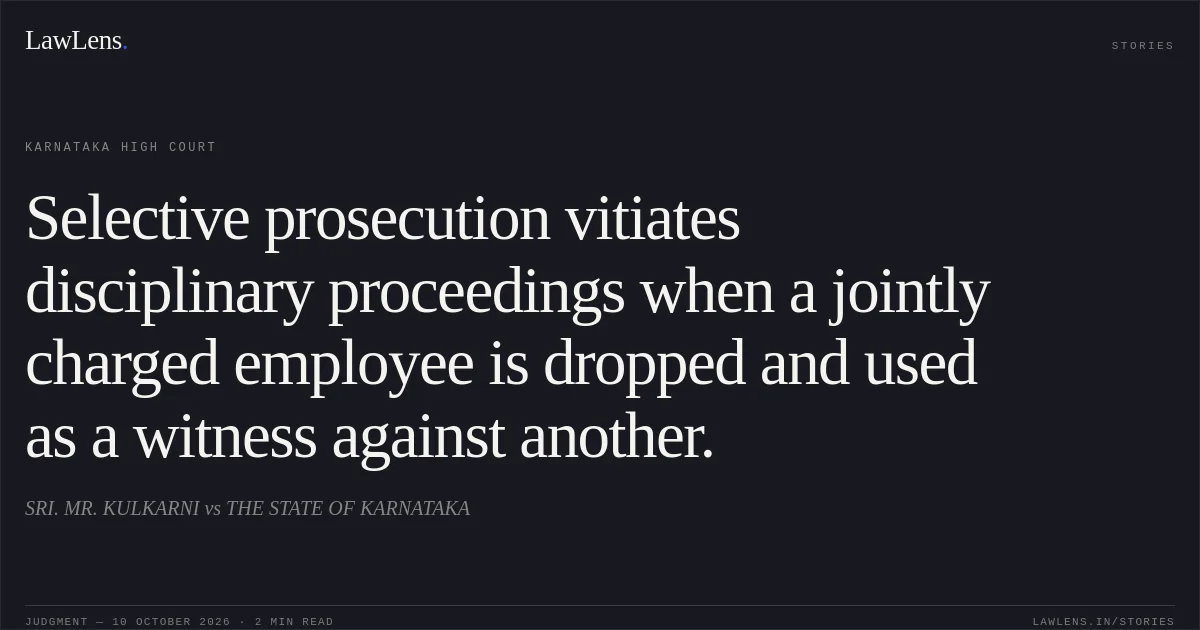
¶ 4, 7–8Although a joint inquiry had been ordered against the petitioner and Jakathi, proceedings against Jakathi were dropped, and he was later examined as a witness against the petitioner.
¶ 9–10The inquiry resulted in recovery of the alleged shortage and reduction in rank. The Tribunal rejected the petitioner’s challenge in 2016, leading to this writ petition.
¶ 3–4, 9–1002Issues
i.Whether the disciplinary proceedings and resulting penalty were sustainable where the charge sheet was issued approximately eleven years after the alleged shortage and the successor did not report the deficiency within the period contemplated by the PWD Manual.
¶ 4, 7–8, 11ii.Whether the inquiry was vitiated by dropping proceedings against Jakathi, who had been a co-accused, and then relying on his evidence against the petitioner.
¶ 9–1203Law Applied
Paragraph 60 of the PWD Manual provides that a relieving officer who does not report a deficiency in stores within a reasonable period of six months may be held responsible for it, insofar as it was ascertainable.
¶ 7The judgment also refers to Rule 11 of the CCA Rules in recounting the Tribunal’s earlier order, which required the inquiry to conform to natural justice and the applicable procedure.
¶ 8The penalty order invoked Rules 8(iv) and 8(v) of the Karnataka Civil Services (Classification, Control and Appeal) Rules, 1957, concerning recovery and reduction in rank.
¶ 9The Court applied the principles of natural justice and held that selective departmental action, in the circumstances of this case, could not be sustained.
¶ 11–1204Reasoning
The Court considered the delay in reporting the shortage and in issuing the charge sheet, noting that the deficiency was reported outside the six-month period stated in the PWD Manual and that proceedings began about eleven years after the alleged incident.
¶ 7–8, 11It further found that Jakathi had initially been included in the joint inquiry but was dropped, while later being used as a witness against the petitioner.
¶ 9–12In the Court’s view, proceeding against the petitioner alone on a shortage for which Jakathi had also been proceeded against, and relying on Jakathi’s evidence, amounted in the circumstances to selective action contrary to natural justice.
¶ 9–12The Tribunal therefore erred in rejecting the petitioner’s challenge.
¶ 9–1205Holding
The High Court allowed the writ petition, set aside the Tribunal’s order dated 31 May 2016, and quashed the penalty imposed on the petitioner.
¶ 13It directed that he receive consequential benefits, including refund of amounts recovered and restoration to the post of Superintendent.
¶ 13The respondents were directed to implement the order within eight weeks of receiving a copy.
¶ 13Original Court PDF
SRI. MR. KULKARNIvsTHE STATE OF KARNATAKA
Click to open original judgment
Original judgment, available to read, download and summarize on LawLens.in