Facts
The appellant, injured in a motorcycle collision on 8 January 2019, claimed compensation under Section 166 of the Motor Vehicles Act, 1988, alleging that the accident was caused by the offending motorcycle rider’s negligence.
Source reference: pp. 2–8He asserted that he was a commercial driver earning ₹20,000 per month and sustained, among other injuries, a brachial plexus injury.
Source reference: pp. 2–8The Tribunal assessed his notional income at ₹14,000 per month, functional disability at 50%, and awarded ₹19,51,083 with interest at 6% per annum.
Source reference: pp. 2–8He appealed seeking enhancement, including recognition of greater functional disability and addition of future prospects.
Source reference: pp. 2–8Issues
1. Whether the Tribunal correctly assessed the appellant’s monthly income and functional disability for calculating loss of future earnings.
Source reference: pp. 10–132. Whether the appellant was entitled to an addition for future prospects and enhanced compensation under other heads.
Source reference: pp. 13–16Law Applied
A claim for compensation for bodily injury is maintainable under Section 166 of the Motor Vehicles Act, 1988, and an appeal against the Tribunal’s award lies under Section 173(1).
Source reference: pp. 2, 4Under Raj Kumar v. Ajay Kumar [(2011) 1 SCC 343], physical disability of a limb cannot automatically be treated as equivalent to the same percentage of whole-body functional disability; the effect on the claimant’s actual earning capacity, having regard to their occupation, must be assessed.
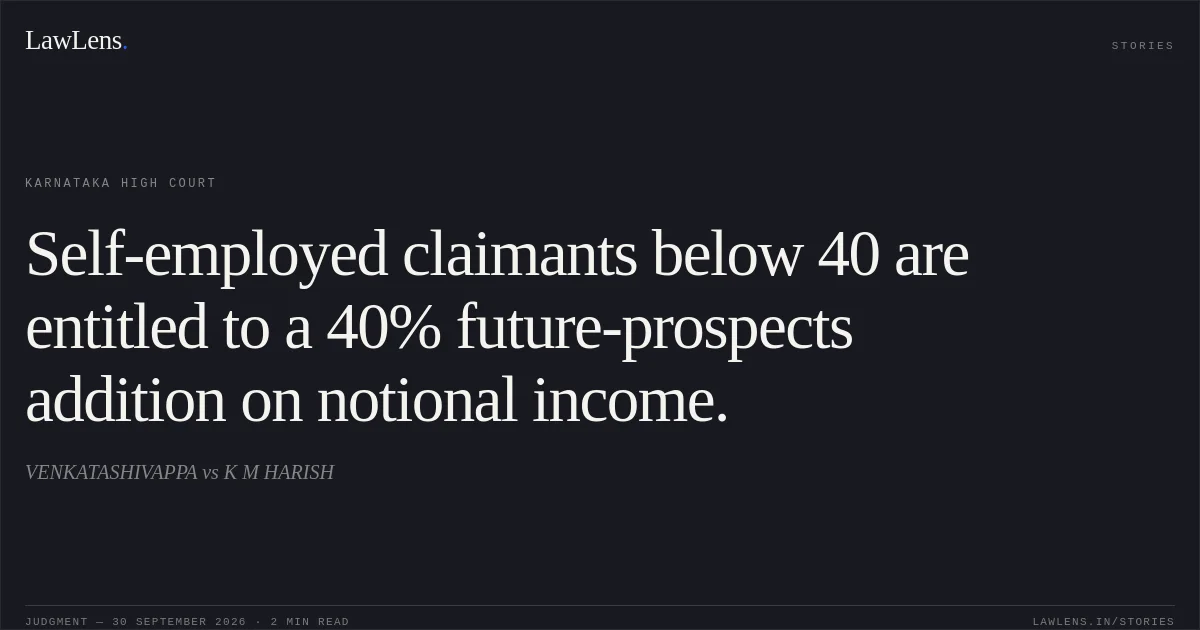
Source reference: pp. 12–13Under National Insurance Co. Ltd. v. Pranay Sethi [(2017) 16 SCC 680], a self-employed person or a person on fixed/notional income below 40 years is entitled to a 40% addition for future prospects.
Source reference: pp. 13–14The Court also relied on the KSLSA notional-income guidelines applicable to the accident date.
Source reference: p. 11Reasoning
The Court declined to increase the monthly income because the appellant produced no documentary proof of earnings; his driving licence established his competence to drive, not his income.
Source reference: p. 11It therefore affirmed the Tribunal’s use of the KSLSA chart to fix income at ₹14,000 per month.
Source reference: p. 11It also upheld the 50% whole-body functional disability assessment, reasoning that the 100% disability of the right upper limb could not, by itself, establish 100% functional disability, and found the Tribunal had appropriately considered the appellant’s occupation as a driver and the medical evidence.
Source reference: pp. 12–13However, because the appellant was 26 and his income was treated as fixed/notional, the Court held that Pranay Sethi required a 40% addition for future prospects.
Source reference: pp. 13–14Applying that addition, the multiplier of 17, and 50% functional disability, it calculated loss of future earnings at ₹19,99,200.
Source reference: pp. 13–15It found no basis to alter the other compensation heads or the 6% interest rate.
Source reference: p. 15Holding
The appeal was partly allowed.
The Court enhanced total compensation from ₹19,51,083 to ₹25,22,283, an increase of ₹5,71,200, with interest at 6% per annum from the date of the petition until realization.
Source reference: pp. 16–17The insurer was directed to deposit the enhanced compensation within six weeks of receiving the certified copy of the order; the owner and insurer remained jointly and severally liable.
Source reference: pp. 16–17Acts & Sections Cited
3 provisions across 1 statute referred to in this judgment. Each provision opens on LawLens.
Motor Vehicles Act, 19883
Original Court PDF
VENKATASHIVAPPAvsK M HARISH
Click to open original judgment
Original judgment, available to read, download and summarize on LawLens.in