01Facts
The parties settled a specific-performance suit by compromise decree.
¶ 3–4Under its terms, the defendant was to pay the plaintiff ₹15,00,000 by Ugadi 2021; upon default, the plaintiff could seek registration of the sale deed through the court and obtain possession of the suit land.
¶ 3–4, 12–13After the defendant failed to pay, the plaintiff commenced execution proceedings and sought appointment of a Court Commissioner to take steps to clear an encumbrance and facilitate execution of the sale deed.
¶ 5The Bank confirmed that the loan secured on the land had been fully repaid, while the Sub-Registrar stated that the mortgagor’s presence was required to register the reconveyance.
¶ 14The Executing Court directed the decree holder to produce the reconveyance deed or encumbrance clearance before it would consider appointing a Commissioner.
¶ 15The decree holder challenged that order by writ petition.
¶ 1, 7–1002Issues
i.1. Whether the Executing Court could make production of a reconveyance deed or encumbrance clearance a precondition to considering appointment of a Court Commissioner, when obtaining that reconveyance required the defaulting judgment debtor’s participation.
¶ 16–18ii.2. Whether the Executing Court should appoint a Court Commissioner to take the necessary steps to clear the encumbrance and give effect to the compromise decree.
¶ 17–1803Law Applied
The Court relied on Order XXI Rules 32(5) and 34 of the Code of Civil Procedure, 1908, observing that where a judgment debtor fails to perform an act required by a decree, the executing court may cause that act to be performed through a person appointed by it.
¶ 17The application before the Executing Court was made under Order XXVI Rule 18-A read with Section 151 CPC; the High Court allowed it and directed appointment of a Commissioner for the necessary acts to clear the encumbrance.
¶ 5, 18No precedent was cited.
Provisions in the judgment · 1 · Linked ones open on LawLens
Code of Civil Procedure, 1908 Section 151
04Reasoning
The Bank’s report established that the secured loan had been discharged, and the Sub-Registrar’s endorsement showed that the judgment debtor’s presence was necessary to register the reconveyance.
¶ 14The judgment debtor had nevertheless remained absent in the execution proceedings.
¶ 16–17In these circumstances, requiring the decree holder to produce a reconveyance that depended on the judgment debtor’s cooperation would make the compromise decree effectively incapable of execution and reward the judgment debtor’s default.
¶ 16–17The Executing Court should instead have used its execution powers to enable the required steps to be taken through a Court Commissioner.
¶ 1705Holding
The High Court held that the Executing Court erred in making production of the reconveyance deed or encumbrance clearance a condition precedent to considering appointment of a Commissioner.
¶ 18It allowed the writ petition, set aside the order dated 3 April 2025, and allowed I.A. No. 3.
¶ 18The Executing Court was directed to appoint a Court Commissioner to take the necessary steps with HDFC Bank, the Sub-Registrar, and any other competent authority to clear the encumbrance over the suit property; it was also requested to dispose of the execution proceedings expeditiously.
¶ 18No order as to costs.
¶ 18Original Court PDF
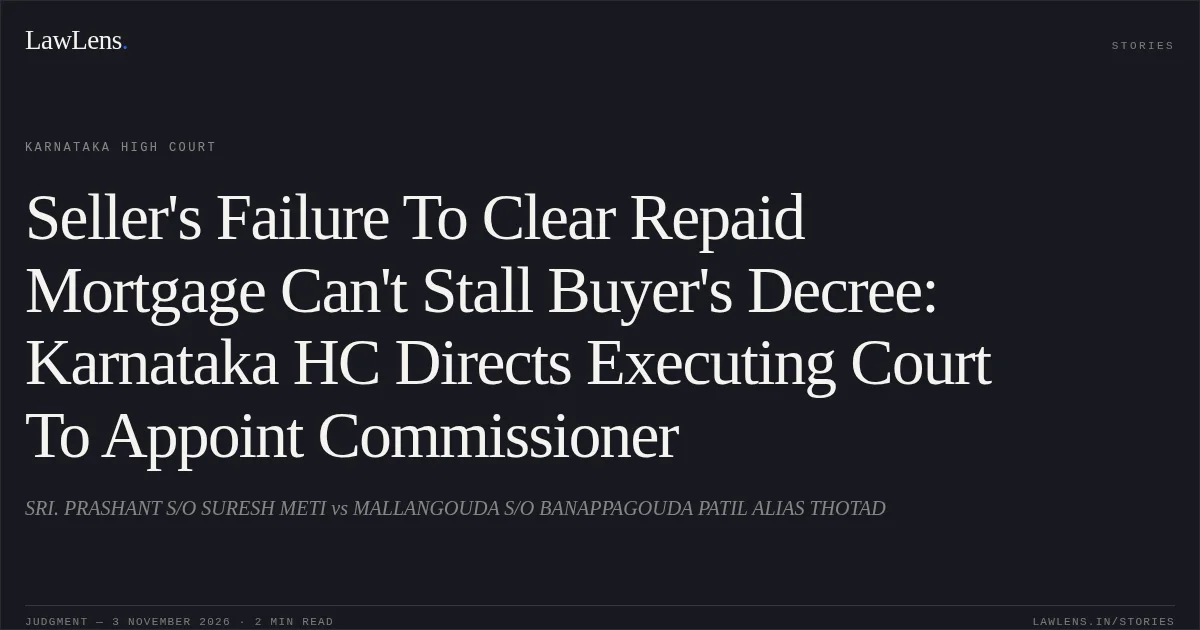
SRI. PRASHANT S/O SURESH METIvsMALLANGOUDA S/O BANAPPAGOUDA PATIL ALIAS THOTAD
Click to open original judgment
Original judgment, available to read, download and summarize on LawLens.in