Facts
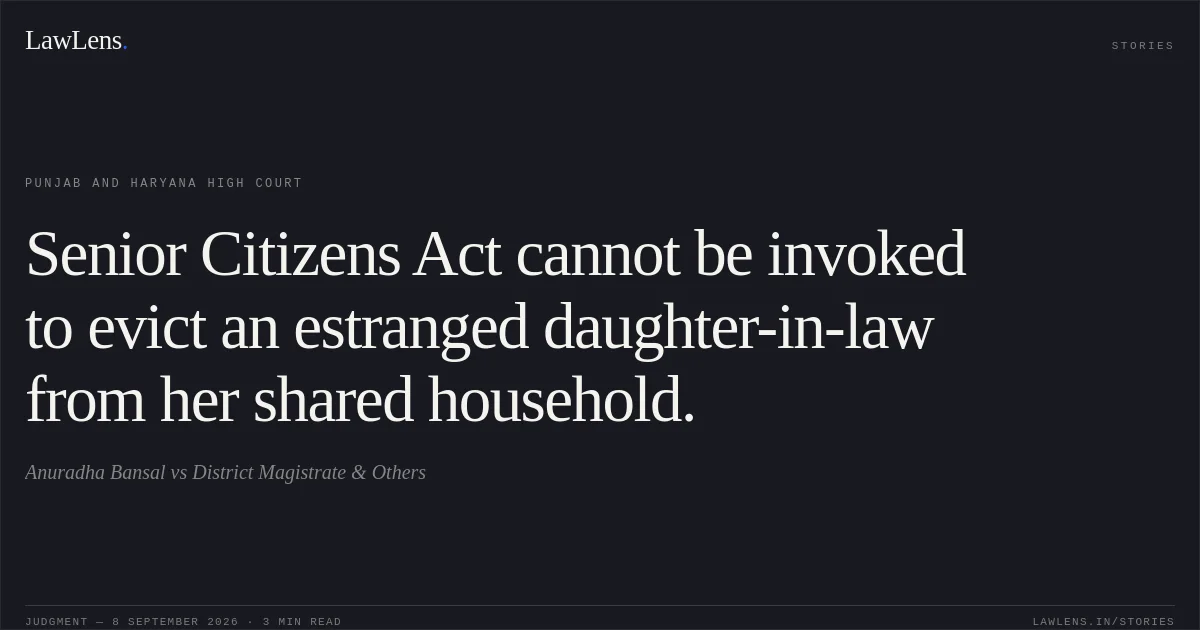
The appellant, Anuradha Bansal, challenged the judgment dated 20.04.2026 dismissing her writ petition seeking eviction of her daughter-in-law, respondent No. 3, from a residential property under the Maintenance and Welfare of Parents and Senior Citizens Act, 2007 (“the 2007 Act”).
Source reference: para. 1The appellant claimed ownership of the property and asserted that her two sons had earlier resided there as tenants, paying rent to her; according to her, after respondent No. 4 stopped paying rent and vacated the premises, respondent No. 3 began harassing her.
Source reference: para. 2Respondent No. 3 and respondent No. 4 were involved in marital discord, and respondent No. 3 had separately initiated proceedings under the 2007 Act, which were pending.
Source reference: para. 4The learned Single Judge found that the appellant’s application before the Maintenance Tribunal had been filed at the instance of respondent No. 4 to create a defence in the proceedings initiated by respondent No. 3, and that the allegation regarding non-payment of rent had neither been pleaded before the Tribunal nor substantiated before the writ court.
Source reference: para. 4The property had devolved in equal shares upon the appellant and both her sons after the death of the appellant’s husband; however, the appellant proceeded only against her younger son and his wife, and not against her elder son.
Source reference: para. 5Issues
1. Whether proceedings under the 2007 Act could be invoked to evict the appellant’s estranged daughter-in-law from the residential property in the circumstances of the case.
Source reference: paras. 1, 42. Whether the learned Single Judge erred in finding that the proceedings were initiated at the instance of respondent No. 4 to advance his position in the matrimonial dispute with respondent No. 3.
Source reference: paras. 4–53. Whether the judgment dated 20.04.2026 disclosed any perversity, illegality, or error warranting interference in an intra-court appeal under Clause X of the Letters Patent.
Source reference: paras. 1, 6Law Applied
The Court applied the Maintenance and Welfare of Parents and Senior Citizens Act, 2007, whose underlying purpose is to enforce the obligation of children and relatives to maintain senior citizens; however, its provisions cannot be used to adjudicate matrimonial or property disputes or as a mechanism to secure the eviction of an estranged daughter-in-law in circumstances where she has a right to reside in the shared household.
Source reference: para. 4The Court relied on S. Vanitha v. Deputy Commissioner, Bengaluru Urban District and Others, (2021) 15 SCC 730, which recognises the daughter-in-law’s right of residence in the shared household and requires reconciliation of proceedings under the 2007 Act with rights arising under matrimonial and domestic-violence law.
Source reference: para. 4An intra-court appellate court will not interfere with the Single Judge’s decision in the absence of perversity, illegality, or a material error of law.
Source reference: para. 6Reasoning
The Court upheld the finding that the appellant’s proceedings were not a bona fide exercise of the 2007 Act but were substantially intended to support respondent No. 4’s position in his matrimonial dispute with respondent No. 3.
Source reference: para. 4The alleged tenancy and non-payment of rent were not raised before the Maintenance Tribunal or proved before the writ court, weakening the appellant’s asserted basis for eviction.
Source reference: para. 4Since the property had devolved equally upon the appellant and both her sons, the appellant’s selective action against only the younger son and his wife, while taking no action against the elder son, further supported the inference that the proceedings were being used for an collateral matrimonial purpose rather than genuine senior-citizen protection.
Source reference: para. 5Applying S. Vanitha, the Court held that the 2007 Act could not be employed to defeat respondent No. 3’s right to reside in the shared household or to determine the underlying matrimonial and property disputes.
Source reference: para. 4Consequently, no perversity, illegality, or other ground for appellate interference was established.
Source reference: para. 6Holding
The Court answered the issues against the appellant.
It held that the 2007 Act could not be invoked in the present circumstances to evict the estranged daughter-in-law from the shared household, particularly where the proceedings appeared to have been instituted to assist the appellant’s son in a matrimonial dispute.
Source reference: paras. 4–5Finding no perversity, illegality, or error in the Single Judge’s judgment, the Court dismissed the Letters Patent Appeal.
Source reference: paras. 6–7The Court refrained from imposing heavy costs owing to the appellant’s advanced age, and directed that any pending miscellaneous applications stand disposed of.
Source reference: paras. 7–8Original Court PDF
Anuradha BansalvsDistrict Magistrate & Others
Click to open original judgment
Original judgment, available to read, download and summarize on LawLens.in