Facts
The applicant, a 1981 batch IPS officer of the Telangana Cadre, was one of the senior-most candidates for the post of Director General of Police (Head of Police Force).
Source reference: p. 2Instead of the applicant, the Government of Telangana appointed his junior, Respondent No. 4 (1982 batch), to the post on 13.11.2015 and fixed his salary in the Apex Scale of Rs. 80,000/-.
Source reference: p. 2The applicant’s representation for parity in pay based on the "Next Below Rule" was rejected by the Ministry of Home Affairs on 03.11.2016, contending that the Apex Scale is post-specific and only for the actual incumbent of the DGP (HoPF) post.
Source reference: p. 4, 7The applicant retired on 31.12.2016 and subsequently challenged the rejection order.
Source reference: p. 6Issues
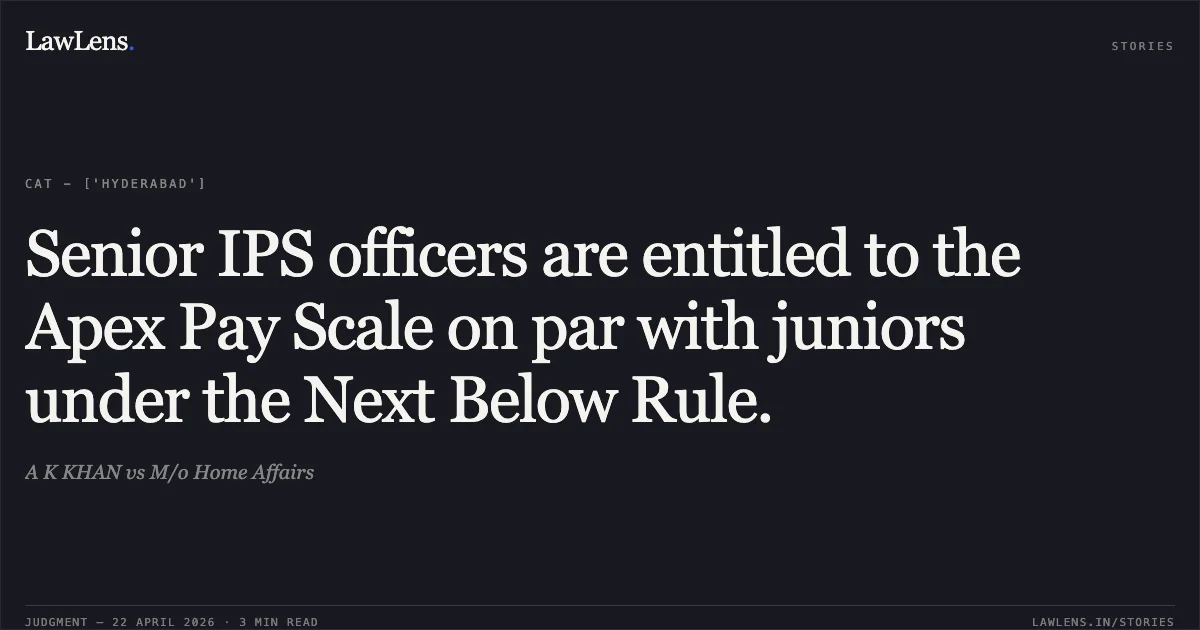
1. Whether a senior IPS officer is entitled to the Apex Scale of Rs. 80,000/- on par with a junior who has been appointed as DGP (HoPF) in the said scale.
Source reference: p. 2 / para. 32. Whether the "Next Below Rule" applies to selection posts like DGP (HoPF) where the salary is fixed at the Apex Scale.
Source reference: p. 5-6 / para. 9Law Applied
The Tribunal applied the "Next Below Rule" of service jurisprudence, which ensures that a senior employee is not financially disadvantaged if a junior is promoted or given a higher scale.
Source reference: p. 3, 11It relied on the precedent of R.K. Sethi v. Oil & Natural Gas Commission, which established that seniors can claim professional/pay parity from the date a junior is promoted.
Source reference: p. 11It further adhered to the principle established in R.N. Ravi v. Union of India (OA 823/2012) and Aloke Bihari Lal v. State of Uttarakhand (OA 681/2011), holding that the Apex Scale is not strictly post-specific for the purpose of pay parity when a junior draws it.
Source reference: p. 11-12The court also noted the dismissal of Civil Appeal No. 4648/2014 by the Supreme Court, which finalized this position.
Source reference: p. 13Reasoning
The Tribunal rejected the Respondents' contention that the Apex Scale is post-specific and inapplicable to the applicant because he did not actually hold the HoPF post.
Source reference: p. 10Upon reviewing the DPC minutes, the Tribunal found that while the State has the discretion to select one officer from a panel of three, no specific reasons were recorded to justify why the senior applicant was bypassed in favor of his junior, nor why he should be denied pay parity.
Source reference: p. 10-11The Tribunal reasoned that under the IPS (Pay) Rules and established service jurisprudence, a senior cannot draw a lesser salary than a junior.
Source reference: p. 13It noted that several Coordinate Benches had already granted similar relief to IPS officers in other states, and those decisions had been upheld by High Courts and the Supreme Court.
Source reference: p. 11-13Therefore, denying the applicant the Apex Scale while his junior received it constituted "hostile discrimination" and violated Articles 14 and 16 of the Constitution.
Source reference: p. 12Holding
The Tribunal allowed the OA and quashed the rejection order dated 03.11.2016. It held that the applicant is entitled to the Apex Scale of Rs. 80,000/- w.e.f. 13.11.2015 based on the Next Below Rule.
The Respondents were directed to re-fix the applicant's salary, pay consequential arrears till his retirement, and revise his pensionary benefits accordingly within one month. Failure to comply within the stipulated time would attract interest at GPF rates.
Source reference: p. 14Acts & Sections Cited
1 provisions across 1 statute referred to in this judgment. Each provision opens on LawLens.
All-India Services Act, 19511
Original Court PDF
A K KHANvsM/o Home Affairs
Click to open original judgment
Original judgment, available to read, download and summarize on LawLens.in