Facts
On July 28, 2017, the Investigating Officer (PW-7) received a tip-off that the appellant and a co-accused were transporting cannabis by bus for sale
Source reference: para 4Following procedural formalities—including recording the information in the Rojnamcha Sanha and preparing a Mukhbir Panchnama—the police conducted a search and recovered 7.774 kg of cannabis from the appellant
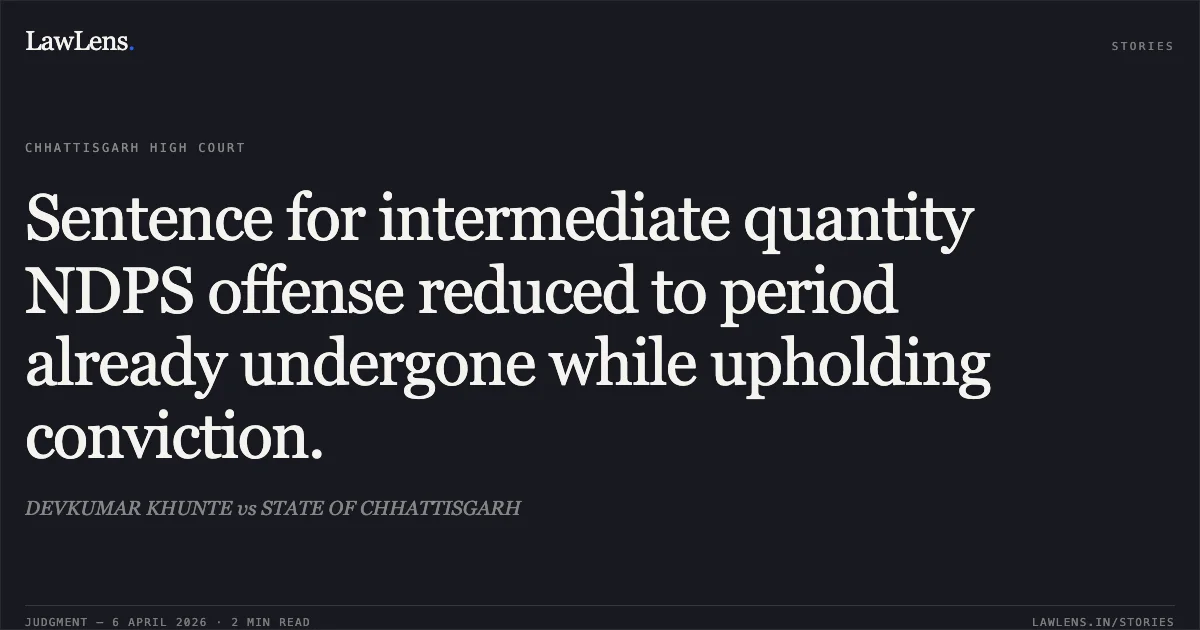
Source reference: para 4The appellant was subsequently charged and convicted by the Special Judge (NDPS Act), Raigarh, on January 30, 2020, under Section 20(b)(ii)(B) of the NDPS Act.
Source reference: para 3He was sentenced to three years of Rigorous Imprisonment (R.I.) and a fine of ₹10,000
Source reference: para 3In the present appeal under Section 374(2) of the CrPC, the appellant’s counsel did not challenge the conviction on merits but sought a reduction of the sentence to the period already undergone (approximately 17 months)
Source reference: para 8Issues
1. Whether the prosecution successfully established compliance with the mandatory procedural requirements of Sections 42, 52-A, and 55 of the NDPS Act.
Source reference: para 13, 142. Whether the sentence of three years R.I. should be modified to the period already served by the appellant given the circumstances of the case.
Source reference: para 16Law Applied
The Court applied Section 20(b)(ii)(B) of the NDPS Act, 1985, which penalizes the possession of intermediate quantities of cannabis
Source reference: para 3It strictly scrutinized the procedural mandates of Section 42 of the NDPS Act, which governs the power of entry, search, seizure, and arrest without a warrant, emphasizing the requirement to record information in writing and notify superior officers
Source reference: para 13Furthermore, the Court relied on the procedural safeguards under Sections 52-A and 55 regarding the handling and sampling of seized substances
Source reference: para 14For procedural conduct of the appeal in the absence of the appellant's counsel, the Court cited Surya Baksh Singh v. State of Uttar Pradesh (2014) 14 SCC 222
Source reference: para 2Reasoning
The Court examined the trial records and the testimony of the Investigating Officer (PW-7) to verify procedural integrity.
Source reference: para 4, 14It found that the officer had recorded the secret information and forwarded it to higher authorities, thereby satisfying the requirements of Section 42
Source reference: para 4, 14The Forensic Science Laboratory report confirmed that the seized 7.774 kg of material was indeed cannabis, solidifying the evidentiary basis for conviction
Source reference: para 15Regarding the sentence, the Court noted that the appellant had been facing litigation since 2017, had no prior criminal record, and had already served 17 months of his three-year sentence
Source reference: para 8, 16The Court reasoned that given these factors and the specific quantity of the contraband (intermediate quantity), reducing the sentence to the period already undergone would serve the ends of justice while maintaining the conviction
Source reference: para 16Holding
The High Court upheld the conviction of the appellant under Section 20(b)(ii)(B) of the NDPS Act
However, it modified the order of sentence, reducing the jail term to the period of approximately 17 months already undergone by the appellant
Source reference: para 16The fine of ₹10,000 and the corresponding default imprisonment sentence were maintained
Source reference: para 16The Court ordered the lower court records to be returned for immediate compliance
Source reference: para 17Acts & Sections Cited
5 provisions across 2 statutes referred to in this judgment. Each provision opens on LawLens.
Code of Criminal Procedure, 19732
Narcotic Drugs and Psychotropic Substances Act, 19853
Original Court PDF
DEVKUMAR KHUNTEvsSTATE OF CHHATTISGARH
Click to open original judgment
Original judgment, available to read, download and summarize on LawLens.in


![Subsequent exoneration does not retrospectively invalidate a finalized promotion select list.. UNNIKRISHNAN M vs M/o Environment And Forests. CAT - ['Ernakulam']. LawLens](/stories/thumbnails/subsequent-exoneration-does-not-retrospectively-invalidate-a-finalized-promotion-select-li-ce80a0e84f2f4887857271e8b4341c42.webp)