Facts
The victim, a four-year-old girl, was allegedly sexually assaulted by her school cab driver, Yogesh Tanwar, on August 11, 2014
Source reference: p. 3-4Upon returning from school, the victim's mother (PW-4) noticed reddish marks and scratches on the child's chest and thighs; the child disclosed that the driver had touched her private parts and inserted his finger into her vagina
Source reference: p. 16-17The Trial Court convicted Tanwar under Section 6 (aggravated penetrative sexual assault) and Section 10 (aggravated sexual assault) of the POCSO Act
Source reference: p. 6Tanwar appealed the conviction (CRL.A. 199/2020) on grounds of faulty identification and tutoring, while the State appealed for enhancement of the sentence (CRL.A. 205/2022)
Source reference: p. 6-7Issues
1. Whether the failure of the child victim to identify the accused during the trial is fatal to the prosecution's case when other evidence corroborates identity
Source reference: p. 12 / para. 34-352. Whether the sentence of 10 years and 5 years for distinct offences in a single transaction should run concurrently or consecutively
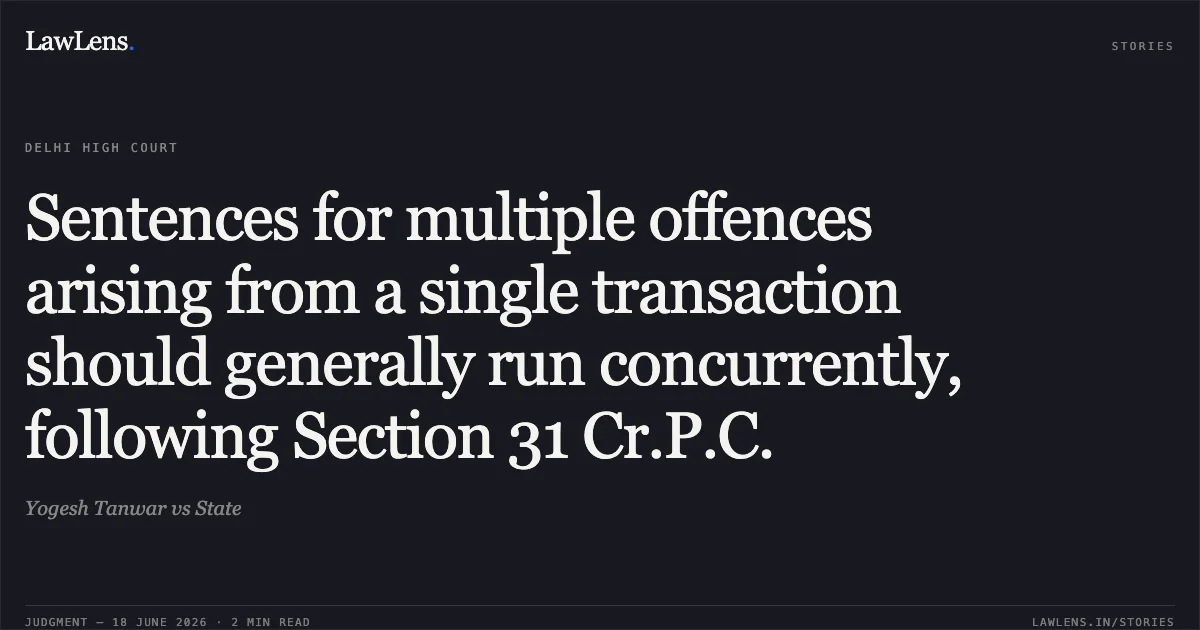
Source reference: p. 21 / para. 563. Whether the aggregate sentence can exceed fourteen years under Section 31 of the Cr.P.C.
Source reference: p. 23 / para. 58-62Law Applied
The Court applied Sections 3, 5, 6, 7, 9, and 10 of the Protection of Children from Sexual Offences (POCSO) Act, 2012, and the presumption of guilt under Section 29
Source reference: p. 18-19It primarily relied on Section 31 of the Cr.P.C., which governs sentences in cases of conviction of several offences at one trial, specifically Proviso (a) which mandates that the aggregate imprisonment period shall not exceed fourteen years
Source reference: p. 22The Court followed the precedents of O.M. Cherian v. State of Kerala, establishing that sentences for offences arising from a single transaction should generally run concurrently
Source reference: p. 24Chattar Singh v. State of M.P., which affirms the fourteen-year statutory limit for consecutive sentences
Source reference: p. 25-26Reasoning
The Court held that the victim’s inability to identify the accused via video link after 1.5 years did not negate the case, as her identity of "Yogesh the driver" was corroborated by the mother (PW-4) and the vehicle owner (PW-6), and the accused admitted his role in his Section 313 statement
Source reference: p. 14-15Regarding the medical evidence, the Court found that the ruptured hymen and congestion supported the charge of "fingering," satisfying the definition of penetration under Section 3 of the POCSO Act
Source reference: p. 18On sentencing, the Court noted that the Trial Court failed to specify if the 10-year and 5-year sentences were to be served concurrently or consecutively, resulting in a 15-year term by default
Source reference: p. 26The Court reasoned that since both offences arose from a single continuous transaction, the "rule of thumb" favoring concurrent sentences applied, and a 15-year aggregate sentence would expressly violate the 14-year cap mandated by the Proviso to Section 31(2) Cr.P.C.
Source reference: p. 27Holding
The Court upheld the conviction of Yogesh Tanwar, finding no merit in the defense of tutoring or false implication
It dismissed the State’s appeal for enhancement, finding 10 years to be an adequate minimum
Source reference: p. 21However, it modified the order on sentence to direct that the punishments (10 years RI and 5 years RI) shall run concurrently, as the 15-year aggregate was legally unsustainable under Section 31 Cr.P.C.
Source reference: p. 27 / para. 65Acts & Sections Cited
16 provisions across 3 statutes referred to in this judgment. Each provision opens on LawLens.
Protection of Children from Sexual Offences Act, 20128
Indian Penal Code, 18602
Code of Criminal Procedure, 19736
Original Court PDF
Yogesh TanwarvsState
Click to open original judgment
Original judgment, available to read, download and summarize on LawLens.in