Facts
The appellant was convicted by the Principal Special Court (POCSO Act), Sivagangai, under Sections 342 and 323 of the IPC and Section 9(m) read with Section 10 of the POCSO Act, and sentenced to imprisonment for each offence, with the sentences directed to run consecutively.
Source reference: pp. 5–6, paras. 8–9In appeal, counsel did not challenge the conviction and confined the arguments to sentence, relying on the appellant’s lack of previous antecedents and the fact that the offences arose from the same transaction.
Source reference: pp. 7–8, paras. 13–15Issues
Whether the appellant’s conviction was sustainable.
Source reference: p. 6, para. 11Whether the sentences should be reduced and directed to run concurrently, given the mitigating circumstances and that the offences arose from the same transaction.
Source reference: pp. 7–8, paras. 13–15; pp. 10–11, paras. 19–21Law Applied
Section 10 of the POCSO Act provides a sentence of imprisonment from five to seven years for the aggravated sexual assault offence considered in this case.
Source reference: p. 9, para. 17Section 31 of the Cr.P.C. gives the court discretion to direct sentences for multiple offences to run consecutively or concurrently, but that discretion must be exercised judicially.
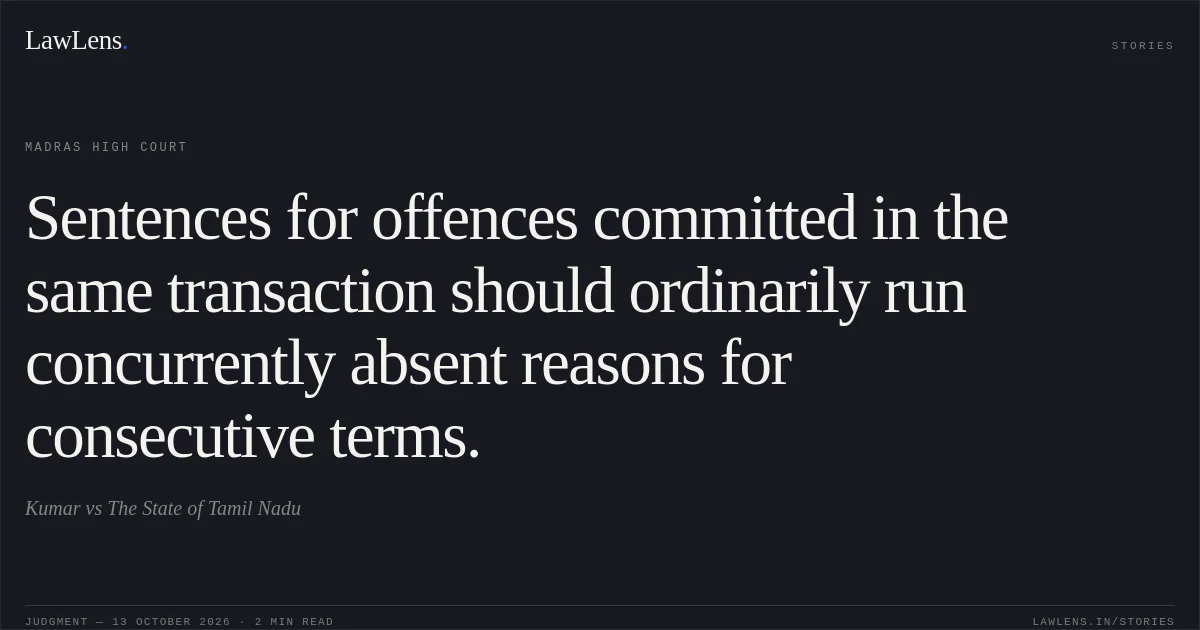
Source reference: pp. 10–11, para. 19The Court relied on Mohd. Akhtar Hussain v. Collector of Customs, (1988) 4 SCC 183; V.K. Bansal v. State of Haryana, (2013) 7 SCC 211; Manoj v. State of Haryana, (2014) 2 SCC 153; O.M. Cherian v. State of Kerala, (2015) 2 SCC 501; Muthuramalingam v. State, (2016) 8 SCC 313; and Sunil Kumar v. State of U.P., (2021) 5 SCC 560, for the principle that sentences for offences committed in the course of the same transaction ordinarily should run concurrently, absent reasons for departure.
Source reference: p. 8, para. 15; p. 11, paras. 20–21Reasoning
The Court upheld the conviction, noting that the victim’s evidence was corroborated by her friend and the medical evidence.
Source reference: p. 9, para. 16On sentence, it found that the Trial Court had not adequately considered the appellant’s status as a first-time offender, lack of previous bad antecedents, and the simple nature of the injuries. It therefore reduced the POCSO sentence from seven years to the statutory minimum of five years.
Source reference: pp. 9–10, paras. 17–18Because the IPC and POCSO offences arose from the same transaction and the Trial Court had given no specific reason for consecutive sentences, the Court directed that all sentences run concurrently.
Source reference: pp. 10–11, paras. 19–21Holding
The appeal was partly allowed. The convictions were sustained, but the POCSO sentence was reduced to five years’ rigorous imprisonment, with a fine of Rs.2,000 and six months’ rigorous imprisonment in default.
The sentences under Sections 342 and 323 IPC were otherwise left undisturbed, but all sentences were directed to run concurrently.
Source reference: pp. 10–12, paras. 18–22Acts & Sections Cited
12 provisions across 4 statutes referred to in this judgment. Each provision opens on LawLens.
Bharatiya Nagarik Suraksha Sanhita, 20231
Code of Criminal Procedure, 19735
Indian Penal Code, 18602
Protection of Children from Sexual Offences Act, 20124
Original Court PDF
KumarvsThe State of Tamil Nadu
Click to open original judgment
Original judgment, available to read, download and summarize on LawLens.in