01Facts
On July 25, 2011, the complainant, Smt. Kailash Bai, was performing parikrama at Gufa Mandir when the accused-respondent snatched her mangal sutra and fled.
¶ 3He was apprehended by nearby police officers, and a pendant was recovered from his possession.
¶ 3The trial court (4th Additional Sessions Judge, Bhopal) convicted the respondent under Section 392 of the IPC on November 21, 2012, but sentenced him only to the period already undergone (approx. 50 days) with a fine of Rs. 3,000/-.
¶ 1The State preferred this appeal under Section 377 of the Cr.P.C. on the grounds of inadequacy of the sentence.
¶ 202Issues
i.1. Whether the sentence of "period already undergone" awarded by the trial court for an offence under Section 392 IPC was grossly inadequate given the nature of the crime.
¶ 2, 7ii.2. Whether the respondent's age at the time of the incident and the lapse of time since the occurrence warrant an enhancement of the sentence.
¶ 6, 10, 1103Law Applied
Section 392 of the Indian Penal Code, 1860, which prescribes punishment for robbery.
¶ 2Section 6 of the Probation of Offenders Act, 1958, which restricts the imprisonment of offenders under 21 years of age unless the court records reasons for not granting probation.
¶ 10The reformative theory of sentencing, emphasizing that the object of punishment for young, first-time offenders is rehabilitation rather than mere retribution.
¶ 6Provisions in the judgment · 3 · Linked ones open on LawLens
Code of Criminal Procedure, 1973 Section 377
Indian Penal Code, 1860 Section 392
Probation of Offenders Act, 1958 Section 6
04Reasoning
The High Court affirmed the conviction, noting that the testimonies of the victim (PW-3) and police witnesses (PW-1, PW-2) were cogent and corroborated by the seizure of the stolen property.
¶ 4, 5Regarding the State's plea for enhancement, the court observed several mitigating factors: the respondent was only 18–20 years old at the time of the incident, had no prior criminal record, and more than 14 years had elapsed since the crime.
¶ 6, 10, 11The court reasoned that while robbery is serious, the trial court's discretion was properly guided by the respondent’s youth and potential for reformation.
¶ 7Crucially, the court noted that under Section 6 of the Probation of Offenders Act, the respondent, being 18 at the time, was protected from standard imprisonment terms.
¶ 1005Holding
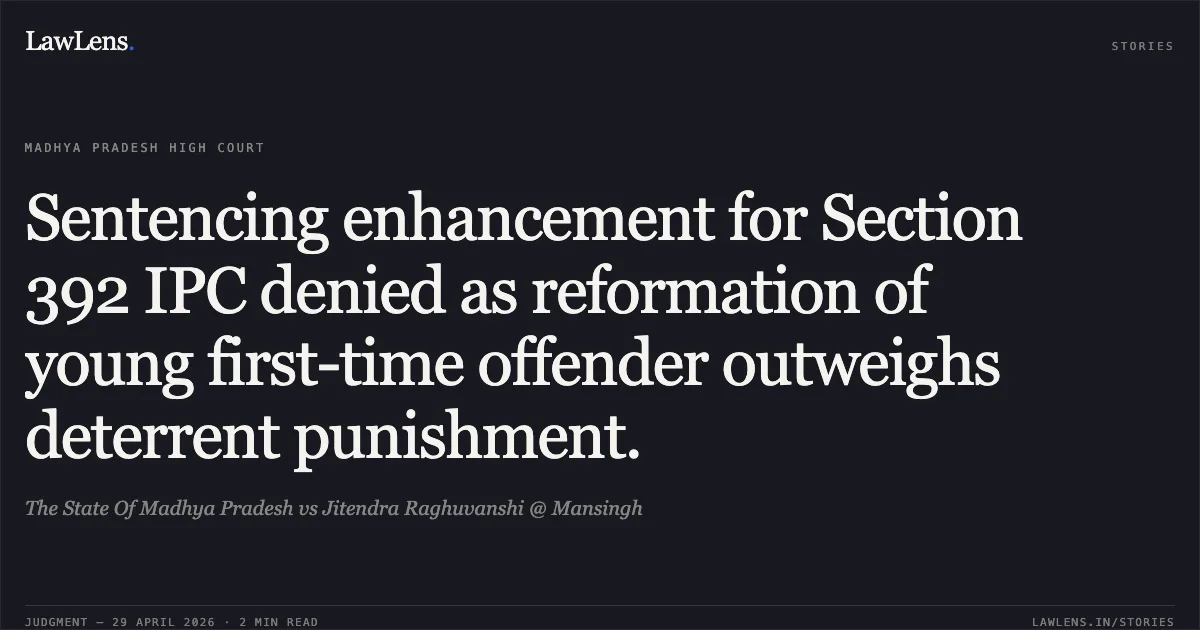
The High Court held that the sentence of the period already undergone plus a fine was sufficient to meet the ends of justice given the specific mitigating circumstances and the passage of a decade.
¶ 9, 11The High Court dismissed the State's appeal and affirmed the judgment of the trial court.
¶ 11Original Court PDF
The State Of Madhya PradeshvsJitendra Raghuvanshi @ Mansingh
Click to open original judgment
Original judgment, available to read, download and summarize on LawLens.in