Facts
The respondent No. 2 entered into an Agreement of Sale-cum-General Power of Attorney dated 31 October 2011 for the purchase of four acres of land, agreeing to pay ₹1 crore.
Source reference: para. 3–4, 8The agreement was executed by late M. Ganga Raju, who acted as GPA holder for the other respondents; the respondent No. 2 paid ₹85 lakhs before the Lok Adalat proceedings.
Source reference: para. 3–4, 8In proceedings initiated before the Kukatpally Lok Adalat, the parties’ settlement was recorded in an Award dated 30 March 2013. It required execution of a registered sale deed within two months, against payment of the remaining ₹15 lakhs.
Source reference: para. 4, 8After Ganga Raju’s death, the petitioners—his wife and daughter—received ₹30 lakhs from the respondent No. 2 and issued receipts describing the payments as part sale consideration for the land.
Source reference: para. 8, 12They challenged the Award, alleging fraud, disputing its signature and authority, and asserting that a separate signed compromise was required and that the Lok Adalat lacked pecuniary jurisdiction.
Source reference: para. 8, 24–25Issues
Whether the petitioners established that the Lok Adalat Award was vitiated by fraud, including by challenging Ganga Raju’s participation or signature after receiving and retaining consideration.
Source reference: para. 10(i), 14–18, 23Whether the Award was invalid because it did not include a separate memorandum of compromise signed by the parties.
Source reference: para. 10(ii), 26–34Whether the Lok Adalat lacked pecuniary jurisdiction to pass the Award, and whether that objection could be raised belatedly.
Source reference: para. 10(iii), 35–42Law Applied
Under the Legal Services Authorities Act, 1987, a Lok Adalat resolves disputes through compromise or settlement; Sections 20(3)–(4) require it to arrive at a settlement guided by justice, equity and fair play.
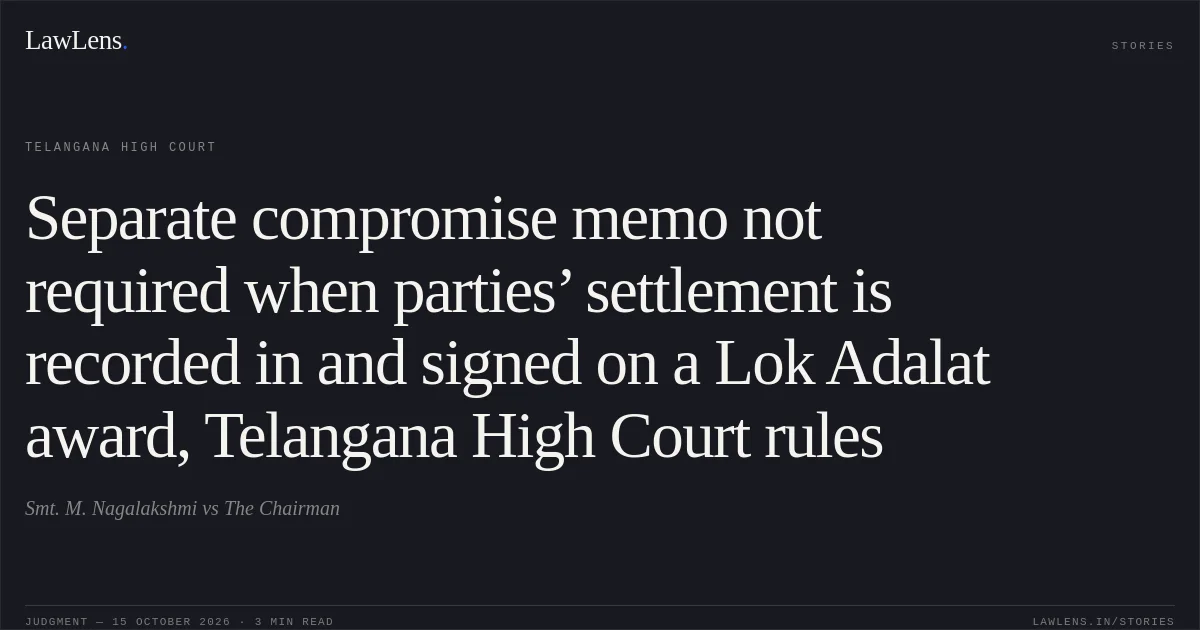
Source reference: para. 26–34Regulations 15 and 17 of the National Legal Services Authority (Lok Adalat) Regulations, 2009 permit the settlement to be formulated before the Lok Adalat and made an Award through the parties’ signatures and the members’ countersignatures; no separate, pre-existing compromise memorandum is required.
Source reference: para. 26–34Fraud must be pleaded with specific particulars; merely alleging fraud is insufficient (Bishnudeo Narain v. Seogeni Rai; Electrosteel Castings Ltd. v. UV Asset Construction Co. Ltd.).
Source reference: para. 14The pecuniary limit in Section 22C applies to Permanent Lok Adalats, not ordinary Lok Adalats under Chapter VI.
Source reference: para. 35–37Under Section 21 CPC, a pecuniary-jurisdiction objection must be raised at the earliest opportunity; an appellate challenge also requires failure of justice.
Source reference: para. 38–40Reasoning
The Court found that the petitioners had admitted Ganga Raju’s signature in their earlier pleadings and had described him as the property’s absolute owner under the GPA.
Source reference: para. 12–18, 20, 23The record also showed that he received ₹85 lakhs and that the petitioners later received and retained ₹30 lakhs, with receipts identifying those payments as part sale consideration.
Source reference: para. 12–18, 20, 23The petitioners therefore failed to establish particularised fraud and could not accept the transaction’s benefits while repudiating the Award.
Source reference: para. 12–18, 20, 23The Award recorded the parties’ settlement and, in the Court’s view, satisfied the Act and Regulations without a separate compromise memorandum.
Source reference: para. 26–34The pecuniary limit relied on by the petitioners concerned Permanent Lok Adalats, not the ordinary Lok Adalat that passed the Award; in any event, the objection was raised belatedly and no failure of justice was shown.
Source reference: para. 35–40Holding
The Court held that the petitioners established neither fraud nor any statutory defect in the Award, and that the separate-compromise and pecuniary-jurisdiction objections did not warrant interference.
It dismissed W.P. No. 16457 of 2026 and all connected applications, with no order as to costs.
Source reference: para. 44–49Acts & Sections Cited
4 provisions across 2 statutes referred to in this judgment. Each provision opens on LawLens.
Legal Services Authorities Act, 19873
Code of Civil Procedure, 19081
Original Court PDF
Smt. M. NagalakshmivsThe Chairman
Click to open original judgment
Original judgment, available to read, download and summarize on LawLens.in