Facts
Sayaji Hotels Ltd., a registered hotel operator, challenged the Commissioner (Appeals)’s order upholding service-tax demands relating to room and grand-room services, sponsorship/business auxiliary services, and recovery of electricity charges for 2010–11 to 2014–15.
Source reference: para. 2–2.1The demand followed departmental scrutiny and a show-cause notice dated 31 August 2015; the original authority confirmed the demand, with cum-tax benefit, and the Commissioner (Appeals) upheld that order.
Source reference: para. 2–2.1The appellant argued that food supplied to hotel rooms was separately charged, payments under liquor-company agreements were not consideration for sponsorship, electricity charges were actual reimbursements, and the extended limitation period was unavailable.
Source reference: para. 4–4.3The Tribunal considered the appeal under both the pre-negative-list and negative-list regimes.
Source reference: para. 6Issues
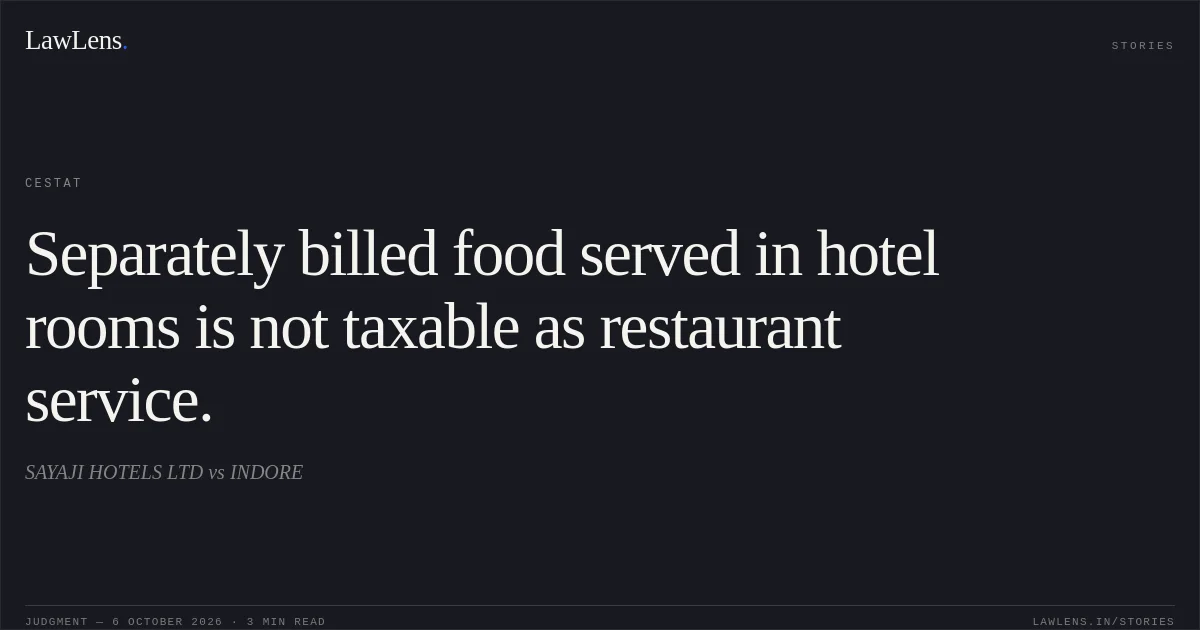
1. Whether food and beverages supplied to hotel rooms or grand rooms were taxable as restaurant or other services.
Source reference: para. 7(i)2. Whether payments received under agreements with liquor companies were consideration for taxable sponsorship or promotional services.
Source reference: para. 7(ii)3. Whether electricity charges recovered from tenants according to sub-meter readings formed part of the taxable value of the appellant’s services.
Source reference: para. 7(iii)4. Whether the extended period of limitation could be invoked in the absence of evidence of deliberate suppression or an alleged intentional act to evade tax.
Source reference: para. 7(iv)Law Applied
For the pre-negative-list period, the Tribunal considered the applicable taxable-service provisions of the Finance Act, 1994, including section 65(105)(zzzzv), which covered specified restaurant services involving the serving of food or beverages on the premises of an air-conditioned restaurant licensed to serve alcohol.
Source reference: paras. 6–7(i)For the post-negative-list period, section 65B(44) defined “service,” excluding, among other things, an activity constituting merely a transfer of title in goods, while section 66D set out the negative list; section 66B governed the charge of service tax.
Source reference: paras. 6–7(i)The Tribunal relied on Circular No. 139/8/2011-TRU concerning room-service food charges, and on Intercontinental Consultants and Technocrats Pvt. Ltd. v. Union of India, holding that Rule 5(1) of the Service Tax (Determination of Value) Rules could not support including reimbursed expenses in taxable value.
Source reference: para. 7(iii)On limitation, it applied the principle in Anand Nishikawa Co. Ltd. v. CCE, Meerut that suppression requires deliberate nondisclosure to evade tax; mere failure to declare is insufficient without a positive act.
Source reference: para. 7(iv)The Tribunal also treated contractual obligations to promote, brand, display, or give exclusivity to a client’s products as consideration-bearing promotional activity.
Source reference: para. 7(ii)Reasoning
The Tribunal found that the department had not shown that room-service food was supplied on restaurant premises or that its value was included in the room-service charge; the appellant’s invoices showed separate food charges. It therefore held the room and grand-room service demand unsustainable.
Source reference: para. 7(i)By contrast, the liquor-company agreements expressly required branding, promotion, exclusivity, and display of branded accessories, so the payments were consideration for promotional services rather than merely trading incentives.
Source reference: para. 7(ii)Electricity charges were recovered from tenants according to sub-meter readings and paid to the electricity suppliers; the Tribunal treated them as actual collections by the landlord, not consideration for a taxable service, and rejected their inclusion in value under Rule 5(1).
Source reference: para. 7(iii)Finally, the record did not establish deliberate suppression, and the show-cause notice had not invoked the proviso to section 73(1); the extended-period demand therefore could not stand.
Source reference: para. 7(iv)Holding
The Tribunal set aside the impugned order except insofar as it confirmed service tax on sponsorship services for the normal period.
The appeal was allowed in part.
Source reference: para. 8Acts & Sections Cited
8 provisions across 1 statute referred to in this judgment. Linked provisions open on LawLens.
Finance Act, 19948
Original Court PDF
SAYAJI HOTELS LTDvsINDORE
Click to open original judgment
Original judgment, available to read, download and summarize on LawLens.in
![HRA parity claims must be assessed against similarly situated employees, with reasoned orders where parity is denied.. Shaphaba Thokchom vs DY. COMPTROLLER AND AUDITOR GENERAL OF INDIA. CAT - ['Guwahati']. LawLens](/stories/thumbnails/hra-parity-claims-must-be-assessed-against-similarly-situated-employees-with-reasoned-orde-a9c45995b0704be18e4bcf7b91c8e507.webp)
![Article 311(2)(c) dismissal is valid where relevant material shows an inquiry would endanger security sources.. Mohd Rafi vs GENERAL ADMINITRATIVE DEPARTMENT. CAT - ['Jammu']. LawLens](/stories/thumbnails/article-311-2-c-dismissal-is-valid-where-relevant-material-shows-an-inquiry-would-endanger-58dabaa9372a4b41bd304e91e9ebe890.webp)