Facts
The applicant sought anticipatory bail in Case Crime No. 34 of 2026, registered at Police Station Kotwali Lotan, District Siddharth Nagar, under Sections 191(2), 127(2), 115(2), 352, 351(3), 333 and 105 of the Bharatiya Nyaya Sanhita.
Source reference: para. 2–3, p. 1He argued that he was not named in the FIR, that witnesses identified him only about two months after the incident, that the informant and injured person had not named him, and that he was a minor at the time of the incident.
Source reference: para. 2–3, p. 1The State opposed the application, relying on a witness’s statement that the applicant had dragged the deceased and on the deceased’s 11 injuries; it also questioned maintainability by reference to Srikant Upadhyay v. State of Bihar.
Source reference: para. 4, p. 1Issues
Whether, in light of the allegations and material collected during the preliminary investigation, the applicant was entitled to anticipatory bail under Section 482 BNSS
Source reference: para. 5–6, 10–12, pp. 1–2, 7–8Whether the principles in Srikant Upadhyay precluded the applicant from invoking the extraordinary anticipatory-bail jurisdiction
Source reference: para. 4, 7, pp. 1–2Law Applied
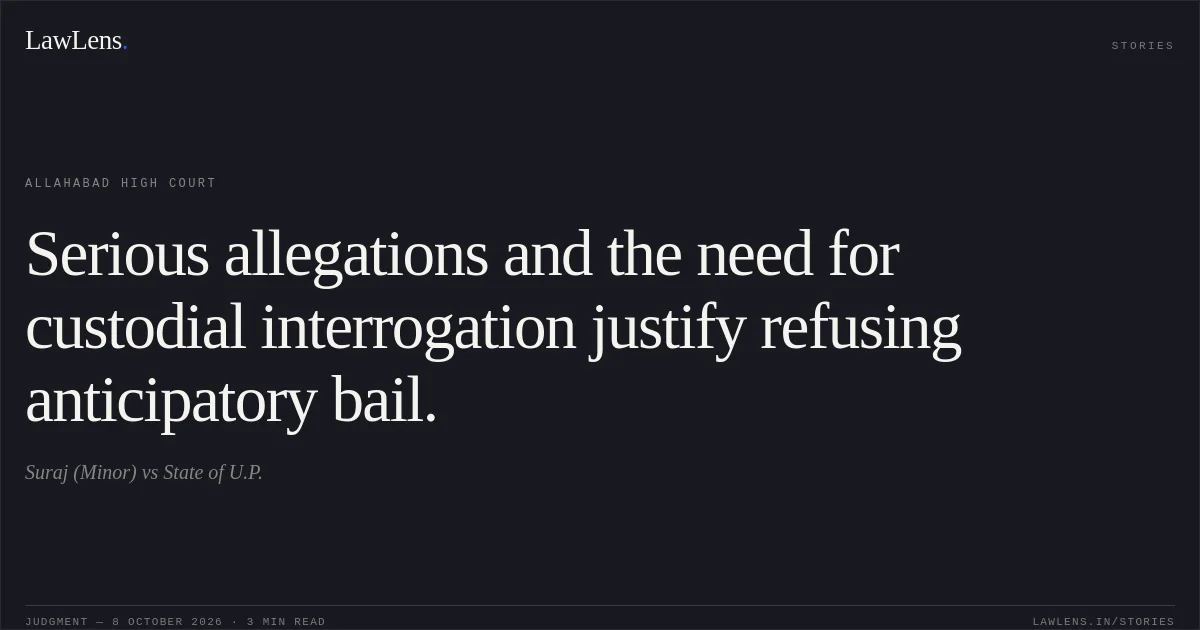
Section 482 BNSS confers an extraordinary discretion to grant anticipatory bail; it is not a matter of course and must be exercised cautiously, having regard to the nature and gravity of the accusation, the applicant’s role, the investigation, and risks such as interference with evidence or evasion of justice.
Source reference: paras. 7–9, pp. 2–6In Srikant Upadhyay v. State of Bihar, the Supreme Court held that anticipatory bail is not a rule and that a person continuously defying court orders or absconding is not entitled to invoke the extraordinary power, subject to the court’s power to grant relief in extreme exceptional cases.
Source reference: para. 7, p. 2P. Chidambaram v. Directorate of Enforcement and Kishor Vishwasrao Patil v. Deepak Yashwant Patil were cited for the principles that arrest may serve investigative purposes, pre-arrest bail can impede investigation, and the discretion must be exercised sparingly.
Source reference: paras. 8–9, pp. 3–6Sushila Agrawal v. State (NCT of Delhi) identifies the nature and gravity of the offence, the applicant’s role, and the possibility of influencing the investigation or tampering with evidence as relevant considerations.
Source reference: para. 9, p. 6The Court also referred to Gurbaksh Singh Sibbia v. State of Punjab in support of treating anticipatory bail as an extraordinary power not to be used routinely.
Source reference: para. 11, p. 7Reasoning
The Court acknowledged that the applicant was not named in the FIR but considered the later witness statements, including the specific allegation that he dragged the deceased, together with the post-mortem evidence of 11 injuries.
Source reference: para. 6, p. 2It found that the allegations were serious, the investigation remained at a preliminary stage, and custodial interrogation was necessary to ascertain the truth; it also found no material at that stage showing that the case was false or that no prima facie case existed.
Source reference: para. 10, p. 7Applying the principles governing the cautious exercise of anticipatory-bail discretion, the Court concluded that the grounds advanced by the applicant did not justify pre-arrest protection.
Source reference: paras. 10–12, pp. 7–8Although the State raised maintainability under Srikant Upadhyay, the Court’s stated basis for dismissal was its assessment of the allegations, the investigation, and the need for custodial interrogation.
Source reference: paras. 4, 7, 10–12, pp. 1–2, 7–8Holding
The Court held that the applicant was not entitled to anticipatory bail and dismissed the application.
Any interim order was vacated, and the Registrar (Compliance) was directed to send a copy of the order to the court concerned through the fastest mode.
Source reference: paras. 14–15, p. 8Acts & Sections Cited
10 provisions across 3 statutes referred to in this judgment. Each provision opens on LawLens.
Bharatiya Nyaya Sanhita, 20237
Bharatiya Nagarik Suraksha Sanhita, 20232
Code of Criminal Procedure, 19731
Original Court PDF
Suraj (Minor)vsState of U.P.
Click to open original judgment
Original judgment, available to read, download and summarize on LawLens.in