Facts
The disputed properties comprised portions of Survey Nos.628/2 and 628/4, classified as minor inam lands granted to the temple’s poojaris as service inam or Poojari Maaniyam for rendering priestly services.
Source reference: paras. 2.1–2.2The lands were notified under the Tamil Nadu Minor Inams (Abolition and Conversion into Ryotwari) Act, 1963 (“Act 30 of 1963”) on 12 March 1966.
Source reference: paras. 2.1–2.2The Settlement Tahsildar initially granted ryotwari patta in favour of the temple, holding that the inam had been granted to the deity.
Source reference: paras. 2.1–2.2The petitioners, claiming to have purchased the properties from the poojaris and to have constructed buildings thereon, challenged that determination.
Source reference: paras. 2.1–2.2The proceedings underwent several rounds of appeal, remand and writ litigation.
Source reference: paras. 2.3–2.4, 6–10Pursuant thereto, the second respondent directed grant of patta in favour of the temple under Section 8(2)(ii) of Act 30 of 1963.
Source reference: paras. 1, 3Issues
Whether the petitioners could reopen the validity and maintainability of the temple’s appeal before the Settlement Officer, despite the earlier orders upholding the remand and directing adjudication by the Assistant Settlement Officer?
Source reference: paras. 5–11Whether the petitioners were entitled to ryotwari patta in respect of the subject land, notwithstanding that it constituted service inam land belonging to the temple and had allegedly been alienated by the poojaris?
Source reference: paras. 12–16Whether the petitioners’ claim for a separate or dual patta in respect of the buildings required consideration under Section 13 of Act 30 of 1963 and the principle recognised in R. Manicka Naicker v. Elumalai Naicker?
Source reference: paras. 12–17Law Applied
The Court applied Act 30 of 1963, particularly Section 8(2)(ii), concerning the grant of ryotwari patta in respect of lands vested upon abolition of minor inams; Section 11, which provides the statutory appellate remedy against orders of the Assistant Settlement Officer; and Section 13, which permits consideration of the rights of a building owner separately from the ownership of the site.
Source reference: para. 12The Court relied on R. Manicka Naicker v. Elumalai Naicker, (1995) 4 SCC 156, for the principle that a dual patta may be recognised where the building belongs to one person and the underlying site belongs to another, but only where the building existed on the notified date.
Source reference: para. 12It also applied the doctrines of finality of litigation and constructive preclusion, holding that issues already decided or left undisturbed in earlier writ proceedings could not be repeatedly reopened.
Source reference: paras. 5–11The Court further recognised that service inam lands could be enjoyed by service holders only so long as the relevant service continued, and that alienations by such service holders to third parties were invalid.
Source reference: para. 16Reasoning
The Court rejected the petitioners’ jurisdictional objection because the temple’s appeal and the consequential remand had already been considered in earlier proceedings, including the writ appeal and subsequent writ petitions.
Source reference: paras. 5–11Those orders had attained finality and expressly required the parties to place their claims before the Assistant Settlement Officer; the petitioners had not obtained any order setting aside the earlier remand or revision proceedings.
Source reference: paras. 5–11On the merits, the Court held that the petitioners could not claim title or patta over the land merely through purchases from the poojaris, since the property was service inam land belonging to the temple and the alleged alienations were invalid.
Source reference: para. 16However, under Manicka Naicker, ownership of a building could potentially be considered separately from ownership of the site.
Source reference: paras. 12–15The evidence relied upon by the petitioners did not conclusively establish that their buildings existed on the notified date: the Commissioner’s report was prepared in 1979 and only estimated the buildings’ ages, while the house-tax notices were subsequent to the notified date and, in one case, stood in another person’s name.
Source reference: paras. 12–15Since the Assistant Settlement Officer had not independently adjudicated the building-related claim, the Court held that this limited issue required reconsideration.
Source reference: para. 16Holding
The writ petitions were partly allowed/disposed of.
The impugned order granting or confirming patta in favour of the temple was upheld insofar as it related to the subject land, and the petitioners’ claim to land patta was rejected.
Source reference: para. 17However, the matter was remanded to the second respondent for determining, independently and in accordance with Section 13 of Act 30 of 1963 and R. Manicka Naicker, whether the petitioners were entitled to patta in respect of the buildings, including whether those buildings existed on the notified date and whether the petitioners could claim rights notwithstanding the alleged invalidity of the underlying sale transactions.
Source reference: paras. 16–17The remanded enquiry was expressly confined to the building claim; all other aspects of the impugned order were confirmed.
Source reference: para. 18No order as to costs was made.
Source reference: para. 18Acts & Sections Cited
4 provisions across 1 statute referred to in this judgment. Linked provisions open on LawLens.
Tamil Nadu Minor Inams (Abolition and Conversion Into Ryotwari) Act, 19634
Original Court PDF
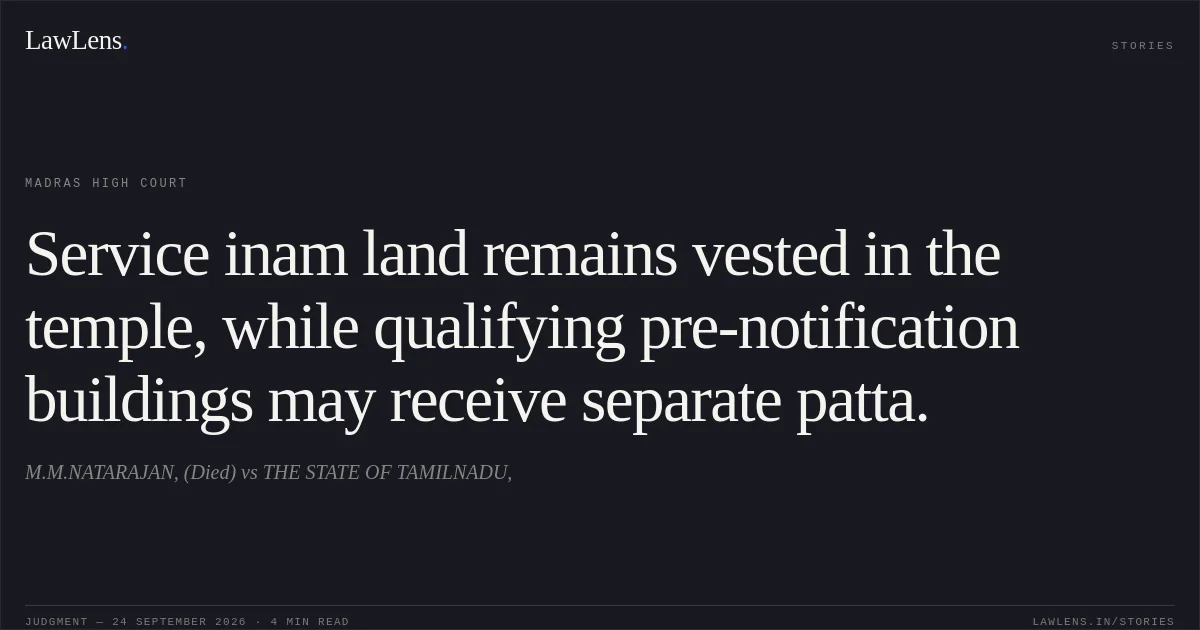
M.M.NATARAJAN, (Died)vsTHE STATE OF TAMILNADU,
Click to open original judgment
Original judgment, available to read, download and summarize on LawLens.in