Facts
The petitioner, a partnership firm, was engaged in works contract services for the Nagaland PWD and Development Authority for projects initiated in 1991 and 2009.
Source reference: p.4On 29.09.2020, the Respondent issued a Demand-cum-Show Cause Notice for the period 2014-15 to 2017-18, alleging evasion of service tax based on Form 26AS data obtained from the Income Tax Department.
Source reference: p.2-3The Petitioner contended the services were exempt under Mega Exemption Notification No. 25/2012.
Source reference: p.5The Additional Commissioner confirmed the demand via an Order-in-Original dated 01.03.2022, invoking the extended period of limitation.
Source reference: p.5The Commissioner (Appeals) upheld this on 11.10.2023, dismissing the appeal on merits while condoning the delay.
Source reference: p.6-7The Petitioner challenged these orders under Article 226, arguing they were arbitrary and lacked jurisdiction.
Source reference: p.11Issues
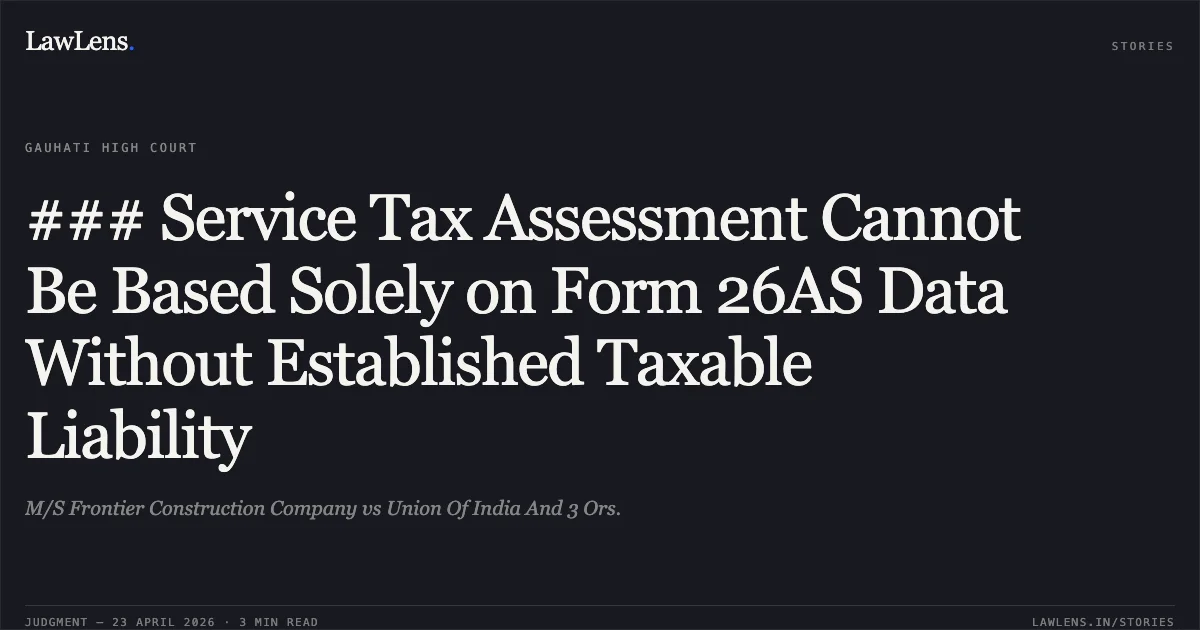
1. Whether the Revenue can determine service tax liability solely on the basis of Form 26AS data and inferences without establishing the taxable nature of the service.
Source reference: p.15 / para. 152. Whether the Revenue justified the invocation of the extended period of limitation (five years) under the proviso to Section 73(1) of the Finance Act, 1994.
Source reference: p.17 / para. 173. Whether the availability of an alternative statutory remedy (further appeal) acts as an absolute bar to a writ petition where a jurisdictional error is alleged.
Source reference: p.24 / para. 25Law Applied
Section 73 of the Finance Act, 1994, which permits the extended five-year limitation only in cases of fraud, collusion, willful misstatement, or suppression of facts with intent to evade tax.
Source reference: p.32-33The principle from Chatturam Horilram Ltd. v. CIT identifies three stages of taxation (declaration of liability, assessment, and recovery), emphasizing that liability must be fixed by statute first.
Source reference: p.29The principle from A.V. Fernandez v. State of Kerala that tax cannot be imposed by inference or analogy.
Source reference: p.31The doctrine in Whirlpool Corporation v. Registrar of Trade Marks and Godrej Sara Lee Ltd. v. Assistant Commissioner, establishing that alternative remedies do not bar a writ if the order is wholly without jurisdiction or violates natural justice.
Source reference: p.48-49Reasoning
The Court reasoned that the Revenue committed a jurisdictional error by treating Form 26AS receipts as "taxable value" without examining the specific nature of the services or the applicable exemptions under Notification No. 25/2012.
Source reference: p.45, 55Citing Cosmic Dye Chemical, the Court noted that "suppression" requires a positive, willful act to evade tax; merely failing to file ST-3 returns or provide documents does not automatically trigger the extended limitation period.
Source reference: p.36, 52-53The Court found the Order-in-Original lacked a "conclusive finding" of intent to evade, rendering the assumption of jurisdiction under the proviso to Section 73(1) unauthorized and "colorable".
Source reference: p.38, 55It held that while the Revenue could have acted within the normal 18-month period, it could not bypass limitation via the "ipse dixit" of the officer without fulfilling the statutory preconditions of the proviso.
Source reference: p.53Holding
The Court allowed the writ petition, holding that the invocation of the extended period of limitation was invalid and the demand based on Form 26AS was legally unsustainable.
The Court ruled that the availability of an alternative remedy is a rule of policy, not law, and does not oust jurisdiction when an authority acts without statutory sanction.
Source reference: p.56The Court issued a writ of certiorari quashing the Demand-cum-Show Cause Notice (29.09.2020), the Order-in-Original (01.03.2022), and the Order-in-Appeal (11.10.2023). All penalties and interest were similarly set aside.
Source reference: p.57Acts & Sections Cited
3 provisions across 2 statutes referred to in this judgment. Each provision opens on LawLens.
Central Goods and Services Tax Act, 20172
Central Excise Act, 19441
Original Court PDF
M/S Frontier Construction CompanyvsUnion Of India And 3 Ors.
Click to open original judgment
Original judgment, available to read, download and summarize on LawLens.in