Facts
The appellant, M/s. Safina Towers Pvt. Ltd., provided taxable services classified under “Management, Maintenance or Repair Services.” The Department alleged that the appellant had not discharged service tax on certain amounts collected under various heads and had irregularly availed CENVAT credit. The demands related principally to the difference between the turnover reflected in the appellant’s financial records and the taxable value declared in its ST-3 returns, covering the period June 2008 to March 2014, with service-tax demand also relating to the period April 2008 to June 2012.
Source reference: p.2The Principal Commissioner confirmed the differential service-tax demand, ordered recovery of allegedly irregular CENVAT credit with interest, and imposed penalties under Sections 76 and 77 of the Finance Act, 1994 and Rule 15 of the CENVAT Credit Rules, 2004.
Source reference: p.2The appellant contended that the financial statements were prepared on an accrual basis whereas ST-3 returns reflected receipts, and relied on a Chartered Accountant’s certificate explaining the differences, including property tax, exempt receipts, electricity and water charges, prior-period rent and non-receipt of certain amounts.
Source reference: pp.3, 12–13The appellant also challenged denial of CENVAT credit on input services, including credit relating to invoices issued in the names of Safina Technology Park and Safina Hotels, and credit concerning maintenance and repair of DG sets.
Source reference: pp.7–11Issues
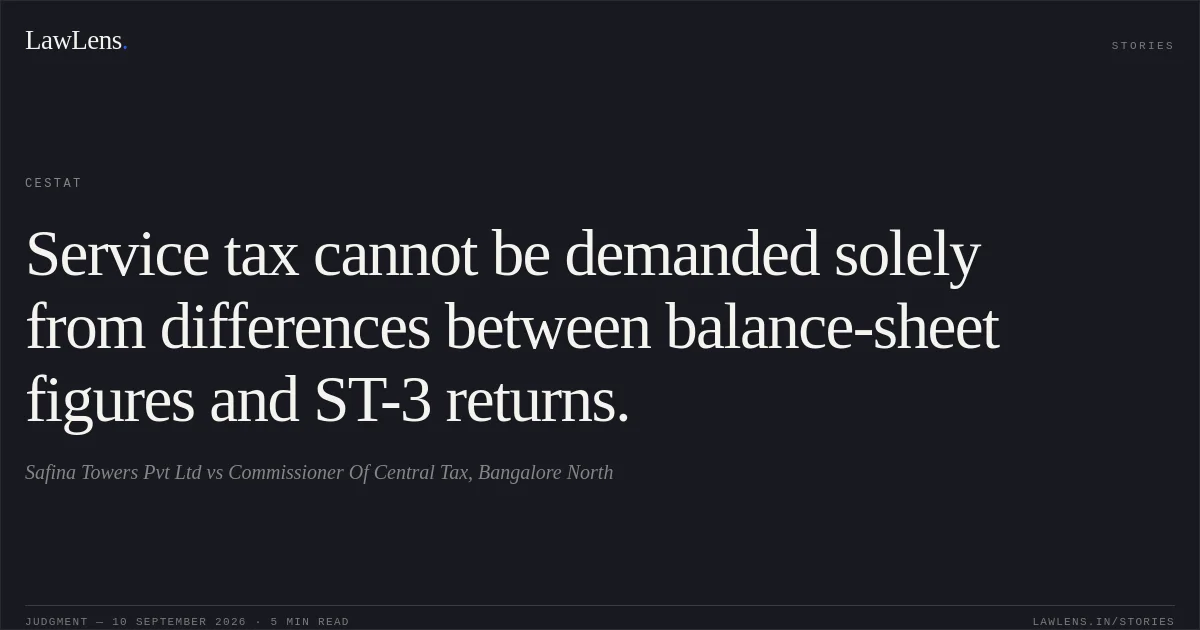
Whether service tax could be demanded merely on the basis of the difference between the turnover shown in the balance sheet/trial balance and the value declared in ST-3 returns, without establishing that the differential amount represented consideration for taxable services?
Source reference: pp.12–13, para. 17Whether CENVAT credit on the disputed input services was admissible, including services covered by invoices issued in the names of Safina Technology Park and Safina Hotels?
Source reference: pp.13–14, paras. 18–19Whether CENVAT credit relating to maintenance and repair of DG sets was allowable where the appellant had discharged service tax on the relevant output activity?
Source reference: pp.10–11, 14, para. 20Whether the extended period of limitation and penalties were invocable in circumstances where the appellant had regularly filed ST-3 returns and the demand was based on differential financial figures?
Source reference: p.12, para. 15; p.14, para. 21Law Applied
The Tribunal applied Section 68 of the Finance Act, 1994, under which service tax is payable by a person providing taxable services on the consideration attributable to such services; a demand cannot be sustained solely by relying on income-tax or financial-statement figures without proving the provision of taxable services.
Source reference: p.13, para. 17It relied on ALP Management Consultants Pvt. Ltd. v. Commissioner of Service Tax, affirmed by the Karnataka High Court and Supreme Court, for the principle that service tax cannot be recovered merely on the basis of income-tax returns or uncorroborated financial figures.
Source reference: p.13, para. 17The Tribunal also applied the principle, reiterated in ITC Ltd. v. Commissioner of GST and Central Excise, that the burden lies on Revenue to establish the taxable nature of the alleged receipts.
Source reference: pp.5–6, 13CENVAT credit was examined under the CENVAT Credit Rules, 2004, particularly the definition of “input service,” Rule 14 concerning recovery of wrongly availed credit, Rule 15 concerning penalties, and Rule 6(5) as relied upon by the appellant for services used commonly in taxable and exempt activities.
Source reference: pp.7, 10–11The extended limitation period under Section 73 of the Finance Act and penalties could not be invoked absent suppression or wilful misstatement; regular filing of ST-3 returns and a mere difference in declared figures did not establish suppression.
Source reference: p.14, para. 21Reasoning
The Tribunal held that the Department had treated the difference between the balance sheet/trial balance and ST-3 returns as automatically representing undeclared taxable services. That approach was legally insufficient because Revenue had to identify the taxable service and prove that the differential amount constituted consideration for it.
Source reference: p.13, para. 17The appellant had produced a Chartered Accountant’s certificate and supporting explanations concerning prior-period rent, property and municipal taxes, exempt turnover, non-receipt of consideration, and electricity and water charges. Although the adjudicating authority rejected the certificate, it did not adequately establish the taxable character of the disputed receipts.
Source reference: p.13, para. 17On CENVAT credit, the Tribunal found that most of the disputed services—including pest control, rent, membership fees, advertising, repairs and maintenance, motor maintenance, telephone, building maintenance, travel, land-lease rentals, website AMC and import-clearance services—fell within the scope of input services. Credit was, however, disallowed for pooja expenses and credit-card payments.
Source reference: p.13, para. 18Credit based on invoices issued in the names of Safina Technology Park and Safina Hotels was denied because those entities were treated as separate legal entities and the appellant had not produced sufficient evidence proving that the services covered by those documents were received by Safina Towers.
Source reference: p.14, para. 19With respect to DG-set maintenance and repairs, the Tribunal distinguished the non-taxable supply of electricity from taxable maintenance and repair activity. Since the appellant had paid service tax of Rs. 2,16,349 on the relevant activity for October 2009 to June 2012, credit relating to those services was held allowable, subject to verification that tax had in fact been discharged.
Source reference: p.14, para. 20Finally, because the appellant had regularly filed ST-3 returns and the dispute arose from reconciliation of financial figures, the Tribunal found no basis for alleging suppression or invoking the extended limitation period or penalties.
Source reference: p.14, para. 21Holding
The appeals were partly allowed.
The service-tax demand founded merely on the difference between the balance sheet/trial balance and ST-3 returns was set aside as unsustainable.
Source reference: p.13, para. 17CENVAT credit was allowed for the eligible input services, but denied in respect of pooja expenses and credit-card payments.
Source reference: p.13, para. 18Credit based on documents issued in the names of Safina Technology Park and Safina Hotels was upheld as inadmissible for lack of proof that the services were received by the appellant.
Source reference: p.14, para. 19Credit relating to DG-set maintenance and repair was allowed, subject to confirmation that the corresponding service tax had been paid.
Source reference: p.14, para. 20The extended-period demand and penalties were set aside, and the matter was confined, where otherwise maintainable, to the normal limitation period.
Source reference: p.14, para. 21Acts & Sections Cited
6 provisions across 1 statute referred to in this judgment. Linked provisions open on LawLens.
Finance Act, 19946
Original Court PDF
Safina Towers Pvt LtdvsCommissioner Of Central Tax, Bangalore North
Click to open original judgment
Original judgment, available to read, download and summarize on LawLens.in