Facts
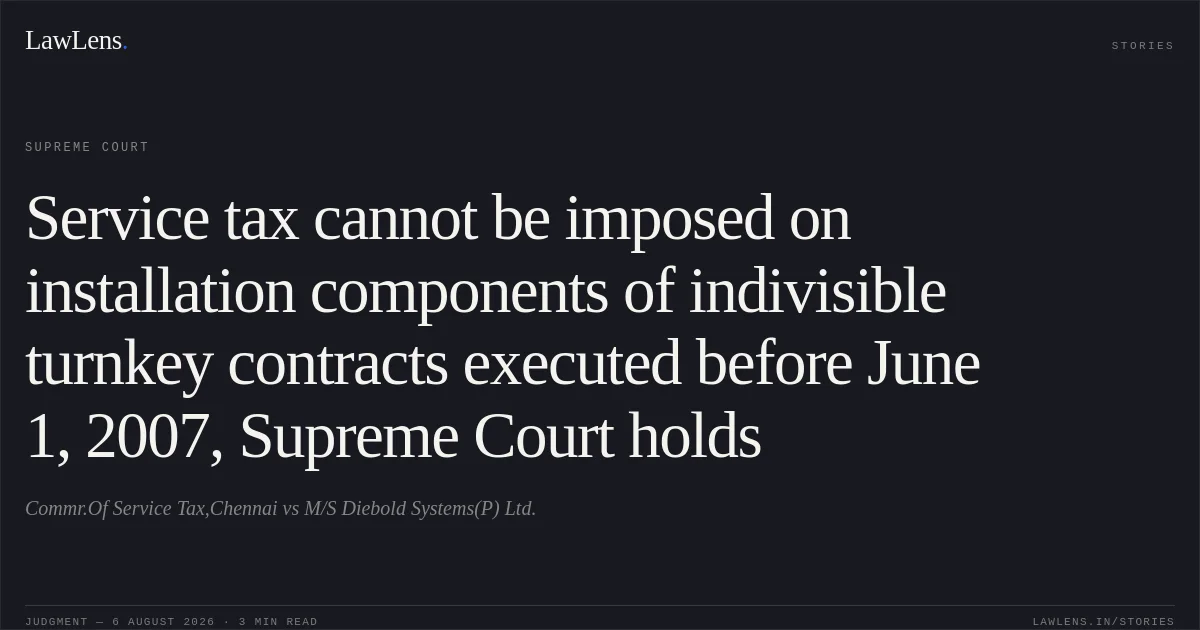
The respondent supplied Automated Teller Machines (ATMs) to banks under turnkey contracts that included supply, installation, testing and commissioning for a single composite consideration.
Source reference: para. 2–3The Revenue treated 33% of the contractual consideration as attributable to installation and commissioning and issued successive show-cause notices for the periods July 2003–April 2006, demanding service tax, interest and penalties under the Finance Act, 1994.
Source reference: para. 4–6The Commissioner confirmed the demands.
Source reference: para. 4–6On appeal, the CESTAT held that the contracts were indivisible turnkey contracts and that, during the relevant period, the Finance Act, 1994 did not authorise the artificial segregation of the installation and commissioning component for service-tax purposes; it accordingly set aside the demands.
Source reference: para. 7–9Issues
Whether the turnkey contracts for the supply, installation and commissioning of ATMs were indivisible composite contracts incapable of being vivisected for levy of service tax under the taxable category of “commissioning or installation” under the Finance Act, 1994.
Source reference: para. 18(a)Whether any part of the composite consideration received by the respondent could be subjected to service tax as consideration for “commissioning or installation”.
Source reference: para. 18(b)Law Applied
Service-tax liability must arise from the charging provisions of the Finance Act, 1994; taxation cannot be imposed by implication, and valuation or machinery provisions cannot create or enlarge the substantive charge.
Source reference: para. 20–21Sections 65(105), 66 and 67 of the Finance Act, 1994, as applicable during the relevant period, provided for taxation of specified taxable services and valuation of an existing taxable service, but did not authorise the dissection of an indivisible composite turnkey contract or the attribution of a notional percentage to a service component.
Source reference: para. 21–22, 28Under State of Madras v. Gannon Dunkerley & Co. (Madras) Ltd., an indivisible works contract is a composite transaction, although Article 366(29A)(b), introduced by the Forty-sixth Constitutional Amendment, permitted the limited segregation of the goods component for sales-tax purposes.
Source reference: para. 26–27Applying Commissioner, Central Excise and Customs, Kerala v. Larsen and Toubro Ltd., the Court held that, before the introduction of the specific “works contract service” entry under Section 65(105)(zzzza) with effect from 1 June 2007, the Finance Act, 1994 contained neither the charging provision nor the machinery necessary to levy service tax on indivisible composite works contracts.
Source reference: para. 30–31The earlier CESTAT decision in Daelim Industrial Co. Ltd. v. Commissioner of Central Excise, Vadodara was consistent with this principle.
Source reference: para. 8, 38Reasoning
The contracts had a single commercial objective—the delivery of fully functional ATMs—and the respondent’s obligations of procurement, supply, transportation, installation, testing and commissioning were integral to that objective.
Source reference: para. 23, 32There was no separate bargain, independent contract or separately earmarked consideration for installation or commissioning.
Source reference: para. 23, 32Consequently, although the respondent factually performed installation and commissioning activities, those activities were merely inseparable incidents of the composite turnkey contracts and did not constitute an independently contracted taxable service.
Source reference: para. 35, 39The Revenue’s attempt to tax 33% of the consideration necessarily required first vivisecting the indivisible contracts and then assigning a notional value to the alleged service component.
Source reference: para. 33–34Sections 65, 66 and 67 did not provide statutory authority or a valuation mechanism for such an exercise during the relevant period.
Source reference: para. 33–34The later introduction of a specific works-contract entry and valuation mechanism from 1 June 2007 reinforced that the earlier provisions were insufficient to tax such composite contracts.
Source reference: para. 36–37Holding
The Court answered both issues in favour of the respondent.
The ATM contracts were indivisible composite turnkey contracts, and the Finance Act, 1994, as applicable from July 2003 to April 2006, did not authorise the Revenue to isolate and tax a notional 33% of the consideration under the category of “commissioning or installation”.
Source reference: para. 37, 40The CESTAT’s order setting aside the tax demands, interest and penalties was affirmed, and the Revenue’s civil appeals were dismissed.
Source reference: para. 40–41Acts & Sections Cited
5 provisions across 1 statute referred to in this judgment. Linked provisions open on LawLens.
Finance Act, 19945
Original Court PDF
Commr.Of Service Tax,ChennaivsM/S Diebold Systems(P) Ltd.
Click to open original judgment
Original judgment, available to read, download and summarize on LawLens.in