01Facts
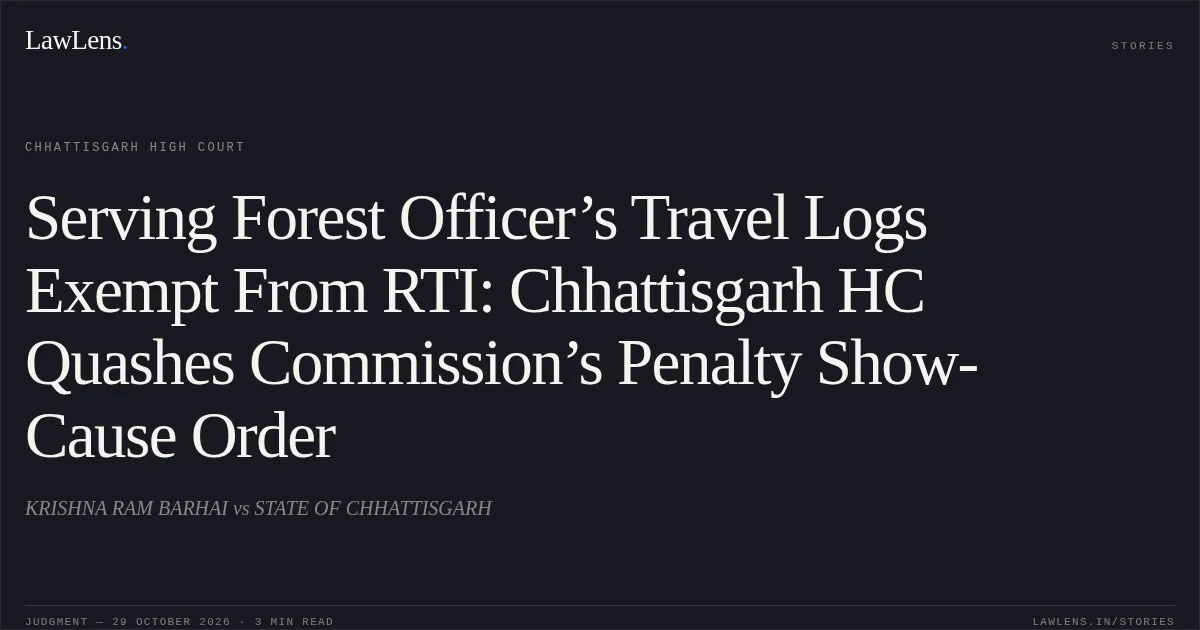
Respondent No. 4 sought certified copies of the petitioner’s official vehicle logbook and daily movement diary for June 2021.
¶ 1–2The petitioner, then the Public Information Officer and Divisional Forest Officer, refused disclosure within the statutory period, citing Sections 8(1)(j) and 11(1) of the Right to Information Act, 2005 (“RTI Act”) and security concerns.
¶ 1–2Instead of filing a first appeal under Section 19(1), Respondent No. 4 lodged a complaint under Section 18.
¶ 1–2The State Information Commission recorded a finding of guilt and issued a show-cause notice concerning penalties under Sections 20(1) and 20(2).
¶ 1–2The petitioner challenged that order under Article 226.
¶ 1–202Issues
i.1. Whether the Commission could entertain a Section 18 complaint challenging a PIO’s express refusal of information where the applicant had not pursued the first appeal under Section 19(1)
¶ 7–9ii.2. Whether the refusal to disclose the vehicle logbook and movement diary was justified, and whether the Commission’s finding of guilt and initiation of Section 20 proceedings could stand without a finding of deliberate default or mala fide conduct
¶ 10–11iii.3. Whether the proceedings were invalid because the Commission acted through a single-member bench
¶ 3, 12–1403Law Applied
Sections 18 and 19 of the RTI Act provide distinct procedures and remedies: Section 18 confers supervisory, inquisitorial jurisdiction, while an applicant seeking redress from an express refusal of information must pursue the statutory appellate route under Section 19; a Commission acting on a Section 18 complaint cannot order disclosure (*Chief Information Commissioner v. State of Manipur*, AIR 2012 SC 864).
¶ 7–9Section 8(1)(j) permits withholding qualifying personal information, and the Court treated the officer’s day-to-day movements and vehicle logbook as exempt in the circumstances of this case.
¶ 10Under Section 20, penalty and a recommendation for disciplinary action require a basis for finding deliberate default or mala fide conduct (*Manohar S/o Manikrao Anchule v. State of Maharashtra*, (2012) 13 SCC 14).
¶ 11The absence of an express provision for benches does not prevent the Information Commission from constituting them; a single commissioner may decide a matter, applying the reasoning in *Central Information Commission v. DDA*, (2024) 8 SCC 812.
¶ 12–14Provisions in the judgment · 11 · Linked ones open on LawLens
Right to Information Act, 2005 11 provisions
Section 2Section 6Section 7Section 8Section 11Section 12Section 15Section 18Section 19Section 20Section 2704Reasoning
The Court held that the applicant had received an express refusal and therefore could not use a Section 18 complaint as a substitute for the first appeal under Section 19(1); the Commission’s order was unsustainable on that ground.
¶ 7–9, 14It also found that the Commission had not adequately considered the petitioner’s explanation that disclosure of a field officer’s travel movements could raise personal-safety and security concerns, and had recorded guilt without finding mala fides or deliberate withholding.
¶ 6, 10–11The petitioner’s objection to the single-member bench, however, failed: the Court considered an individual commissioner competent to decide the matter, consistent with *Central Information Commission v. DDA*.
¶ 12–1405Holding
The Court held that the Commission’s order could not stand because the Section 18 complaint was not the proper route after an express refusal and because the finding of guilt and Section 20 proceedings lacked a finding of mala fide or deliberate default.
¶ 14–16It rejected the challenge to the single-member bench, but set aside the Commission’s order dated 11 April 2022 and allowed the writ petition.
¶ 14–16Original Court PDF
KRISHNA RAM BARHAIvsSTATE OF CHHATTISGARH
Click to open original judgment
Original judgment, available to read, download and summarize on LawLens.in