Facts
Pinki @ Simran and her two minor daughters were found murdered near railway tracks in Ludhiana on 28 December 2009.
Source reference: paras. 4.1–4.7The Trial Court convicted all three accused under Section 302 read with Section 34 IPC and sentenced them to rigorous imprisonment for life, directing them “to remain in prison till rest of their life”. The High Court affirmed the conviction and sentence, but did not specifically examine the legality of the direction requiring imprisonment for the remainder of the convicts’ natural lives. Before the Supreme Court, the appellants challenged only the legality and extent of the sentence; the conviction was not reconsidered.
Source reference: paras. 3.1, 5, 6–6.2, 8Issues
Whether a Court of Session, while imposing imprisonment for life under Section 302 IPC, is competent to direct that the accused remain imprisoned for the remainder of their natural lives, thereby excluding statutory remission or commutation?
Source reference: para. 12(A)If the Trial Court was not competent to impose such a special-category sentence, what sentence should be imposed upon the appellants?
Source reference: para. 12(B)Law Applied
Section 302 IPC prescribes death or imprisonment for life, along with fine, for murder. Sections 45 and 53 IPC establish that imprisonment for life ordinarily extends for the remainder of the convict’s natural life; however, such imprisonment remains subject to statutory remission and commutation under Sections 432–435 CrPC and constitutional clemency powers under Articles 72 and 161.
Source reference: paras. 13, 15Under Swamy Shraddananda (2) v. State of Karnataka, courts may impose a special-category sentence of imprisonment beyond the ordinary remission period as an alternative to capital punishment. Union of India v. V. Sriharan alias Murugan affirmed that such a sentence may be imposed only by the High Courts and the Supreme Court, and not by subordinate courts such as a Court of Session. Kiran v. State of Karnataka reaffirmed that a Sessions Court cannot curtail the statutory powers of remission or commutation by directing imprisonment until the end of the convict’s natural life.
Source reference: paras. 17–19Reasoning
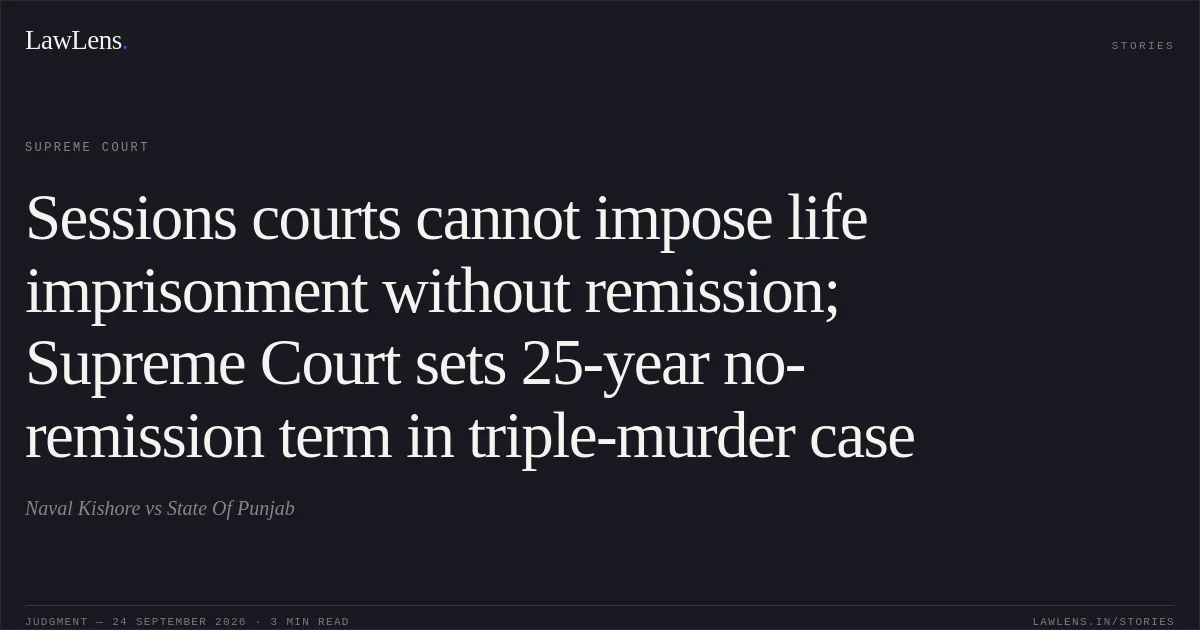
The Supreme Court distinguished between ordinary life imprisonment, which is subject to the statutory remission and commutation framework, and a special-category sentence excluding remission. Although the Trial Court was competent to impose life imprisonment under Section 302 read with Section 34 IPC, it lacked authority to impose the latter form of sentence because that power is reserved for Constitutional Courts.
Source reference: paras. 25–27The direction that the appellants remain imprisoned for the rest of their lives therefore impermissibly curtailed the powers vested in the executive under Sections 432–435 CrPC. In determining the substitute sentence, the Court considered the aggravating circumstances—the premeditated killing of three persons, including two children, and the use of sharp-edged weapons—as well as mitigating circumstances, including the appellants’ substantial incarceration, satisfactory prison conduct, and the fact that the proceedings were confined to sentencing. Balancing the seriousness of the crime against proportionality and the possibility of rehabilitation, the Court held that ordinary life imprisonment was inadequate, while imprisonment for the remainder of natural life would be disproportionate.
Source reference: paras. 19, 25, 28–32Holding
The Court answered the first issue in the negative: the Trial Court was competent to impose imprisonment for life but was not competent to direct that the appellants remain imprisoned for the rest of their natural lives.
The conviction under Section 302 read with Section 34 IPC was affirmed. The sentence was modified from rigorous imprisonment for life with the direction of imprisonment until the end of natural life to rigorous imprisonment for 25 years without the benefit of statutory remission. The appeal was accordingly allowed in part.
Source reference: paras. 33–35Acts & Sections Cited
8 provisions across 2 statutes referred to in this judgment. Each provision opens on LawLens.
Indian Penal Code, 18604
Code of Criminal Procedure, 19734
Original Court PDF
Naval KishorevsState Of Punjab
Click to open original judgment
Original judgment, available to read, download and summarize on LawLens.in