Facts
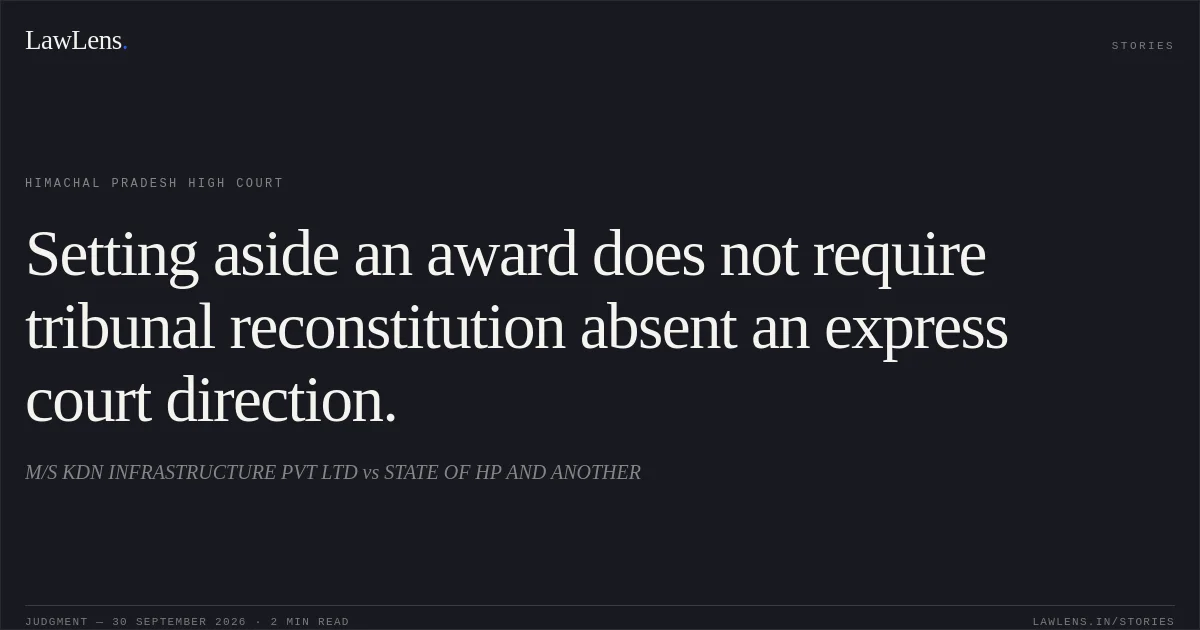
The State challenged a majority arbitral award dated 6 February 2012, which partly allowed the contractor’s claims and rejected the Department’s counterclaims, arising from a 1989 contract for construction of a bridge.
Source reference: para. 1–4, 8–10, 14–16Two earlier awards had been set aside by the High Court. In its order dated 6 January 2010, the Court directed the arbitrators to reconsider the claims and counterclaims, providing for replacement of an arbitrator only if that arbitrator was unwilling or unable to act.
Source reference: para. 1–4, 8–10, 14–16The State argued that the same tribunal could not hear the matter again, that its counterclaims were not decided on merits, and that the award improperly treated extensions of time as an admission of liability.
Source reference: para. 1–4, 8–10, 14–16Issues
1. Whether the tribunal’s composition was contrary to the High Court’s order dated 6 January 2010, rendering the award liable to be set aside.
Source reference: para. 8–132. Whether the majority award failed to decide the Department’s counterclaims on merits.
Source reference: para. 14–153. Whether the award was liable to be set aside because extensions of time were treated as an admission of liability or because the findings on delay were unsustainable.
Source reference: para. 16Law Applied
Section 34(2) of the Arbitration and Conciliation Act, 1996 permits setting aside an award on specified grounds, including an invalid tribunal composition or procedure, and Section 34(2A) permits setting aside a domestic award for patent illegality apparent on its face.
Source reference: para. 6Relying on Consolidated Construction Consortium Limited v. Software Technology Parks of India, (2025) 7 SCC 757, the Court reiterated that Section 34 is a limited, non-appellate remedy: courts must not reappraise evidence or interfere merely because an award may be erroneous, and must respect arbitral autonomy unless a statutory ground for interference is established.
Source reference: para. 6–7A tribunal comprising three arbitrators may issue an award by majority; unanimity is not required.
Source reference: para. 16Reasoning
The 2010 order directed the existing arbitrators to reconsider the dispute and required replacement only if an arbitrator was unwilling or unable to act; no such circumstance arose. The State’s contention that the tribunal had to be reconstituted therefore misread the order.
Source reference: para. 10–13The majority award addressed the counterclaims and gave reasons for rejecting them, so the claim that they were left undecided was unfounded.
Source reference: para. 14–15The extension-of-time argument lacked a foundation in the Section 34 petition; the challenge to the delay findings was also unsupported at the hearing.
Source reference: para. 16The existence of a dissenting award did not invalidate the majority award, and no basis for judicial reappraisal or interference was shown.
Source reference: para. 16Holding
The Court rejected the State’s challenges, holding that the tribunal’s composition complied with the 2010 order, the counterclaims had been considered, and the remaining grounds did not establish a basis for setting aside the award under Section 34.
The petition and any pending miscellaneous applications were dismissed.
Source reference: para. 17Acts & Sections Cited
2 provisions across 1 statute referred to in this judgment. Each provision opens on LawLens.
Arbitration and Conciliation Act, 19962
Original Court PDF
M/S KDN INFRASTRUCTURE PVT LTDvsSTATE OF HP AND ANOTHER
Click to open original judgment
Original judgment, available to read, download and summarize on LawLens.in