Facts
The landlord had obtained concurrent eviction orders from the Rent Controller and the Rent Control Appellate Authority under the Tamil Nadu Buildings (Lease and Rent Control) Act, 1960.
Source reference: no citationThe tenant challenged those orders in C.R.P. No. 414 of 2020, which was allowed on 1 December 2023, setting aside the eviction orders.
Source reference: paras. 2, 7The revisional order directed the tenant to continue paying rent and restrained eviction “till C.S. No. 23 of 2012” was disposed of.
Source reference: para. 3; p. 2C.S. No. 23 of 2012 was subsequently dismissed on 5 January 2024.
Source reference: no citationThe landlord therefore sought clarification/review, contending that the protection granted by the revisional order had ended and that the pending execution petition, E.P. No. 1411 of 2019, should proceed.
Source reference: no citationThe tenant opposed the application, submitting that O.S.A. No. 222 of 2024, filed against the dismissal of the suit, was pending and constituted a continuation of the suit.
Source reference: para. 4; p. 3; para. 5; p. 4The tenant also contended that review was not maintainable.
Source reference: para. 5Issues
Whether the landlord was entitled to review or obtain clarification of the order dated 1 December 2023 so as to proceed with execution after the dismissal of C.S. No. 23 of 2012, notwithstanding the pendency of O.S.A. No. 222 of 2024?
Source reference: paras. 3–6; pp. 2–4Whether the landlord could execute the eviction orders passed under the repealed Tamil Nadu Buildings (Lease and Rent Control) Act, 1960, after those orders had been set aside in revision?
Source reference: paras. 7–9; pp. 4–6Whether the landlord had a fresh remedy under Section 21(2)(a) of the Tamil Nadu Regulation of Rights and Responsibilities of Landlords and Tenants Act, 2017/2019 enactment, to seek recovery of possession under the new statutory regime?
Source reference: paras. 7–10; pp. 4–6Law Applied
The Court applied Order XLVII Rules 1 and 2 read with Section 114 of the Code of Civil Procedure, 1908, governing review jurisdiction, and held that no clarification or review was warranted on the facts.
Source reference: no citationIt considered the repeal of the Tamil Nadu Buildings (Lease and Rent Control) Act, 1960 and the operation of the Tamil Nadu Regulation of Rights and Responsibilities of Landlords and Tenants Act, 2017, as amended in 2019, with effect from 21 February 2019.
Source reference: para. 7Under the new enactment, the definition of “tenant” excludes a person against whom an eviction order has been passed under the repealed Act; conversely, where the earlier eviction order has been set aside, the occupant may qualify as a tenant under the new legislation.
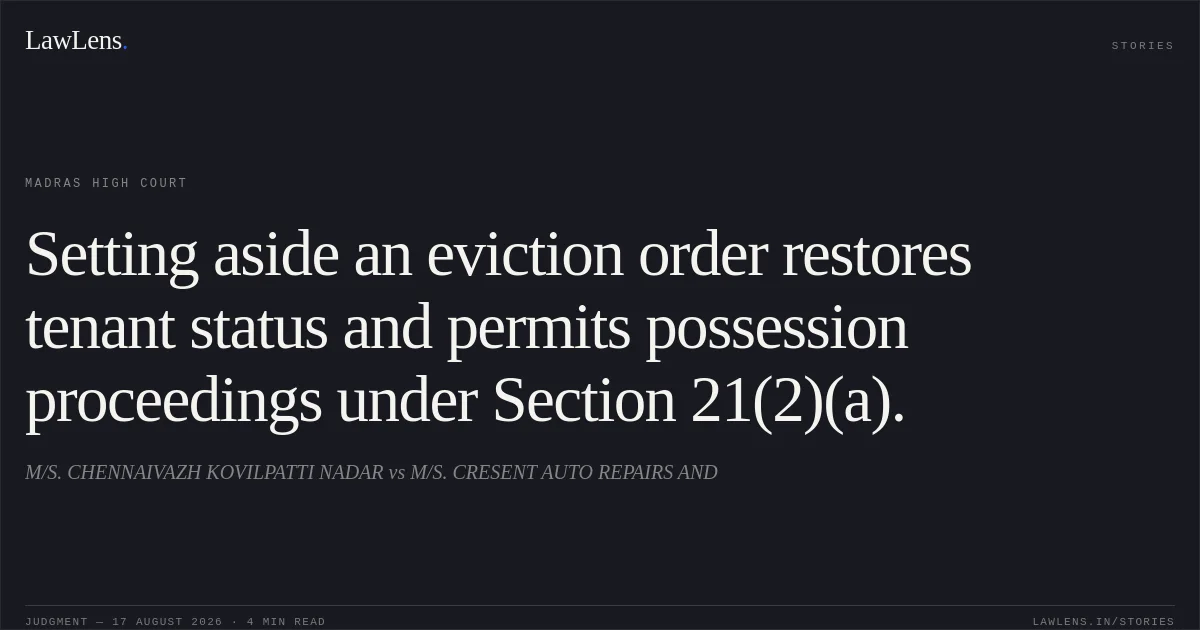
Source reference: paras. 7–8Section 21(2)(a) of the new enactment provides the landlord with a statutory avenue to seek recovery of possession.
Source reference: paras. 8, 10The Court also applied the principle that a stay does not arise merely from the pendency of an appeal; absent an interim order, the pendency of O.S.A. No. 222 of 2024 did not itself create a bar to pursuing an appropriate remedy.
Source reference: paras. 4, 10–11Reasoning
The Court held that the landlord could not rely on the earlier eviction orders because the revisional order dated 1 December 2023 had expressly set them aside.
Source reference: paras. 2, 7Consequently, no subsisting eviction decree existed in favour of the landlord, and the execution petition could not be revived on the basis of orders that no longer operated.
Source reference: paras. 7–9The protection granted to the tenant in the concluding portion of the revisional order was expressly linked to the disposal of C.S. No. 23 of 2012; that suit had already been dismissed, and O.S.A. No. 222 of 2024 had not resulted in any stay.
Source reference: paras. 4, 10Nevertheless, the Court declined to treat the application as warranting clarification because the landlord’s substantive remedy had to be pursued under the new statutory framework rather than through execution of the extinguished eviction orders.
Source reference: no citationSince the tenant had not suffered an operative eviction order as of the relevant date, the landlord was entitled to invoke Section 21(2)(a) of the new Act and seek recovery of possession afresh.
Source reference: paras. 8–10Holding
The Court dismissed Rev.Appl. No. 148 of 2026 and declined to issue the requested clarification or direction to proceed with the pending execution petition.
It held that the earlier eviction orders had been set aside and therefore did not constitute an executable eviction decree.
Source reference: paras. 7–9The landlord was, however, granted liberty to invoke Section 21(2)(a) of the new tenancy legislation and pursue recovery of possession through a fresh statutory proceeding.
Source reference: para. 10The tenant was left free to seek listing or interim protection in O.S.A. No. 222 of 2024 before the Division Bench.
Source reference: para. 11The order was made without costs, and the observations were declared to be without prejudice to the parties’ rights in the pending appeal.
Source reference: paras. 11–13Acts & Sections Cited
1 provisions across 1 statute referred to in this judgment. Each provision opens on LawLens.
Code of Civil Procedure, 19081
Original Court PDF
M/S. CHENNAIVAZH KOVILPATTI NADARvsM/S. CRESENT AUTO REPAIRS AND
Click to open original judgment
Original judgment, available to read, download and summarize on LawLens.in