Facts
The Applicant, belonging to the Scheduled Caste community, was appointed as a Lower Division Clerk (LDC) in the Employees’ Provident Fund Organisation (EPFO) on 31.08.1989
Source reference: p.4He was subsequently promoted to Upper Division Clerk (UDC) in 1992, Assistant in 2003, and Section Supervisor on an ad-hoc basis in 2014, eventually retiring in 2021
Source reference: p.4The Applicant challenged the seniority lists dated 31.12.2012 and 31.03.2016, alleging that the 6th Respondent (Shri P. Muthuswamy), who was junior to him in the LDC cadre, was erroneously placed above him in the seniority hierarchy
Source reference: p.3, 9He further contended that the Respondents failed to implement the post-based roster system and failed to conduct departmental examinations since 2012, thereby stagnating his promotion
Source reference: p.5The Respondents argued that the Applicant had failed to object to draft seniority lists circulated since 1997 and that the 6th Respondent was promoted via the Examination Quota, not the seniority quota
Source reference: p.8-9Issues
1. Whether the 6th Respondent was erroneously promoted and placed above the Applicant in the seniority list
Source reference: p.9, para. 112. Whether the Applicant's challenge to the seniority lists was barred by the doctrine of delay and laches and the principle of settled seniority
Source reference: p.10, para. 12; p.14, para. 17Law Applied
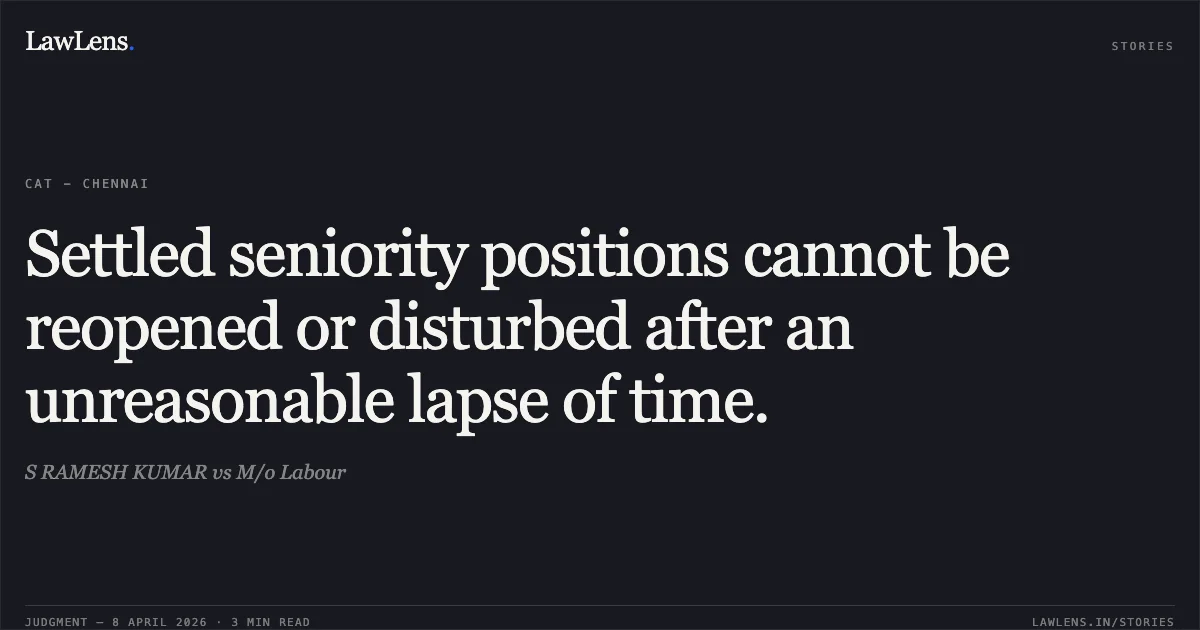
The Tribunal primarily applied the doctrine of "settled seniority," which dictates that seniority positions, once established and remained in existence for a reasonable period, should not be disturbed to ensure administrative stability and harmony
Source reference: p.11, para. 14It relied on the Supreme Court precedents in H.S. Vankani & Ors. v. State of Gujarat & Ors. (2010), which held that unsettling seniority after a long lapse of time generates bitterness and disrupts public interest
Source reference: p.11Shiba Shankar Mohapatra & Ors. v. State of Orissa & Ors. (2009), which established that 3 to 4 years is a reasonable period for challenging seniority
Source reference: p.13The Tribunal also invoked the legal maxim vigilantibus non dormientibus jura subveniunt (the law aids the vigilant and not those who sleep over their rights)
Source reference: p.14, para. 16Reasoning
The Tribunal found the Applicant’s claim regarding the 6th Respondent’s seniority to be factually incorrect, noting that the 6th Respondent was promoted to UDC under the Examination Quota (EQ) rather than the seniority quota
Source reference: p.9, para. 11Upon examining the records, the Tribunal observed that the Applicant had been ranked below the 6th Respondent in seniority lists as far back as 2003 (Serial No. 726 vs. 699) and 2009, yet he failed to raise any timely objections when draft lists were circulated
Source reference: p.9-10Applying the principles from H.S. Vankani and Shiba Shankar Mohapatra, the Tribunal reasoned that the Applicant had "acquiesced" to his position for over a decade.
Source reference: p.13-14It determined that reopening a seniority list from 2012 in 2016—based on grievances rooted in 1992—would unfairly prejudice third parties whose rights had crystallized in the interim
Source reference: p.13-14The Tribunal concluded that the Applicant failed to exercise due diligence, rendering the claim "stale"
Source reference: p.14Holding
The Tribunal answered both issues in the negative, holding that the inter se seniority was correctly fixed based on the promotion quota and that the challenge was barred by delay and laches
The Tribunal held that a person who remains inactive regarding their rights cannot seek to unsettle long-standing administrative arrangements
Source reference: p.14Consequently, the Original Application (OA) was dismissed as devoid of merit, with no order as to costs
Source reference: p.15Original Court PDF
S RAMESH KUMARvsM/o Labour
Click to open original judgment
Original judgment, available to read, download and summarize on LawLens.in