Facts
The petitioners, Direct Recruit District Judges appointed on 01.02.2016, challenged the Final Seniority List dated 16.03.2022.
Source reference: para 2, 14They contended that Promotee District Judges (respondents) were placed above them in violation of the "Quota Rule" prescribed under the Karnataka Judicial Services (Recruitment) Rules and that seniority was wrongly backdated for Fast Track Court (FTC) Judges to dates anterior to their substantive appointment.
Source reference: para 17, 20This dispute followed a long procedural history, including a 2014 Division Bench judgment (WA No. 6514/2013) which had previously settled inter se seniority between direct recruits and promotees.
Source reference: para 7A Single Judge set aside the 2022 list, ruling that promotions exceeded the 65% quota.
Source reference: para 34On appeal, a Division Bench delivered a split verdict: Anu Sivaraman J. sought to dismiss the writ petition, while Rajesh Rai K.J. sought to allow it and redo the list.
Source reference: para 45-47Consequently, a Full Bench was constituted to resolve the impasse.
Source reference: para 50Issues
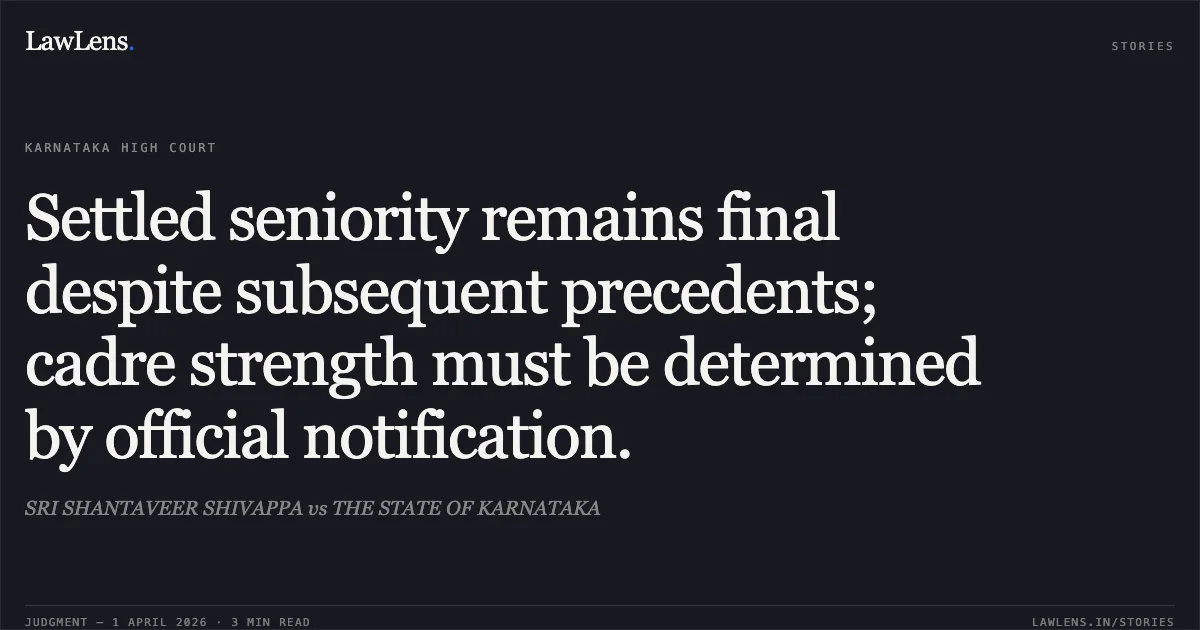
Whether the seniority of promotee Judges, settled by a previous Division Bench in 2014, can be reopened based on subsequent Supreme Court precedents regarding the date of substantive appointment?
Source reference: para 39, 121Whether "cadre strength" for the purpose of the Quota Rule can be determined via inferential exercises from individual court-creation notifications or must be formally notified by the State?
Source reference: para 66, 73Whether the Quota Rule is "post-based" or "vacancy-based" under the applicable recruitment rules?
Source reference: para 104Law Applied
The Court applied the Karnataka Judicial Service (Recruitment) Rules 2004 and 2011, which establish recruitment quotas (65% Promotion, 10% LDCE, and 25% Direct Recruitment).
Source reference: para 8, 136Rule 11(2) of the 2004 Rules incorporates the Karnataka Civil Services Rules 1958, specifically Rule 8(7) defining "Cadre".
Source reference: para 135, 138The Court relied on the principle from R.K. Sabharwal v. State of Punjab, which mandates that quotas are "post-based" and must be calculated against the total cadre strength, not individual vacancies.
Source reference: para 104The Court applied the doctrine of finality, holding that a judgment inter-parties cannot be reopened due to a subsequent change in law, as per public policy.
Source reference: para 42, 121Reasoning
The Full Bench reasoned that the 2014 judgment in WA No. 6514/2013 had already adjudicated that there was no transgression of the Quota Rule at that time and settled the seniority of FTC Judges.
Source reference: para 78-80Therefore, the petitioners could not use subsequent Supreme Court rulings like Dinesh Kumar Gupta or C. Yamini to unsettle vested seniority rights.
Source reference: para 121Regarding "cadre strength," the Court found that the High Court’s reliance on "working strength" and various notifications was imprecise.
Source reference: para 66It noted that many notifications creating "Special Courts" expressly barred new recruitment or were trial-specific, meaning they did not automatically increase the cadre strength.
Source reference: para 69, 72The Court held that without a definitive, formally notified cadre strength by the State (in consultation with the High Court), it is impossible to factually determine if the 65% promotee quota was exceeded.
Source reference: para 73, 143The Court further clarified that because the Quota Rule is post-based, the petitioners' arguments regarding vacancies were legally flawed.
Source reference: para 104Holding
The Full Bench allowed the Writ Appeals, set aside the Single Judge’s order, and dismissed the original Writ Petition.
The Court held that the petitioners failed to demonstrate a breach of the Quota Rule based on definitive cadre data.
Source reference: para 132The High Court must request the State Government to formally notify the cadre strength with necessary details.
Source reference: para 153(i)A "4-Point Roster" (50:25:25) must be implemented prospectively as per recent Supreme Court directions in the All India Judges Association case.
Source reference: para 152, 153(iv)The State and High Court are directed to frame specific Seniority Rules and Rules regarding the conditions of service for the Higher Judicial Service.
Source reference: para 153(v)-(vi)Acts & Sections Cited
2 provisions across 2 statutes referred to in this judgment. Each provision opens on LawLens.
KARNATAKA HIGH COURT ACT, 19611
Code of Civil Procedure, 19081
Original Court PDF
SRI SHANTAVEER SHIVAPPAvsTHE STATE OF KARNATAKA
Click to open original judgment
Original judgment, available to read, download and summarize on LawLens.in


![Subsequent exoneration does not retrospectively invalidate a finalized promotion select list.. UNNIKRISHNAN M vs M/o Environment And Forests. CAT - ['Ernakulam']. LawLens](/stories/thumbnails/subsequent-exoneration-does-not-retrospectively-invalidate-a-finalized-promotion-select-li-ce80a0e84f2f4887857271e8b4341c42.webp)