Facts
The appellants are a contractual labor union and individual workers who were engaged by ONGC through contractors prior to June 24, 2008, but were disengaged before April 1, 2012
Source reference: p. 6, 7During a pending industrial reference regarding wages and service conditions, a settlement was reached during conciliation proceedings, which culminated in an Industrial Award dated September 25, 2014
Source reference: p. 6This Award provided job security benefits specifically to workers engaged on June 24, 2008, or January 1, 2011, who continued in service until the settlement date
Source reference: p. 7The appellants sought a direction to extend these benefits to workers disengaged prior to April 1, 2012, arguing for preferential consideration in future engagements
Source reference: p. 7The learned Single Judge dismissed the writ petitions, holding the settlement-based Award binding on all parties
Source reference: p. 7Issues
1. Whether workers excluded by the specific cut-off dates in an industrial settlement/award can claim preferential engagement or job security benefits under the same award
Source reference: p. 7, 112. Whether the principles of Section 25H of the Industrial Disputes Act, 1947, regarding re-employment of retrenched workmen, apply to contractual laborers whose engagement ended prior to a settlement
Source reference: p. 8, 11Law Applied
Section 18(3) of the Industrial Disputes Act, 1947, which mandates that settlements arrived at during conciliation proceedings are binding on all parties to the dispute, not just the signatories
Source reference: p. 9The principle that industrial peace is achieved through collective bargaining and negotiated settlements, which are accorded finality to preserve harmony
Source reference: p. 9Section 25H of the Industrial Disputes Act... statutory preference for re-employment is predicated on "retrenchment" and does not override the express terms of a settled award
Source reference: p. 10, 11Reasoning
The court reasoned that the settlement was a "negotiated resolution" where cut-off dates were an "essential component of the bargaining"
Source reference: p. 10Since the appellants did not challenge the validity of the settlement or the award itself, the Writ Court cannot exercise judicial review under Article 226 to "rewrite the settlement" or create an additional category of beneficiaries not contemplated by the parties
Source reference: p. 10The court rejected the application of Section 25H, noting that this was not a case of retrenchment and statutory finality of the settlement takes precedence
Source reference: p. 11The court analyzed the "future contracts" clause of the award, concluding it ensures that future workers receive settlement benefits from their date of engagement, but it does not retrospectively enlarge the eligibility criteria to include those previously disengaged
Source reference: p. 11, 12Holding
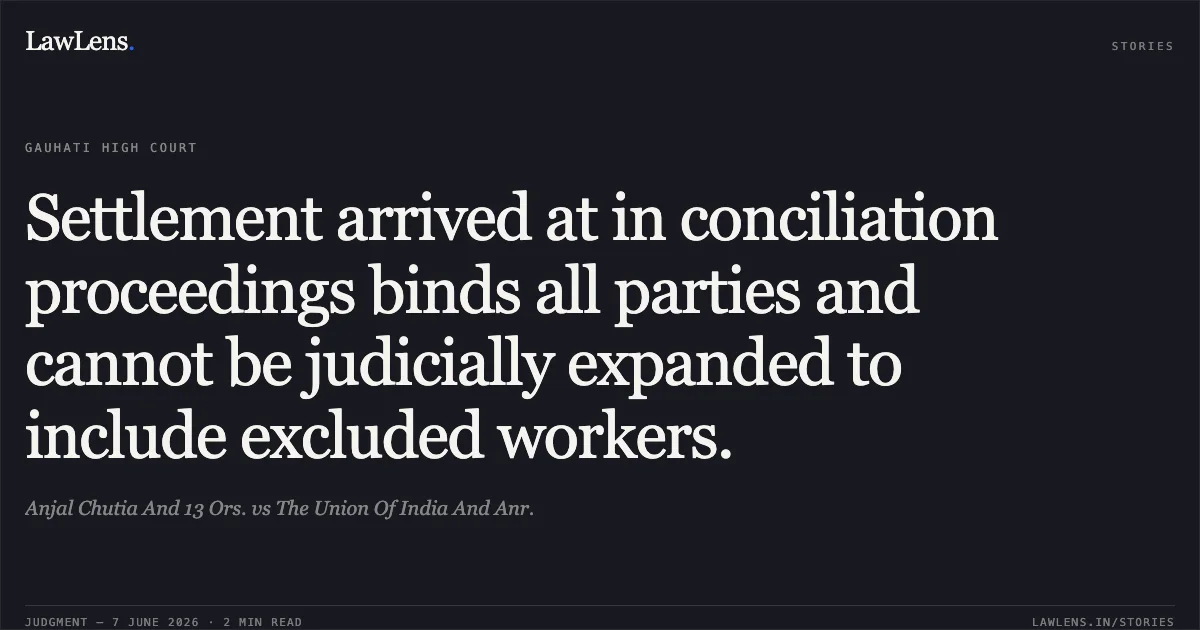
The court dismissed the appeals, holding that the appellants fall outside the eligibility criteria defined in the binding industrial award
The court clarified that while the appellants have no right to continuity of service or back wages, if they are engaged afresh under future contracts where settlement conditions are incorporated, they shall be entitled to the benefits of the settlement only from the date of such fresh engagement. The judgment of the learned Single Judge was upheld
Source reference: p. 12Acts & Sections Cited
2 provisions across 1 statute referred to in this judgment. Linked provisions open on LawLens.
Contract Labour (Regulation and Abolition) Act, 19702
Original Court PDF
Anjal Chutia And 13 Ors.vsThe Union Of India And Anr.
Click to open original judgment
Original judgment, available to read, download and summarize on LawLens.in