Facts
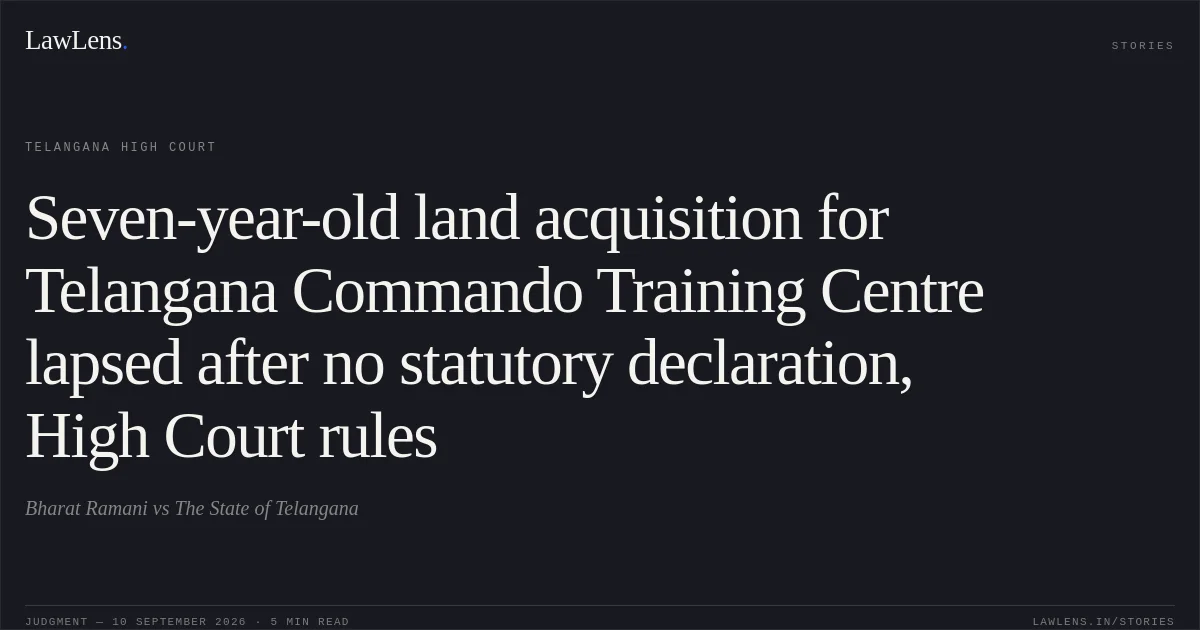
The three writ petitions concerned the same lands measuring Ac.10-10 guntas in Sy. Nos. 362, 373 and 374 of Manchirevula Village, Rajendranagar Mandal, Ranga Reddy District.
Source reference: para. 7–9The petitioners claimed title and possession through registered sale deeds, exchange deeds and earlier transactions relating to plots in the subject layout.
Source reference: para. 7–9The State had made two earlier attempts to acquire the lands under the Land Acquisition Act, 1894.
Source reference: para. 10–17, 87–90A third acquisition was initiated for construction of a Greyhounds Commando Training Centre.
Source reference: para. 18The State issued a Section 10-A exemption notification on 26 October 2018 and published a preliminary notification under Section 11(1) of the Right to Fair Compensation and Transparency in Land Acquisition, Rehabilitation and Resettlement Act, 2013 (“2013 Act”) on 29 May 2019.
Source reference: para. 18Although objections were received and considered, no declaration under Section 19(1) was issued within twelve months.
Source reference: para. 19–22, 32–34No declaration under Section 19(1), award under Section 25, or payment or deposit of compensation had occurred by the date of judgment.
Source reference: para. 22Issues
Whether the preliminary notification dated 29 May 2019 stood rescinded by operation of Section 19(7) of the 2013 Act because no declaration under Section 19(1) was issued within twelve months.
Source reference: para. 37(i)Whether the proceedings dated 21 January 2020 constituted a valid extension under the second and third provisos to Section 19(7) of the 2013 Act.
Source reference: para. 37(ii)Whether the status quo order dated 12 January 2021 attracted the first proviso to Section 19(7), thereby excluding the period during which it operated, or otherwise preserved or revived the preliminary notification.
Source reference: para. 37(iii)Whether the earlier acquisition proceedings under the Land Acquisition Act, 1894, or the possession allegedly taken thereunder, could sustain the present acquisition or defeat the petitioners’ claims.
Source reference: para. 37(iv)Whether the petitioners in W.P. No. 924 of 2021 were entitled to protection against dispossession, interference with possession and enjoyment, and felling of trees otherwise than in accordance with law.
Source reference: para. 37(v)What consequential relief should be granted, including relief concerning the Section 22-A prohibitory list and the alleged two-feet wall.
Source reference: para. 37(vi)Law Applied
The Court applied Section 19(7) of the 2013 Act, under which a preliminary notification is deemed to have been rescinded if no declaration under Section 19(1) is made within twelve months; the statutory period may be affected only by a court-ordered stay or injunction that actually holds up the acquisition proceedings, or by a valid extension granted by the appropriate Government, supported by recorded reasons, notification and website publication.
Source reference: para. 43–46, 63–64Section 25 was held to operate only after publication of a Section 19 declaration and therefore did not arise where no declaration had been issued.
Source reference: para. 86Section 10-A exempts specified projects only from Chapters II and III and does not dispense with compliance with Sections 11, 15, 19 or 25.
Source reference: para. 49–50The Court relied on Padma Sundara Rao (Dead) v. State of Tamil Nadu, (2002) 3 SCC 533, for strict adherence to statutory time limits; Nazir Ahmad v. King Emperor, AIR 1936 PC 253, and State of U.P. v. Singhara Singh, AIR 1964 SC 358, for the principle that statutory powers must be exercised in the prescribed manner.
Source reference: para. 56–58The Court relied on Gordhandas Bhanji and Mohinder Singh Gill, (1978) 1 SCC 405, against supplying reasons retrospectively.
Source reference: para. 69The Court relied on Bishambhar Dayal, K.T. Plantation, Tukaram Kana Joshi, Vidya Devi, Hari Krishna Mandir Trust, and Kolkata Municipal Corporation v. Bimal Kumar Shah, (2024) 10 SCC 533, for the Article 300-A rule that deprivation of property must have lawful authority, follow a fair statutory procedure, serve a public purpose, and be completed within the prescribed framework.
Source reference: para. 93, 100–104Reasoning
The Court held that the twelve-month period under Section 19(7) expired on 28 May 2020 without a Section 19(1) declaration, triggering the statutory consequence of rescission.
Source reference: para. 53–60The alleged extension was invalid because the relied-upon proceedings were not produced, there was no evidence of recorded reasons, notification or website publication, and the power under Section 19(7) belonged to the appropriate Government—not, on the material placed before the Court, the District Collector.
Source reference: para. 63–70The Court further held that the Telangana Amendment Act, 2016 did not amend Section 19 and therefore could not enlarge or alter the statutory power of extension.
Source reference: para. 47–48, 67The status quo order dated 12 January 2021 concerned possession and enjoyment of specified plots; it did not stay the acquisition process or prevent publication of a declaration.
Source reference: para. 74–85Section 19(1) also permitted separate declarations for different parcels.
Source reference: para. 74–85Accordingly, the respondents’ voluntary decision to stop the acquisition did not amount to the proceedings being held up by a court-ordered stay or injunction.
Source reference: para. 74–85In any event, the order was passed after the original statutory period had expired and could not revive a notification already rescinded.
Source reference: para. 74–85The earlier 1894 Act proceedings had either ceased to operate or had been quashed and could not supply a continuing acquisition authority or validate the 2019 proceedings.
Source reference: para. 87–95Because the respondents had no completed acquisition, declaration, award, compensation payment or other lawful basis for possession, any attempt to dispossess the petitioners or interfere with their possession would violate Article 300-A.
Source reference: para. 96–107Holding
W.P. Nos. 8527 and 8552 of 2024 were allowed.
The Court declared that the acquisition initiated by Gazette Notification No. R.R.42 dated 29 May 2019 stood rescinded and had ceased to have legal effect under Section 19(7) of the 2013 Act; continued action based on that notification was declared without authority of law.
Source reference: para. 127–129The competent authorities were directed to consider, by a reasoned order within eight weeks, deletion of the lands from the Section 22-A prohibitory list insofar as the entry was founded on the rescinded acquisition.
Source reference: para. 130W.P. No. 924 of 2021 was also allowed to the extent that the respondents were restrained from dispossessing the petitioners from the specified plots, interfering with their possession or enjoyment, or felling trees on the strength of the 2019 acquisition proceedings, except in accordance with law.
Source reference: para. 131Relief for removal of the alleged two-feet wall was declined because its existence and ownership involved disputed questions of fact; however, the respondents were restrained from making further construction except in accordance with law.
Source reference: para. 132The Court clarified that the order did not determine title and did not prevent the State from initiating a fresh acquisition for a genuine public purpose in strict compliance with the 2013 Act and other applicable law.
Source reference: para. 133–134No order was made as to costs.
Source reference: para. 135Acts & Sections Cited
14 provisions across 1 statute referred to in this judgment. Each provision opens on LawLens.
Right to Fair Compensation and Transparency in Land Acquisition, Rehabilitation and Resettlement Act, 2013
Original Court PDF
Bharat RamanivsThe State of Telangana
Click to open original judgment
Original judgment, available to read, download and summarize on LawLens.in