Facts
On 29 January 2006, the appellant was riding motorcycle No. GJ-6-AG-2633 towards Jabugam when a truck, allegedly driven rashly and negligently by Respondent No. 1, collided with the motorcycle, causing the appellant multiple grievous injuries.
Source reference: p.2, para. 2(i)The appellant, aged approximately 34 years, claimed that he worked as a heavy-vehicle driver and also supervised agricultural activities, earning ₹5,000 per month as a driver and ₹3,00,000 annually from agriculture.
Source reference: p.2, para. 2(ii)He sustained extensive fractures and other injuries, underwent multiple surgeries, and was certified as having 88.44% permanent disability of the body as a whole.
Source reference: pp.7–8, paras. 11–12The Motor Accident Claims Tribunal awarded ₹8,54,610 with interest at 7.5% per annum.
Source reference: p.2, para. 2(iv)The claimant appealed under the Motor Vehicles Act, 1988, challenging the quantum of compensation.
Source reference: p.3, para. 2(v)Issues
1. Whether the Tribunal had correctly assessed the appellant’s monthly income for determining loss of future earning capacity.
Source reference: pp.3, 6, paras. 4, 92. Whether the appellant was entitled to an addition for future prospects.
Source reference: pp.3–4, 6, paras. 4, 103. Whether the functional disability should be assessed at 100%, considering the appellant’s injuries and occupation as a heavy-vehicle driver.
Source reference: pp.4, 7–8, paras. 5, 11–124. Whether the compensation under medical expenses, actual loss of income, special diet, transportation and attendant charges, pain and suffering, and loss of amenities required enhancement or modification.
Source reference: pp.4–6, 8–10, paras. 5–6, 14–19Law Applied
The Court applied the principles governing computation of just compensation for motor-accident injuries under the Motor Vehicles Act, 1988.
Source reference: no citationRelying on Minu Rout v. Satya Pradyumna Mohapatra, (2013) 10 SCC 695, it treated ₹6,000 per month as a reasonable income for a heavy-vehicle driver.
Source reference: p.6, para. 9Under National Insurance Co. Ltd. v. Pranay Sethi, (2017) 16 SCC 680, and Sidram v. Divisional Manager, United India Insurance Co. Ltd., 2022 INSC 1202, 40% was added towards future prospects for a claimant aged 34 years.
Source reference: p.6, para. 10Applying Raj Kumar v. Ajay Kumar, (2011) 1 SCC 343, the Court distinguished medical or physical disability from functional disability and assessed the latter by reference to the claimant’s actual occupation.
Source reference: pp.4, 7–8, paras. 5, 12It further relied on Mohd. Sabeer @ Shabir Hussain v. Regional Manager, U.P. State Road Transport Corporation, 2022 SCC OnLine SC 1701, to award separate compensation for loss of amenities of life.
Source reference: pp.5, 9–10, paras. 6, 18Reasoning
The Court found that the Tribunal’s assessment of ₹3,000 per month was unduly low because the appellant possessed a valid licence and was working as a heavy-vehicle driver; accordingly, his income was reassessed at ₹6,000 per month.
Source reference: p.6, para. 9Since he was 34 years old, 40% was added for future prospects, producing a monthly income of ₹8,400.
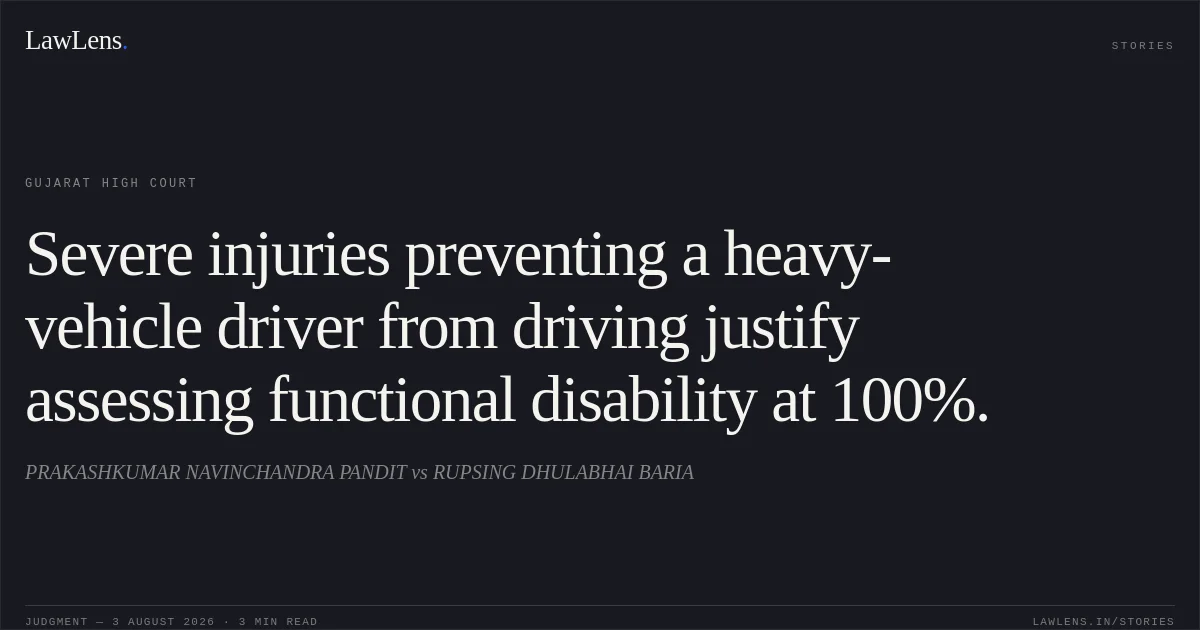
Source reference: p.6, para. 10Although the medical disability was certified at 88.44%, the appellant had suffered severe fractures of the right femur and tibia involving the knee, upper-limb and hand injuries, crush injuries, and multiple surgeries.
Source reference: p.7, para. 11; p.8, para. 12Applying the functional-disability principle in Raj Kumar, the Court held that these injuries rendered him completely incapable of continuing his occupation as a heavy-vehicle driver and therefore assessed functional disability at 100%.
Source reference: p.8, para. 12Using a multiplier of 16, it awarded ₹16,12,800 for future loss of income.
Source reference: p.8, para. 13The Court maintained medical expenses of ₹2,58,210, removed the separate award of ₹18,000 for actual loss of income because the entire loss was accounted for under future loss of income, and enhanced the amounts for special diet, transportation and attendant charges to ₹25,000 and pain, shock and suffering to ₹1,00,000.
Source reference: pp.8–9, paras. 14–17In view of the permanent deprivation of a normal life, it additionally awarded ₹1,50,000 for loss of amenities.
Source reference: p.10, para. 18Holding
The appeal was partly allowed.
The total compensation was enhanced from ₹8,54,610 to ₹21,46,010, resulting in additional compensation of ₹12,91,400.
Source reference: p.10, para. 19The additional amount was directed to carry interest at 7.5% per annum from the date of filing of the claim petition until realization.
Source reference: p.10, para. 20Respondent No. 3–Insurance Company was directed to deposit the enhanced compensation and interest within six weeks, after which the Tribunal was to disburse the amount to the appellant, subject to deduction of any deficit court fee and due verification.
Source reference: p.11, para. 21The award was modified accordingly, with no order as to costs.
Source reference: p.11, paras. 22–23Original Court PDF
PRAKASHKUMAR NAVINCHANDRA PANDITvsRUPSING DHULABHAI BARIA
Click to open original judgment
Original judgment, available to read, download and summarize on LawLens.in