Facts
Linkson International Ltd. (“Corporate Debtor”) was admitted into CIRP on a petition filed by Punjab National Bank under Section 7 of the Insolvency and Bankruptcy Code, 2016 (“IBC”). The first respondent was appointed as IRP, subsequently confirmed as RP, and later appointed as liquidator on 20 July 2018.
Source reference: para. 2The liquidator appointed a chartered-accountant firm to conduct a forensic audit into the Corporate Debtor’s financial affairs. The report identified alleged siphoning and misappropriation of approximately ₹527.06 lakhs through property transactions, fictitious or unsupported cash expenses of ₹103.15 lakhs, incomplete books of account, and non-production of relevant financial records.
Source reference: paras. 3–5The audit concerned properties purchased by the Corporate Debtor at Shri Gopal Complex and Megh Complex. The properties were allegedly purchased at substantially inflated values, remained in the possession of the vendors, and generated rental income received by the vendors rather than the Corporate Debtor.
Source reference: paras. 6–16, 46–58Significant portions of the loan proceeds were transferred by the vendors to related companies having common directors with the Corporate Debtor, indicating alleged round-tripping of funds.
Source reference: paras. 47–50, 58, 61The liquidator filed IA No. 1568 of 2020 under Sections 60(5), 35, 36, 66 and 68–72 of the IBC. The NCLT partly allowed the application and directed the respondents to contribute jointly or severally ₹437.02 lakhs to the Corporate Debtor. It also directed the appellants to contribute ₹103.15 lakhs towards unsupported cash expenses.
Source reference: para. 18The suspended directors appealed under Section 61 of the IBC, contending, inter alia, that the order was passed ex parte, that they were prevented from appearing due to serious illnesses, and that the forensic audit report was inconclusive and based on incomplete material.
Source reference: paras. 20–32The liquidator maintained that repeated opportunities had been provided and that the appellants had failed to produce the relevant books and documents.
Source reference: paras. 33–43Issues
Whether the NCLT was justified in relying upon the forensic audit report and the supporting documentary material to conclude that the property transactions were accommodation, undervalued or fraudulent transactions intended to siphon funds and defraud creditors?
Source reference: paras. 44–45, 61–68Whether the appellants could challenge the NCLT’s ex parte order on the ground that they were denied an opportunity of hearing?
Source reference: paras. 20–22, 63–65Whether the appellants were liable to contribute towards the alleged fraudulent property transactions and unsupported cash expenses under Section 66 of the IBC?
Source reference: paras. 18, 35–43, 59–68Law Applied
The Tribunal applied Sections 35(1)(i), 60(5) and 66 of the IBC: the liquidator may investigate the Corporate Debtor’s affairs and seek appropriate directions from the Adjudicating Authority, while persons responsible for carrying on the business with intent to defraud creditors may be directed to make a contribution to the Corporate Debtor.
Source reference: paras. 3–5, 18A forensic audit report is not conclusive evidence by itself, but it may be relied upon when its conclusions are supported by reliable documentary material such as sale deeds, bank statements, sub-registrar records and title reports.
Source reference: paras. 44, 62Although strict principles of the Evidence Act do not apply to IBC proceedings, basic principles of appreciation of evidence apply; where relevant facts and records are especially within a party’s knowledge, that party bears the responsibility of producing them after the applicant has discharged its initial burden.
Source reference: para. 64The Tribunal also treated the failure of the erstwhile management to produce books and documents as a relevant circumstance against the appellants.
Source reference: paras. 44, 63–65Reasoning
The NCLAT held that the forensic report was not relied upon in isolation. Its findings were corroborated by bank records, registered sale deeds, sub-registrar records, valuation material and title-verification reports.
Source reference: paras. 44, 62The properties were purchased at values substantially higher than their stamp-duty or apparent market values; some portions were not even constructed, the vendors continued to possess the properties, and tenants continued paying rent to the vendors rather than the Corporate Debtor.
Source reference: paras. 46–58, 66The timing and movement of funds further demonstrated that loan amounts paid to the vendors were rapidly transferred to related entities and, in part, back to the Corporate Debtor or its associated companies. This supported the conclusion that the transactions were accommodation transactions designed to obtain loans and route the money back to related parties.
Source reference: paras. 61, 66–68The appellants’ contention that the bank had independently valued and financed the properties did not displace the documentary trail showing inflated valuations, unresolved prior mortgages, lack of mutation, continued vendor possession and transfers to related parties.
Source reference: paras. 66–68Similarly, the unsupported cash expenses were recorded in lump-sum entries under various heads without reliable supporting documentation, justifying the finding that they were fictitious or improperly withdrawn funds.
Source reference: paras. 59–60On the hearing objection, the Tribunal found that the appellants had been given repeated opportunities before the NCLT but failed to contest the proceedings. Their medical explanations were not accepted as sufficient. They were nevertheless permitted to place material before the NCLAT, but the documents produced did not effectively discredit the forensic report or explain the transactions.
Source reference: paras. 63–65Holding
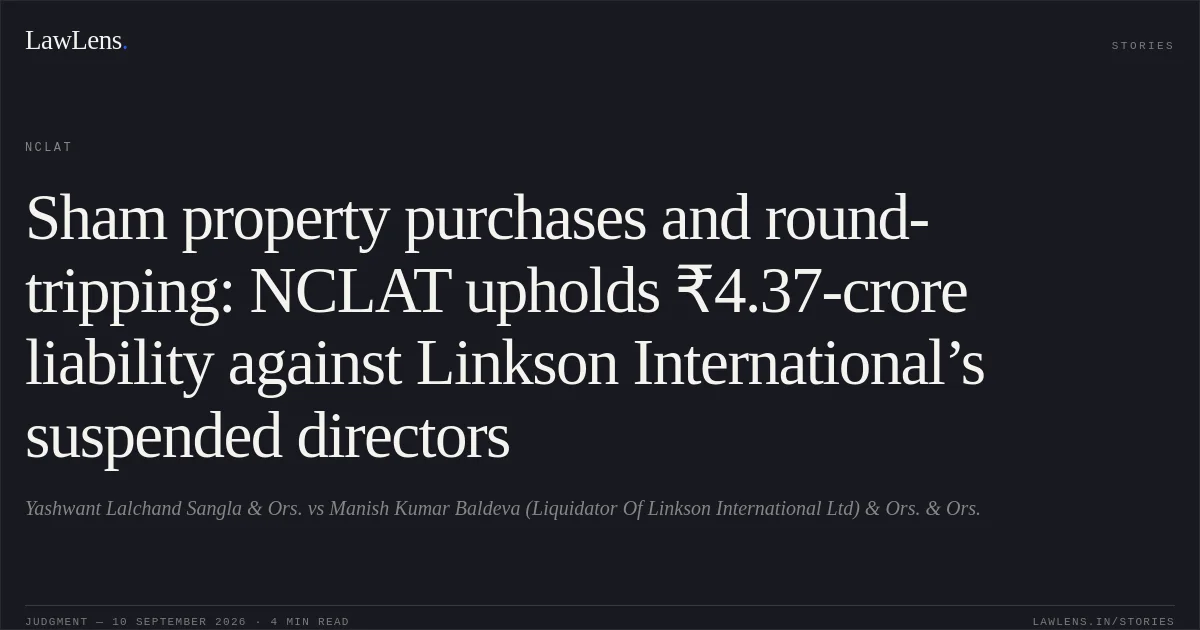
The NCLAT dismissed the appeal, holding that the property transactions constituted accommodation and fraudulent transactions intended to facilitate borrowing and siphoning of funds, and that the forensic audit report was sufficiently corroborated by documentary evidence.
The direction requiring the appellants and other concerned respondents to contribute jointly or severally ₹437.02 lakhs to the Corporate Debtor was upheld. The finding concerning ₹103.15 lakhs of unsupported cash expenses was also sustained.
Source reference: para. 18There was no order as to costs, and the pending interlocutory applications were disposed of.
Source reference: paras. 69–71Acts & Sections Cited
4 provisions across 1 statute referred to in this judgment. Each provision opens on LawLens.
Insolvency and Bankruptcy Code, 2016.4
Original Court PDF
Yashwant Lalchand Sangla & Ors.vsManish Kumar Baldeva (Liquidator Of Linkson International Ltd) & Ors. & Ors.
Click to open original judgment
Original judgment, available to read, download and summarize on LawLens.in